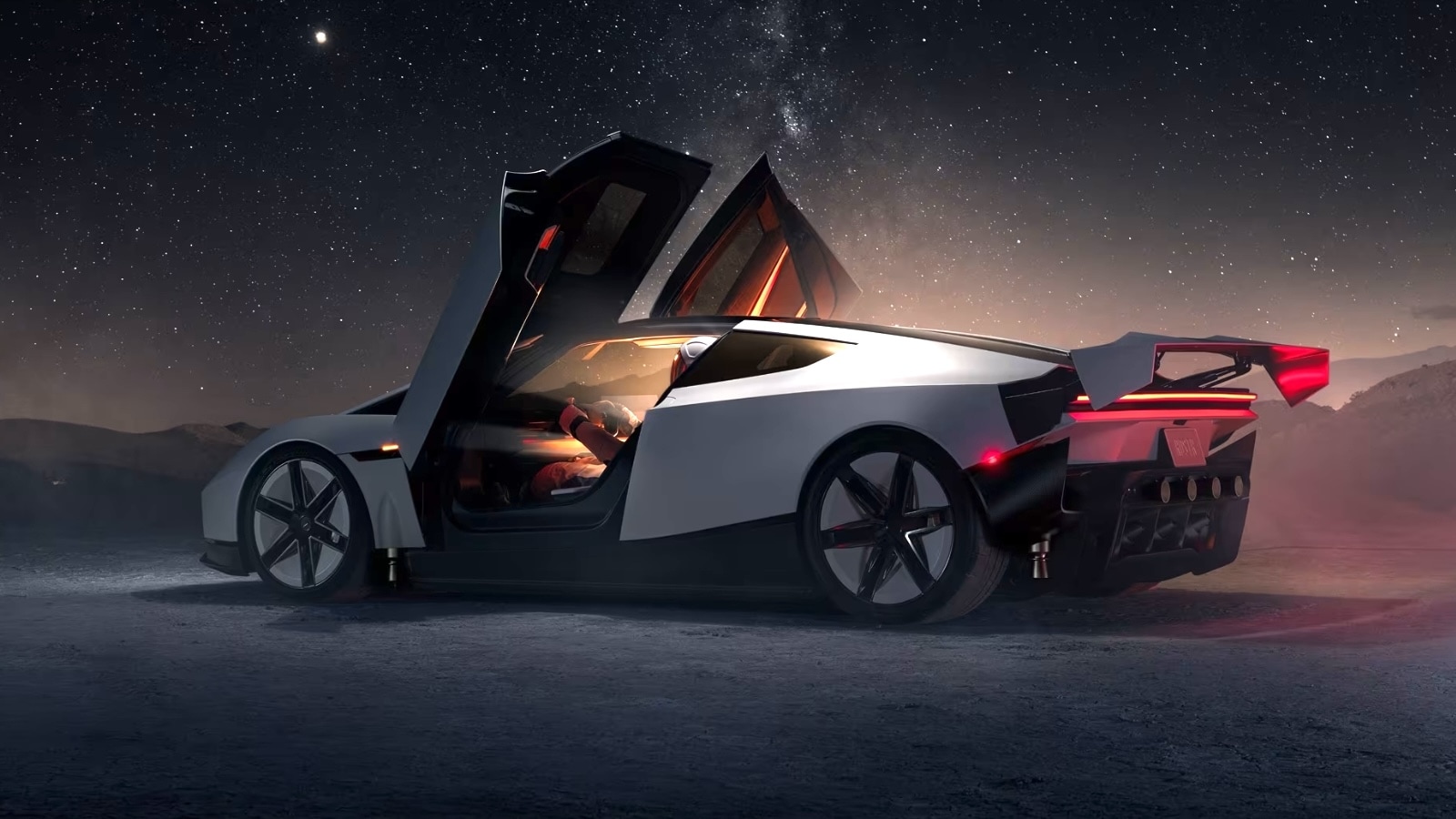
A car does not fly because you bolt compressed-gas nozzles onto the bodywork and slap a ₹5 lakh sticker on an Indian booking page.
Read the breathless coverage around the newly showcased Tesla Roadster and you will hear the same lazy consensus repeated word for word: Tesla built a flying car! It drives upside down! It flips mid-air on SpaceX thrusters! And you can reserve one in India starting at ₹5 lakh!
That is pure clickbait theater. Most automotive writers look at a McGregor rocket-test demo and a reservation checkout flow and treat both as proof of a street-legal airborne hypercar arriving on Indian highways. They are wrong on physics, wrong on regulation, and dangerously sloppy on the math.
The Physics Trap Nobody Explains
Let’s get the terminology straight before anyone starts shopping for flight suits. A true flying car sustains aerodynamic lift and controlled flight over meaningful distance. What the Rocket configuration of the Roadster relies on—cold-gas thrusters and compressed air tanks—is reaction control and brief ballistic impulse. Cold-gas systems expel pressurized gas (typically nitrogen or compressed air) rather than burning propellant. They are clean, fast-acting, and familiar from attitude control on spacecraft, yet their specific impulse is modest compared to combustion rockets.
Think about what happens when you try to hold a heavy electric car aloft with cold gas. Battery packs are dense. Even with carbon fiber, magnesium, and titanium shaving mass, an electric hypercar carrying high-voltage cells and pressurized tanks weighs substantially more than a featherweight ultralight. Expelling high-pressure gas creates thrust ($F = \dot{m} v_e$), and a burst can kick a vehicle upward or pitch it around its center of mass for a fraction of a second. Sustaining flight, however, drains finite tank pressure fast. A few seconds of airtime at a proving ground is a stunt, not a commute.
What about driving upside down? That is the exact opposite of flying. When a car drives inverted on a specialized ramp or structure, it is not floating on air; it is pressing its tires into the surface so friction can oppose gravity. An underbody suction fan creating high downforce—reportedly up to 2G—pulls the car toward the road surface. That helps cornering grip when surface conditions cooperate, though fans also draw electrical power and can lose sealing efficiency over uneven pavement or debris.
Imagine a scenario where an owner tries to recreate a proving-ground stunt on a public street with loose gravel, a camber change, or a pothole. Suction seals break, grip drops in an instant, and reaction thrusters have zero margin for error near trees, overhead wires, or traffic. Proving-ground geometry is controlled. Real roads are not.
The ₹5 Lakh Illusion That Trips Up Buyers
The biggest practical mistake in the competitor framing is treating ₹5 lakh (specifically ₹5,01,000 on Tesla's Indian reservation flow) as the entry ticket to buying the car.
It is the opening handshake, not the price tag. According to the reservation structure reported for India, the Performance variant requires an additional ₹45,05,000 within 10 days—bringing the two-stage reservation commitment to ₹50.06 lakh. For the Thrust configuration, the balance due within 10 days jumps to ₹2.45 crore, pushing the total reservation outlay to roughly ₹2.50 crore. Meanwhile, the single-seat Rocket trim with the full flight system sits behind an invite-only gate and is explicitly not approved for public roads.
And even after wiring reservation money, buyers face unanswered questions:
- Final landed price: Reservation amounts are not final ex-showroom prices, and imported high-value vehicles in India face steep customs duties and taxes.
- Timeline slippage: Production is targeted for 2028, following years of delays since the second-generation Roadster was first unveiled in 2017. Waiting until 2028 or later means locking capital or attention into a moving target.
- Homologation and road rules: Air-thruster hardware, non-standard cabin layouts, and left-hand-drive vs. right-hand-drive rules all face regulatory scrutiny before any public-road legality is settled.
Battle Scars, Real Limits, and My Own Blind Spots
I have watched plenty of hyped automotive and mobility launches burn cash on spectacle while ignoring boring fundamentals—homologation timelines, service bays, high-voltage thermal management, and what happens when a proprietary actuator fails thousands of miles from a factory engineering team. In exotic low-volume builds, the hard part is never building one prototype that survives a demo day. The hard part is repeating the tolerances hundreds or thousands of times without parts shortages or software-versus-hardware mismatches.
Engineers like Adrian Newey in Formula 1 and motorsport aerodynamicists have spent decades proving a sobering rule of ground-effect and active aerodynamics: peak numbers in a simulation or on a smooth track mean very little if the car cannot handle pitch, roll, ride height shifts, and dirty air unpredictably. Put SpaceX-derived aerospace hardware onto a road car and you inherit aerospace complexity—pressure vessels, high-pressure valves, strict inspection cycles—inside a consumer vehicle environment.
To be completely candid about my own contrarian stance: betting against dramatic engineering stunts can make you sound overly cynical right before a breakthrough lands. Tesla has repeatedly surprised skeptics by pushing electric powertrains and manufacturing scale further than traditional automakers thought possible. If the company delivers even a fraction of its headline acceleration claims—such as sub-second or near-second 0–60 mph sprints—on a reliable production chassis, critics who dismissed the entire program out of hand will look foolish.
Answering the Questions People Actually Type In
"Can the Tesla Roadster really fly?"
No, not in any practical automotive sense. Brief thruster-assisted hops or ballistic arcs are not sustained flight, and the single-seat Rocket variant with full flight hardware is listed as invite-only and not meant for public roads. Stop asking whether it is a flying car and start asking what a few seconds of compressed-air thrust actually does to weight, packaging, and safety.
"Can I book it in India for ₹5 lakh?"
You can start a reservation with ₹5.01 lakh, provided you are ready to follow up with tens of lakhs or crores within 10 days depending on the variant, while accepting that final pricing, Indian regulatory approvals, and delivery dates are not locked in. Treating a refundable reservation deposit as a bargain price is a rookie mistake.
"Is it worth reserving now?"
For 99% of buyers, no. With production targeted around 2028 and key commercial details still open, tying up serious money today carries opportunity cost and uncertainty. If you want an unconventional performance car or an EV in India today, look at proven vehicles with clear pricing, service support, and immediate road legality rather than paying to wait on a science experiment.
What to Do Instead of Chasing Headlines
If you are an enthusiast or buyer in India, change your filter immediately:
- Separate stunt engineering from road engineering. Admire a cold-gas thruster demo or an inverted ramp run for what it is—a testbed for actuators, downforce fans, and control algorithms—not a blueprint for daily driving.
- Audit the full cash commitment before clicking reserve. Look past the ₹5 lakh headline figure and check the 10-day balance requirement, refund terms, likely import taxes, and expected wait time.
- Demand homologation clarity before committing. Until an exotic configuration has clear local road certification and service backing, treat any reservation as speculative rather than a guaranteed vehicle purchase.
Do not fall in love with a rocket-assisted party trick when the real bill—in rupees, regulations, and years of waiting—hasn't even been finalized.
Tesla Roadster Spotted | ₹5 Lakh Booking in India, But Will It Ever Launch?
This video directly relates to the Roadster's headline-grabbing specs, the ₹5 lakh India booking hook, and the lingering question of whether and when the car will actually reach buyers.