The first time I felt a car bend my perception of time, I was sitting in the passenger seat of a borrowed electric coupe on a wet coastal highway outside Monterey, listening to the faint whine of inverters instead of a growling exhaust. My stomach dropped before my brain registered movement. Nothing about the cabin looked violent—there was no shaking steering column, no roaring intake—yet the guardrails outside seemed to stretch like taffy. I remember laughing nervously and thinking, If this is what batteries alone do to the human nervous system, what happens when someone straps orbital hardware to the sheet metal?
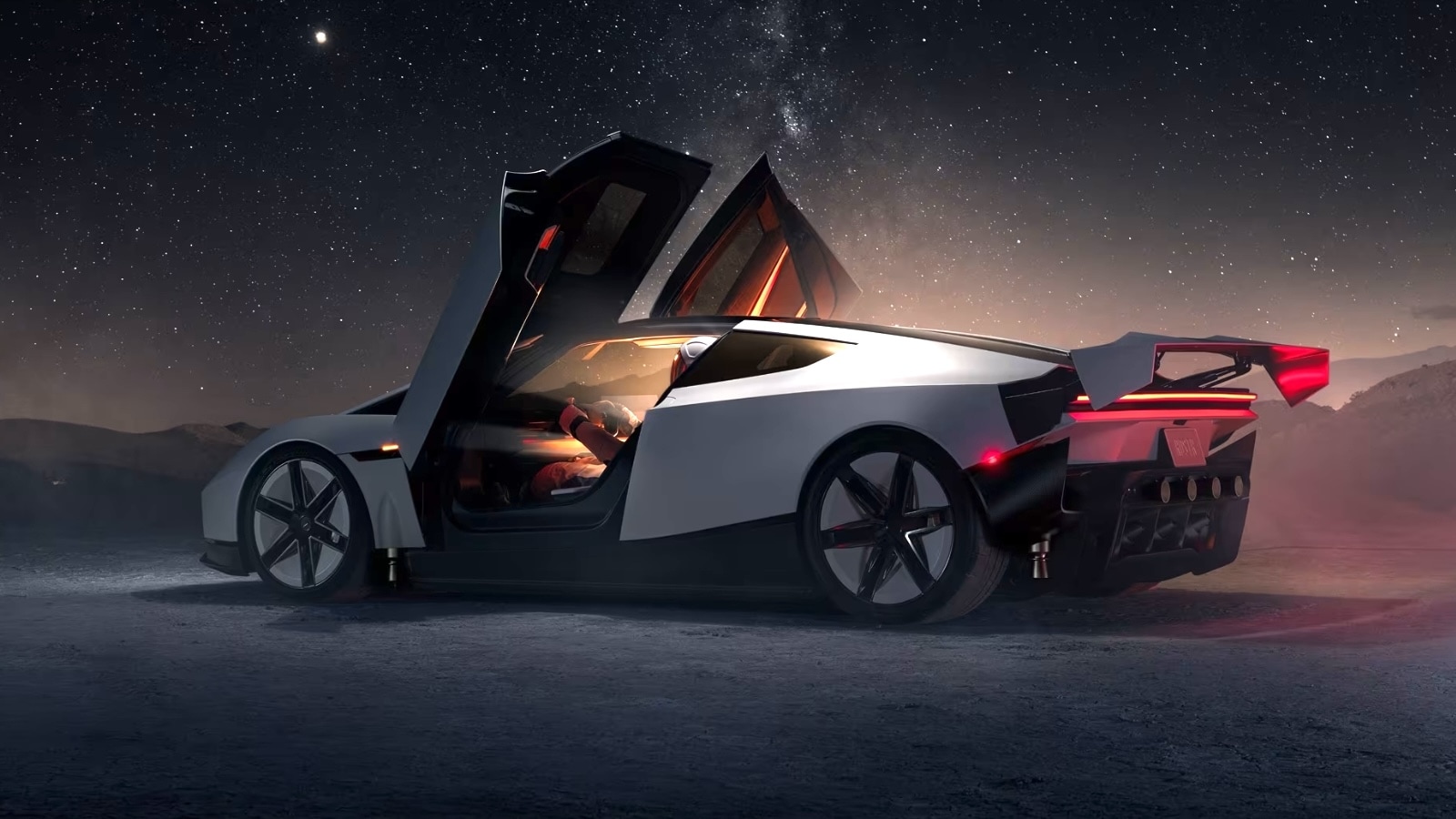
For years, headlines about Tesla pairing electric sports cars with SpaceX cold-gas rocket thrusters sounded like late-night engineering folklore. A car that hovers? A roadster that hits sixty miles per hour in roughly a second? A machine blurring the line between a grand tourer and a small spacecraft? Whenever those claims surface, standard coverage tends to treat them like a parlor trick—a spec-sheet arms race between billionaires and supercar makers. For a different perspective, read: this related article.
Cold. Clinical. Easy to scroll past.
Yet beneath the spectacle sits a much quieter, sharper question about what humans actually want when they get behind the wheel. We do not buy performance cars merely to shave tenths of a second off a stopwatch. We chase a feeling of weightlessness, control, and escape from traffic that crawls at four miles per hour on a Tuesday morning. And when rocket physics enters a passenger cabin, the stakes stop being mechanical trivia and become deeply personal. Similar analysis on the subject has been shared by CNET.
Why a Rocket Car Hits Closer to Home Than You Think
To see why rocket-assisted road cars provoke both awe and skepticism, step away from the test track for a moment and picture a fictional driver—let's call her Maya—stuck in bumper-to-bumper rain on an interstate outside Chicago. Maya is a structural engineer who spent her twenties testing bridge joints in freezing wind. She knows load limits. She knows what happens when materials meet sudden, concentrated force.
Maya has never owned a hypercar, and she probably never will. Still, she pays attention every time Tesla and SpaceX talk about cold-gas thrusters—pressurized air or nitrogen stored in composite overwrapped pressure vessels, released through nozzles to generate thrust without the burning flame of a traditional rocket engine. To Maya, that distinction matters. A flame-throwing car on a suburban street sounds like a lawsuit waiting to happen. High-pressure compressed gas, by contrast, is closer in spirit to a giant, precision-controlled pneumatic burst.
Even then, physics does not care about our wishes.
Think of thrust on a car like a strong gust of wind hitting a canoe on a choppy lake. If you push gently from the stern, the canoe glides forward smoothly. If you blast high-pressure air right behind it without enough weight, grip, or aerodynamic balance, the bow can lift or the tail can step out before you even blink. In automotive terms, tires only have so much friction with asphalt—what engineers call the grip limit. Once acceleration exceeds what rubber can hold against the pavement, raw force stops translating cleanly into forward motion.
That is the invisible tension behind every headline about a "flying" or rocket-boosted Tesla Roadster. People hear the word flying and picture wings folding out over a gridlocked highway. In reality, aerodynamic lift on a car body is usually an enemy at high speed because it reduces tire grip; race engineers spend millions of dollars creating downforce to push cars down into the road, not lift them off it. Short hops or controlled hover demonstrations on a closed pad are one thing. Sustained flight on public roads is a regulatory, physical, and practical mountain that no production car has conquered.
The Seductive Myth of Effortless Escape
I have spent enough hours in garages, test lots, and design studios to recognize the hunger driving these stories. Modern commuting is exhausting. You sit sealed inside a box, surrounded by other boxes, breathing recycled air while brake lights pulse red for miles. Humans were not wired to spend two hours a day inching forward at walking pace.
Rocket thrusters speak directly to that claustrophobia. They offer the fantasy of sudden liberation—of bypassing the gridlock, of bending gravity's rules just enough to feel alive again.
When a car promises sub-two-second—or even near-one-second—acceleration, it is really selling a compressed version of thrill. A roller coaster gives you that rush on a fixed track with harnesses and operators. Putting that kind of thrust inside a road-going vehicle invites a different emotion: wonder mixed with unease. Would a driver even want that much violent push on a daily commute? Probably not. You do not need orbital-grade thrust to pick up groceries or merge onto a ring road.
Yet human progress rarely starts with sensible groceries. Early aviation looked absurd to people riding carriages. Early electric vehicles looked slow and fragile to drivers who trusted iron pistons and cast-iron blocks. Speculative ideas—even exaggerated ones—often act like flares shot into dark sky. They force engineers to ask what is actually possible if you throw out old assumptions.
Speed without control is just a faster way to run out of road.
That line has stuck with me since my first track day years ago, when an instructor watched me brake too late into a corner and told me afterward that courage is cheap, while reading the surface is everything. High thrust changes the math of driving in ways a spec sheet never captures. Your eyes process scenery at a fixed biological rate. Your inner ear senses g-forces in fractions of a second. A machine can accelerate faster than human reflexes adapt if software, chassis geometry, and road conditions are not aligned.
What Cold-Gas Thrusters Actually Change—and What They Don't
Strip away the hype, and the engineering logic behind pairing electric motors with cold-gas thrusters becomes much easier to grasp. Electric motors already deliver near-instant torque because current hits the windings without waiting for combustion cycles or gear shifts. Add stored high-pressure gas, and in theory you have an extra source of push or directional force that does not rely solely on wheel spin.
Still, every gain comes with trade-offs.
Pressurized tanks take up space. They add mass. They require strict safety margins, inspection cycles, and thermal or structural safeguards. If you pack high-pressure vessels into a sports car, every pound and cubic inch has to earn its keep. A two-seat roadster is already tight on packaging; squeezing in batteries, motors, cooling loops, and high-pressure tanks is like trying to pack a winter expedition into a carry-on suitcase.
There is also the question of everyday reality. Suppose a sports car has rocket thrusters for track use or special demonstrations. How often will a real owner fire them? Once a month? Twice a year? Most of the time, that hardware would sit dormant while the car behaves like a quick, sleek electric coupe—or worse, carries dead weight that slightly dulls everyday agility.
I am not ashamed to admit that part of me feels skeptical when grand claims collide with mundane logistics. Having watched plenty of ambitious prototypes get delayed, scaled back, or redesigned over the years, I know how wide the gap can be between a bold announcement and a key in a customer's hand. Doubt is not cynicism when it comes from paying attention. It is just healthy respect for how hard real hardware is to build.
The Human Stakes Behind Every Bold Claim
Why should anyone outside the hypercar crowd care about whether a rocket-assisted sports car ever reaches driveways?
Because the cultural ripple effects reach further than exotic sheet metal. Every time a headline frames a car around rocket thrusters or "flying" capability, it reshapes how the public thinks about mobility, regulation, and technological limits. Regulators look at safety standards and public road rules. Insurance actuaries look at risk and liability. Everyday drivers look at whether technology is making streets calmer or more chaotic.
Consider a hypothetical family—say, David and Elena, parents of two kids who walk to school a few blocks from a busy avenue. They do not care about zero-to-sixty times in fractions of a second. What they care about is predictability. When a car approaches a crosswalk or a tight intersection, they want drivers whose attention is steady and vehicles whose behavior matches what everyone else on the street expects.
That is where the narrative gets interesting. A spectacle can inspire young engineers to study aerodynamics, materials science, and control systems. I have met students who chose mechanical engineering precisely because a wild, improbable project made physics feel like magic instead of textbook equations. Inspiration matters. Without people dreaming slightly past the edge of current capability, breakthroughs stall.
At the same time, public trust is fragile. When headlines overpromise—turning nuanced engineering talk about thrusters or aerodynamic concepts into literal promises of flying cars—disappointment follows whenever reality turns out to be more grounded. People grow weary of hype. Once trust erodes, even real engineering milestones get met with eye-rolls.
Between Gravity and Glass
Late at night, when the highway outside my window finally goes quiet and only an occasional set of headlights sweeps across the ceiling, I still think about that rainy coastal drive years ago. The silence of electric power paired with sudden, surging acceleration felt strange—almost like cheating physics for a few seconds before the curve came up and reminded me that friction, weight, and momentum still rule everything.
A rocket-boosted sports car sits right on that fault line between dream and constraint. On one side is the timeless human urge to defy limits, to feel the rush of raw energy, to imagine machines that refuse to stay bound by ordinary rules. On the other side is the quiet discipline of asphalt, tires, human reaction time, and laws written to keep real people safe in real weather.
Maybe the thrusters stay an exotic novelty, a dazzling showcase of cross-pollination between aerospace and electric drive. Maybe they push chassis control and materials in ways that quietly filter down into safer, sharper everyday vehicles years later.
Either way, the real story was never about whether a sports car can sprout wings and leap over traffic. It is about how badly we still want to feel alive when we move—and how carefully we have to balance our hunger for flight against the ground beneath our wheels.
Picture a sleek coupe idling on a damp tarmac at dusk, compressed gas waiting behind cold metal while a single red taillight glows softly against the mist, poised right at the edge where ambition meets the road.