Salt crusts on the eyebrows before the sun even clears the horizon. If you have ever stood on the wooden deck of a thirty-foot outrigger forty nautical miles off the coast of Zambales, you know that the South China Sea does not look like a geopolitical flashpoint. It looks like a sheet of hammered pewter. It smells of diesel exhaust, drying squid, and wet hemp rope.
Consider a hypothetical fisherman—let us call him Mateo—pulling a gillnet out of the swell near Scarborough Shoal. To a diplomat sitting in an air-conditioned conference room in Jakarta or Beijing, Mateo is a statistic inside an Exclusive Economic Zone. To himself, he is simply trying to pay for his daughter’s nursing school tuition before the monsoon season locks his boat in the harbor. Read more on a similar topic: this related article.
Then, the gray hull appears on the horizon.
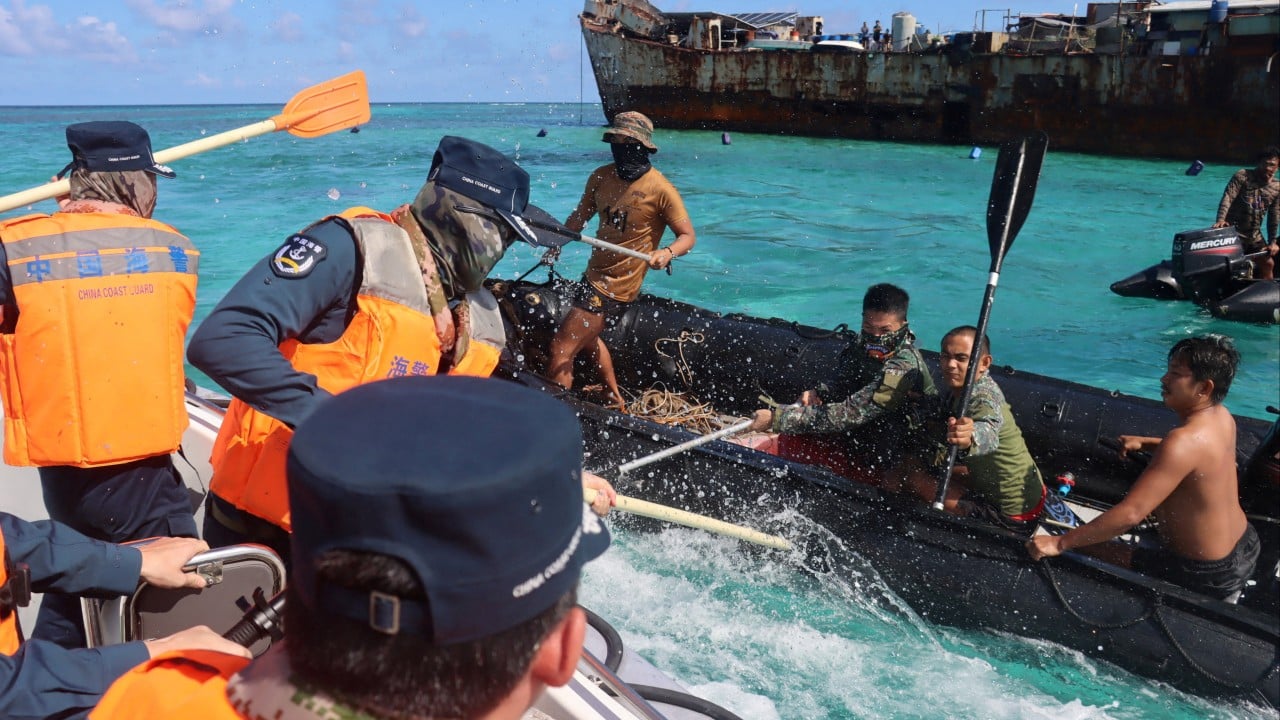
It does not fly a pirate flag. It is three times the size of Mateo’s wooden hull, painted the stark white of a coast guard vessel, carrying water cannons capable of stripping the paint off steel and splintering mahogany ribs in seconds. No shots are fired. None need to be. The giant simply steers across Mateo’s bow, churning a wake that nearly capsizes the outrigger, and blasts a long, deafening horn. Mateo cuts his lines, losing a week’s worth of gear, and turns back toward shore with an empty hold. Further journalism by Al Jazeera highlights comparable perspectives on this issue.
Multiply Mateo by three million fishermen across Southeast Asia, add three trillion dollars in annual global maritime trade, and place them all inside a semi-enclosed sea roughly the size of the Mediterranean. That is the real weight sitting on the negotiating tables as Beijing and the ten-member Association of Southeast Asian Nations race against their self-imposed 2026 deadline to finalize a South China Sea Code of Conduct.
Wait.
"Race" is the wrong word. A race implies two runners sprinting toward the same finish line. What has happened between China and ASEAN over the past two decades looks much more like two people walking backward toward a cliff while arguing over who owns the flashlight.
The Architecture of a Twenty-Four-Year Standoff
To understand why the 2026 deadline feels less like a breakthrough and more like a high-stakes poker bluff, you have to look at the ghosts haunting the conference room. The conversation did not start yesterday. In 2002, after years of simmering friction over rocks, reefs, and sandbars that disappear at high tide, China and ASEAN signed the Declaration on the Conduct of Parties in the South China Sea.
It was a promise to make a promise.
Think of that 2002 declaration like a roommate agreement written on a cocktail napkin during a peaceful Sunday brunch. Everyone agreed not to throw parties, not to block the hallway, and to talk things out before yelling. There were no penalties for breaking the rules because, at the time, nobody had built a fortress in the living room yet.
Then came the dredging barges. Between 2013 and 2016, China pumped millions of tons of sand and crushed coral onto seven submerged reefs in the Spratly Islands, turning specks of rock into three thousand acres of artificial islands complete with deep-water ports, radar arrays, and ten-thousand-foot runways capable of landing heavy bombers. By the time formal negotiations for a legally binding Code of Conduct actually began in 2018, the physical geography of the sea had already been rewritten in concrete.
When diplomats agreed in 2023 to accelerate talks and finish the Code of Conduct by 2026, the announcement was greeted with polite applause and private skepticism. Even now, sitting inside the 2026 window, the fundamental fractures remain as wide as the sea itself.
I remember sitting in a cramped press briefing room in Manila years ago, watching an exhausted ASEAN legal advisor trace a map with a red felt-tip pen. "We are trying to write traffic laws," he told me quietly over lukewarm coffee, "while one driver insists he owns the entire highway, the shoulder, and the gas stations on the other side of the street."
Four Fault Lines Beneath the Waves
Why has a document that is essentially a maritime rulebook taken nearly a quarter of a century to draft? Because beneath the diplomatic boilerplate sit four irreconcilable questions that neither side can afford to lose—and neither side knows how to compromise on without looking weak at home.
First, there is the question of geography. Where does the Code of Conduct actually apply? Beijing claims historic rights over roughly ninety percent of the South China Sea, demarcated by its controversial nine-dash line—now expanded to ten dashes on official Chinese maps—which sweeps deep into the waters claimed by Vietnam, the Philippines, Malaysia, and Brunei. ASEAN negotiators want the Code to clearly respect the 1982 United Nations Convention on the Law of the Sea, known as UNCLOS, which grants coastal states sovereign rights over resources within two hundred nautical miles of their shores. If the Code does not define its geographic boundaries, signing it is like signing a property lease that never mentions the street address.
Second, there is the trap of legal binding force. An agreement without teeth is just stationery. Southeast Asian claimants—particularly the Philippines and Vietnam, whose vessels bear the brunt of maritime confrontations—insist the Code must be legally binding under international law, complete with enforcement mechanisms and dispute-resolution panels. Beijing prefers a political framework built on voluntary restraint and bilateral dialogue, which naturally favors the largest, wealthiest power at the table.
Third, consider the ghost in the room: outside powers. During negotiations, China pushed for clauses that would restrict joint military exercises with countries outside the region unless every signatory agreed, alongside limits on foreign oil and gas companies operating in disputed waters. For countries like the Philippines, which relies on a mutual defense treaty with the United States, or Vietnam and Indonesia, which partner with Western and regional energy firms to drill offshore, giving Beijing a veto over their foreign alliances is non-negotiable.
Fourth, ASEAN itself is not a monolith. This is the vulnerability that keeps Southeast Asian strategists awake at night. ASEAN operates by consensus. Ten nations—soon eleven with Timor-Leste—must agree before the bloc speaks with one voice. Yet only four ASEAN members have overlapping territorial claims with China in the South China Sea. Landlocked Laos or economically dependent Cambodia do not have fishermen getting water-cannoned off Second Thomas Shoal. Beijing knows this. Over the years, Chinese trade, infrastructure loans, and diplomatic pressure have repeatedly dulled ASEAN’s collective edge, turning urgent maritime security crises into watered-down communiqués that carefully avoid naming the aggressor.
The Invisible Stakes in Your Living Room
It is easy, sitting thousands of miles away in London, Chicago, or Frankfurt, to view a dispute over uninhabited coral atolls as an abstract chess match between rival ministries. That distance is an illusion.
Look at the device you are reading this on. Look at the coffee cup on your desk, the steel frame of your car, or the winter coat hanging in your closet. Roughly one-third of all global maritime shipping passes through the narrow bottleneck of the South China Sea. Every year, tankers carrying Middle Eastern crude oil to Japan and South Korea, and container ships hauling electronics, textiles, and pharmaceuticals from Asian factories to European and American ports, thread through these contested waters.
If a miscalculation—a ramming incident that sinks a coast guard cutter, a downed reconnaissance drone, a collision between patrol boats near Sabina Shoal—sparks even a localized naval blockade, global supply chains will not merely bend. They will snap.
Insurance premiums for commercial vessels transiting the region would skyrocket overnight. Shipping companies would be forced to reroute thousands of cargo vessels south around Australia, adding days or weeks to delivery schedules and billions of dollars in fuel costs. Inflation would spike in grocery stores and electronics shops across the Western world before a single diplomat could convene an emergency session at the United Nations.
And beneath the shipping lanes lies another hunger. The South China Sea accounts for roughly twelve percent of the global fish catch, feeding hundreds of millions of people across coastal Asia. Industrial fishing fleets, often backed by state subsidies and escorted by maritime militia vessels, have stripped shallow reefs bare using giant steel trawlers and cyanide. When fish stocks collapse in the Spratlys, desperation pushes local boats further into contested waters, raising the odds of the next violent collision.
What Happens When the Clock Strikes Midnight?
Let us be completely honest about where things stand in late 2026: the probability of China and ASEAN signing a comprehensive, legally binding, enforceable Code of Conduct that resolves territorial disputes is near zero.
Pretending otherwise does a disservice to reality. Nobody in Beijing is going to dismantle the runways on Mischief Reef or Subi Reef. Nobody in Manila or Hanoi is going to surrender their sovereign rights under international law, especially after the 2016 Permanent Court of Arbitration ruling in The Hague explicitly invalidated China’s sweeping historic claims—a ruling Beijing dismissed as "waste paper."
Yet diplomatically, failure carries a steep price for both sides.
For ASEAN, missing the 2026 target without a tangible deliverable exposes the bloc as paralyzed, eroding its cherished doctrine of "ASEAN Centrality"—the idea that Southeast Asian nations, rather than Washington or Beijing, should sit in the driver’s seat of regional security. For China, walking away empty-handed confirms the narrative pushed by Washington and its allies: that Beijing uses endless negotiations as a smokescreen while steadily tightening physical control over the sea.
So watch for the diplomatic sleight of hand.
Consider what happens next: rather than admitting defeat, negotiators are far more likely to unveil a "framework agreement" or an "early harvest" Code of Conduct. On paper, it will look triumphant. There will be handshakes beneath silk flags, solemn speeches about regional harmony, and new hotlines connecting coast guard headquarters in Beijing, Manila, Hanoi, and Kuala Lumpur.
Those hotlines are not useless. When two steel ships are closing on each other at twenty knots in heavy fog, a direct radio channel between bridge commanders can prevent an accidental collision from spiraling into a shooting war. Protocols for search-and-rescue operations, marine environmental protection, and notification of military exercises genuinely reduce the temperature of daily encounters.
But a hotline does not tell a fisherman whose nets belong in the water. A hotline does not stop a coast guard vessel from blocking resupply missions to rusted outposts like the BRP Sierra Madre, where a handful of Filipino marines live on a crumbling World War II tank landing ship grounded on Second Thomas Shoal.
The Human Equation
Whenever I feel tempted to get lost in the technical jargon of exclusive economic zones, baselines, and low-tide elevations, I think back to the wooden boats tied up along the piers of Pangasinan and Da Nang.
The men who pilot those boats do not read diplomatic communiqués. They read the color of the water, the direction of the swell, and the silhouette of distant radar masts against the clouds. For twenty-four years, politicians in suits have promised them a rulebook that would make the sea safe again. They promised it in 2002. They promised it in 2017. They promised it for 2026.
Meanwhile, the concrete on the artificial islands has cured. The radar domes spin twenty-four hours a day, sweeping invisible beams across the water. And tomorrow morning, before dawn breaks over the South China Sea, a fisherman will untie his hemp rope, start his single-cylinder diesel engine, and steer his wooden hull into the gray expanse—hoping that the piece of paper diplomats are arguing over will somehow be strong enough to stop a water cannon.