Friday night lights in Southern California have a specific weight to them. They don't just illuminate a patch of Bermuda grass; they cast long, heavy shadows over everything that came before and everything that might come next. Stand near the chain-link fence at Trabuco Hills Stadium on an autumn evening, smell the sharp tang of freshly cut turf mixing with cheap popcorn and eucalyptus, and watch the man standing on the Santa Margarita Catholic High School sideline.
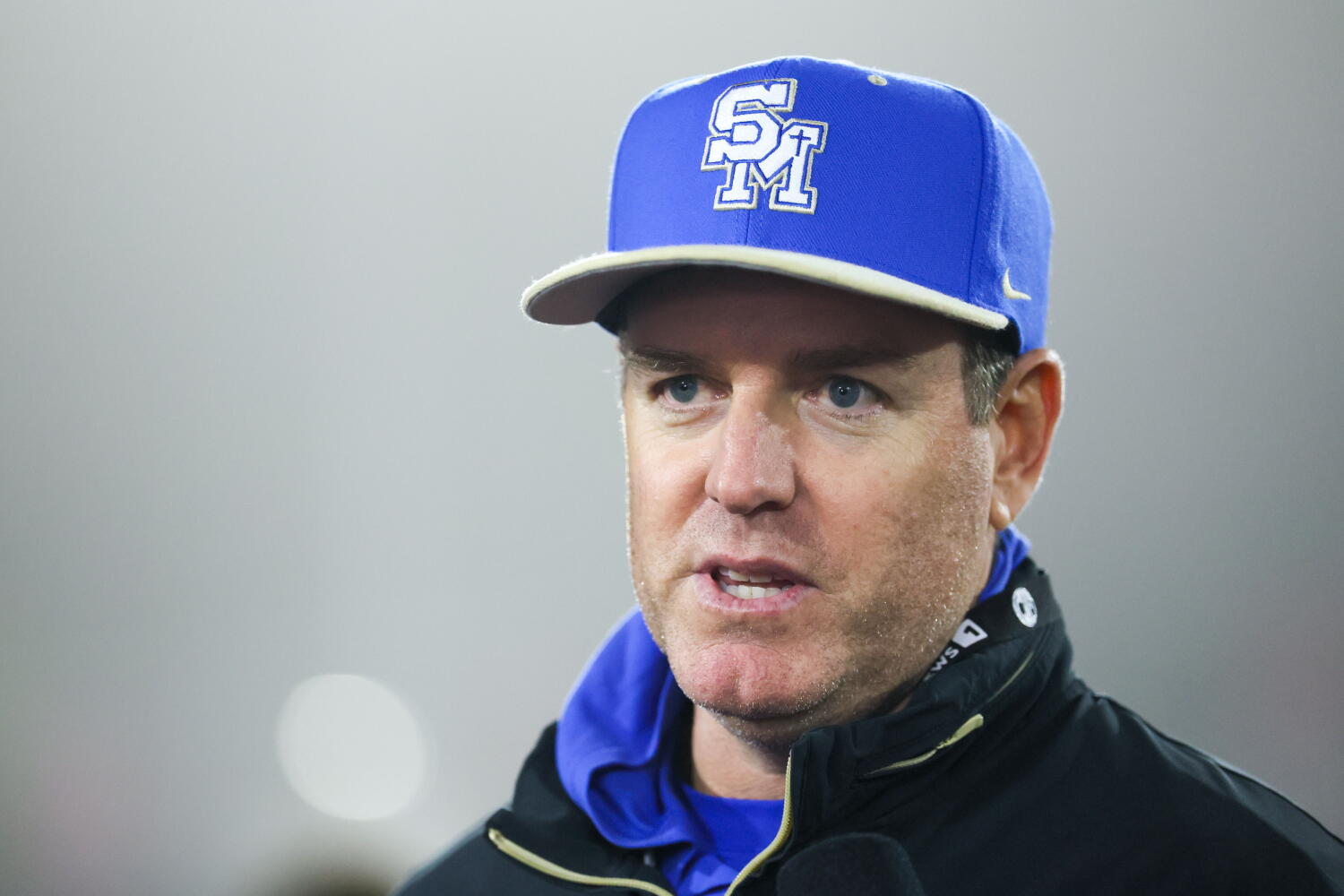
He isn't wearing a headset with a corporate sponsor’s logo stitched across the temple. He isn't screaming into a laminated play sheet. He’s just standing there—six-foot-five, broad-shouldered, wearing a simple polo and a visor, watching seventeen-year-old boys try to figure out where their feet belong when a two-hundred-and-forty-pound defensive end is bearing down on them.
That is Carson Palmer. Heisman Trophy winner. First overall pick in the 2003 NFL Draft. A man who made more than a hundred and seventy million dollars throwing a leather ball through tightening windows in Cincinnati, Oakland, and Arizona.
And right now, he is undefeated.
The scoreboard reads perfection. The Eagles are rolling through the brutal gauntlet of the Trinity League—a high school football conference so absurdly stacked with future Sunday talent that coaches routinely joke it’s tougher than half the divisions in college ball. Yet, the louder the stadium gets, and the cleaner the record stays, the heavier the silence becomes whenever someone asks the obvious question.
How long does a guy like this stay?
The Gravity of the Headset
To understand why the football world is staring at a high school sideline in Orange County with a mixture of awe and suspicion, you have to understand the peculiar addiction of the coaching profession.
I’ve spent enough years standing in muddy end zones and cramped press boxes to know the look in a coach's eyes when October turns to November. Most high school coaches are grinders. They teach sophomore history or freshman biology during the day, eat lukewarm pasta out of Tupperware containers between fourth period and film study, and drive home at eleven o'clock at night in sedans with two hundred thousand miles on the odometer. They do it because they have no other way to stay close to the fire.
Carson Palmer does not need the fire to keep warm. He already lived inside the sun.
When he took over the program at Santa Margarita—his own alma mater, the place where his jersey already hangs in the rafters—the skeptics didn't even bother to hide their smirks. We have seen this movie before. A retired superstar gets bored of playing golf in Idaho or sitting on a television set in Bristol. He misses the locker room banter. He misses the Friday adrenaline. So, he takes a high school job, treats it like a hobby for eighteen months, realizes that seventeen-year-olds forget their blocking assignments when they have a chemistry test the next morning, and quietly slips out the back door before the spring game.
Except Palmer didn't slip out. He leaned in.
Watch the tape of Santa Margarita this season and you won't see a celebrity dabbling in youth sports. You see an offense built on surgical, agonizing precision. You see a quarterback room where teenagers are reading pre-snap safety rotations that most Division I backups struggle to identify. You see a roster playing with a terrifying, quiet discipline—the exact kind of discipline Palmer had to learn the hard way after tearing his ACL in a 2006 playoff game and spending a decade clawing his way back into the upper echelon of professional quarterbacks.
Winning changes the temperature in the room. When you take a storied program that had drifted toward the middle of the pack in the nation’s toughest league and suddenly start stacking victories without a single loss, people stop treating your presence like a cute human-interest story. They start calling you a prodigy.
The Anatomy of a Rumor
Consider a hypothetical scenario. Picture a Tuesday morning in late October, somewhere in the sprawling athletic complex of a major Pac-12 or Big Ten university. An athletic director is staring at a buyout clause worth twenty-five million dollars and a booster base that is threatening to withhold donations unless the offense starts scoring points. That athletic director picks up his phone, looks at a list of expensive, recycled college coordinators, and then pauses on a name that isn't on the list at all.
Carson Palmer.
He’s forty-six years old. He has Heisman pedigree. He has NFL credibility that no twenty-eight-year-old "offensive guru" can replicate in a living room when sitting across from a five-star recruit's parents. Better yet, he’s proving right now, under the Friday night lights of Orange County, that he can actually organize a staff, manage a clock, and develop teenagers.
That is why the questions are swirling. It isn't idle gossip; it’s basic market economics.
In modern college football, the distance between a high school sideline and a Power Four head coaching chair has shrunk to nothing. Look at the names that have floated through the rumor mills over the last decade—former pros who bypassed the traditional twenty-year climb of graduate assistantships and position coaching because universities are desperate for instant authority. When a former MVP candidate starts winning undefeated streaks at a powerhouse like Santa Margarita, the phone calls don't trickle in. They flood.
Every time Santa Margarita puts up forty points on a Friday night, a booster in Los Angeles, or Seattle, or Tempe starts doing the math. If he can make the Trinity League look this manageable, what could he do with an NIL collective and a hundred-million-dollar facility?
What Happens When the Whistle Blows
Here is the part that gets lost in the transactions and the coaching carousels: what it actually costs to leave.
I remember talking to a veteran defensive coordinator a few years back who had just turned down a massive jump to the college ranks to stay at his suburban high school. I asked him if he regretted leaving seven figures on the table. He looked out at his practice field, where a backup long-snapper was struggling to tie his cleats, and laughed. "In college," he told me, "if a kid misses a block, you go into the transfer portal and replace him by Tuesday. Here, if a kid misses a block, you have to figure out why his parents are getting divorced and how to get his geometry grade up so he's eligible for Friday. Which one sounds like actual coaching to you?"
Palmer knows both worlds intimately. He spent fifteen seasons in the NFL meat grinder, where loyalty is measured in game checks and a bad Sunday afternoon gets your name trending for all the wrong reasons. He walked away from the Arizona Cardinals after the 2017 season with his body battered—broken ribs, torn ligaments, a shattered thumb, a separated shoulder—and retreated to the quiet mountains of Ketchum, Idaho. He hunted. He fished. He raised his kids away from the noise.
Coming back to Rancho Santa Margarita wasn't a career move. It was a pilgrimage.
When you return to the exact patch of grass where you were once an awkward, gangly kid trying to figure out if you were good enough to play at USC, you aren't looking for a stepping stone. You're trying to pay off a debt you didn't realize you owed until you got old enough to appreciate who taught you how to throw a spiral.
Yet, ambition is a funny, stubborn thing. You don't become the first overall pick in the draft, survive the chaos of the early-2000s Cincinnati Bengals, and revive your career in your mid-thirties in the Arizona desert by being content with "good enough." Competitive people don't turn off the switch; they just dim the lights for a little while.
Stand near the Santa Margarita bench during the fourth quarter of a tight game. Watch Palmer's jaw tighten when a receiver runs a lazy route on third-and-six. Look at the way he talks to his offensive coordinator—not like a guy enjoying a retirement hobby, but like a field general who cannot stand the thought of leaving three points on the board. That intensity doesn't stay contained inside a three-thousand-seat high school stadium forever. Eventually, the walls start to feel a little too close.
The Invisible Stakes in the Locker Room
Ask the kids in that locker room what they think about the rumors, and you'll get the standard, coached-up answers. We're just focused on this week. Coach Palmer is locked in. We don't listen to the outside noise.
Don't believe a word of it. Seventeen-year-olds live on their phones. They see the message board threads. They hear the whispers from rival recruiters who slide into their direct messages on a Sunday afternoon with a simple, venomous pitch: You really think Carson is gonna be there for your senior year? He’s taking a college job in December.
Negative recruiting is the oldest, dirtiest currency in sports, and right now, every rival program in Southern California is spending it freely against Santa Margarita.
Think about the psychological tightrope Palmer has to walk every single Monday morning. He has to stand in front of eighty teenagers and demand total, uncompromising commitment—asking them to bleed, sweat, and sacrifice their weekends for a common goal—while knowing that his very name is being tossed around in athletic directors' offices from coast to coast. If he addresses the rumors too directly, he gives them oxygen. If he ignores them completely, the silence breeds doubt.
And what about his own kids? Palmer came back to Southern California largely for family, to be present in a way an NFL schedule never allows. Taking a college head coaching job in the era of year-round recruiting, transfer portal windows, and revenue sharing isn't a job; it's a hostage situation. You don't see your family from August until February, and when you do, your phone is vibrating every four minutes because a nineteen-year-old backup cornerback wants thirty thousand dollars more to stay on the roster.
Why on earth would a man who already beat the game trade Friday nights with his neighbors for that kind of misery?
Because greatness is never rational.
Think about the trajectory of Palmer’s life. Every major chapter has been defined by stepping into situations that looked slightly impossible. Taking over a moribund Bengals franchise and dragging them to their first playoff appearance in fifteen years. Walking into Oakland after a mid-season trade with zero preparation. Resurrecting his career under Bruce Arians in Arizona when half the league thought his arm was dead. Palmer doesn't run away from pressure; he metabolizes it.
Right now, Santa Margarita is undefeated, staring down the barrel of a CIF Southern Section Division 1 playoff run—a tournament that essentially crowns the national champion of high school football. If the Eagles run the table, if Palmer hoists that trophy at the Rose Bowl or the Coliseum in late November, the story changes overnight. He ceases to be a former quarterback doing his alma mater a favor. He becomes the hottest coaching commodity in America.
The Final Snap
Go back to that chain-link fence on a Friday night. The fourth quarter is winding down. Santa Margarita has the ball, nursing a two-score lead, bleeding the clock with the kind of ruthless, methodical ground game that breaks a defense's spirit.
Palmer takes a half-step back from the white sideline stripe. He pulls his visor down slightly against the glare of the stadium lights. Around him, assistant coaches are barking into headsets, teenagers are jumping up and down waving towels, and the student section is roaring a chant that echoes off the surrounding hills of Rancho Santa Margarita.
For three hours on a Friday night, the world makes complete sense. There are no buyout clauses here. No booster dinners. No agents leaking fake interest to drive up a contract extension. Just twenty-two kids, a hundred yards of grass, and the pure, uncomplicated geometry of a well-run play.
The clock hits zero. The players mob each other near the forty-yard line. Palmer walks slowly toward midfield to shake the opposing coach's hand, offering a brief, respectful nod before turning back toward the tunnel where his family is waiting near the gate.
He looks entirely at peace. He looks like a man who has found the exact place he was meant to be. And somewhere, three hundred miles away in a quiet office overlooking an empty college stadium, a phone is already starting to ring.