In a small manufacturing town in Ohio, a floor manager named Elias watches a shipping container swing precariously from a crane. Inside that steel box are precision-machined components that cost forty percent more than they did three years ago. Elias doesn’t think about geopolitical grand strategy or the Thucydides Trap. He thinks about the three guys he had to let go in April because the margins simply evaporated. To him, the tension between Washington and Beijing isn't a headline. It is a slow-motion car crash happening in his ledger.
Five thousand miles away, in a sleek tech hub in Shenzhen, a software engineer named Lin stares at a line of code. Her company can no longer buy the high-end American chips required to run the AI models she spent five years perfecting. She is pivoting to domestic hardware that runs hotter and slower. Her world, once defined by a seamless global internet of ideas, is shrinking into a walled garden.
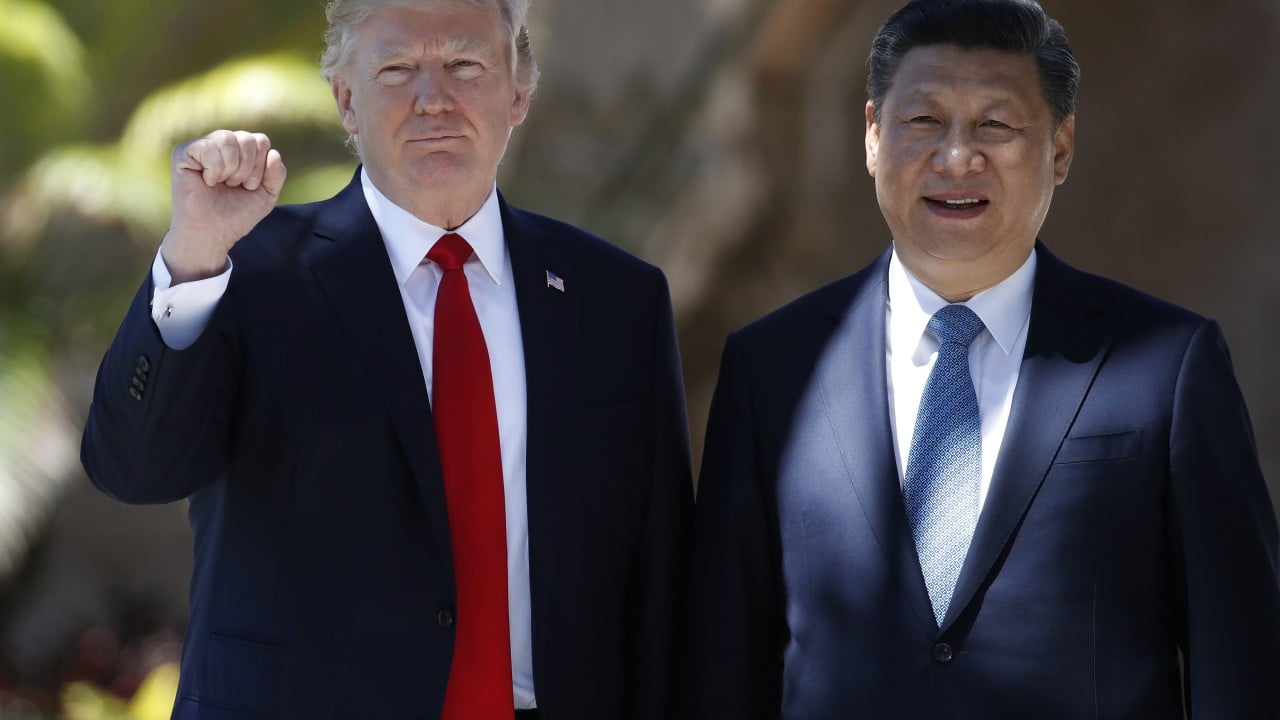
These two people are the collateral of a struggle often framed as a clash of titans. We talk about Donald Trump and Xi Jinping as if they are players in a vacuum, two men sitting across a table in a quiet room. But the table is made of glass, and it is cracking under the weight of their competing versions of the future.
The Architect and the Disrupter
To understand who holds the upper hand, we must look past the bluster of campaign rallies and the stoic silence of the Great Hall of the People. We are witnessing a collision between two fundamentally different philosophies of power.
Xi Jinping plays a game of decades. His strength lies in the absolute synchronization of a state-led economy. When Xi decides that electric vehicles or green energy will be the pillar of the Chinese century, the entire apparatus of the state—banks, factories, and schools—moves in unison. It is a massive, heavy flywheel. Once it starts spinning, it is nearly impossible to stop. China’s advantage is this terrifying consistency. They do not have to worry about an election in four years changing the entire trajectory of their industrial policy.
Then there is the American side, currently personified by the return of Donald Trump’s "America First" doctrine. If Xi is an architect building a fortress brick by grueling brick, Trump is a wrecking ball aimed at the scaffolding. His advantage isn't consistency; it’s volatility.
By wielding tariffs as a primary weapon, Trump forces a decoupling that the global market wasn't prepared for. He uses the sheer size of the American consumer market as a hostage. "If you want access to our wallets," the argument goes, "you play by our rules." It is a high-stakes gamble that bets on the idea that China needs the American consumer more than America needs Chinese factories.
The Pain of the Pivot
Think of the global economy as a complex nervous system. For thirty years, we spent billions of dollars knitting the nerves of the US and China together. We created a world where a phone is designed in California, powered by chips from Taiwan, assembled in Zhengzhou, and sold in London.
Now, we are trying to perform surgery on that nervous system without anesthesia.
The "upper hand" is a fickle thing. On paper, the United States still holds the keys to the most vital kingdom: high-end semi-conductors. You cannot run a modern military, a modern bank, or a modern hospital without the tiny slivers of silicon that are currently choked off by US export controls. This is a massive lever. It has forced China into a desperate, multi-billion-dollar sprint to achieve "self-reliance."
But levers can snap.
While the US controls the "brains" of the modern world, China controls the "muscles." They dominate the processing of rare earth minerals. They are the world's battery factory. If you want to build a green future, you currently have to go through Beijing.
Consider the hypothetical case of a solar farm in Nevada. Under a renewed Trump administration, the tariffs on Chinese solar panels might jump to sixty percent. The goal is to "bring jobs back." But those American factories don't exist yet. They take years to build. In the meantime, the Nevada project stalls. The workers who would have installed those panels are sent home. The "upper hand" in a trade war often feels like hitting your opponent with a brick while you are both standing on a frozen lake. You might land the blow, but the ice is breaking for everyone.
The Invisible Stakes of the Dollar
Beyond the factories and the ports, a quieter battle rages over the very concept of money. For nearly eighty years, the US Dollar has been the world’s "reserve currency." It is the oxygen of global trade. Because everyone needs dollars to buy oil or grain, the US can run massive debts and print money with fewer consequences than anyone else.
Xi Jinping knows this is the ultimate American superpower.
China is aggressively pushing the Yuan as an alternative, signing deals with Russia, Brazil, and Saudi Arabia to trade in their own currencies. It’s a slow-burn strategy. It isn't working yet—most of the world still trusts the Dollar because the US system is transparent and liquid. But the more the US uses the Dollar as a weapon—via sanctions and freezing assets—the more other countries start looking for an exit door.
Trump’s approach to this is a paradox. He wants a strong America, but his trade policies often alienate the very allies needed to keep the Dollar dominant. If the US retreats into isolationism, it leaves a vacuum. And in the world of power, vacuums are filled instantly.
The Human Toll of Strategy
We often hear about "trade deficits" as if they are scores in a football game. They aren't. A trade deficit is simply a reflection of where people choose to put their money.
When we talk about who has the advantage, we have to ask: at what cost?
In China, the cost is a generation of young people who are "lying flat." They are highly educated but find themselves in an economy that is slowing down under the weight of debt and US pressure. The social contract—work hard, follow the Party, and you will get rich—is fraying. Xi’s upper hand depends entirely on his ability to keep the floor from falling out from under the middle class.
In the US, the cost is the price of a life. Every tariff is a tax on the person buying a toaster, a car, or a house. If the "upper hand" is achieved by making the cost of living unbearable for the bottom fifty percent of the population, is it really a victory?
The reality is that we are no longer in a world where one side "wins." We are in a world of managed damage.
The Silicon Wall
The most significant shift isn't in the total volume of trade, but in the nature of what is being traded. We are seeing the birth of a "Two-World" system.
Imagine two different internets, two different satellite arrays, and two different sets of standards for everything from autonomous cars to medical data. This is the goal of the current decoupling. The US wants to ensure that the foundational technology of the next century isn't built on Chinese architecture. China wants to ensure it can never be "turned off" by a flick of a switch in Washington.
This race is where the true upper hand will be found.
The US has the advantage of innovation. The American system is messy, chaotic, and often dysfunctional, but it remains the world’s greatest engine for "The New." It attracts the best minds from every corner of the globe. People still want to move to Palo Alto to change the world.
China has the advantage of scale and implementation. They can build a high-speed rail network or a nationwide 5G grid in the time it takes an American city to finish a single environmental impact study.
The conflict is between the Power of the Idea and the Power of the Machine.
The Sound of the Break
In the end, the question of who has the upper hand is the wrong question. It assumes the game has an end. It doesn't.
We are living through a fundamental reordering of how humans interact across borders. The era of "Globalism" is being replaced by "Regionalism" and "Fortress Economics."
Donald Trump views this as a necessary correction to a system that cheated American workers. He sees the pain of the transition as a price worth paying to break China’s momentum. Xi Jinping views this as a historical inevitability—the decline of a fading hegemon trying to kick the ladder out from under its successor.
But back in that Ohio factory, Elias doesn't care about historical inevitability. He cares about the fact that his "Made in America" dream now requires parts he can't afford and a global stability that no longer exists.
The upper hand belongs to whoever can keep their own population from revolting as the cost of this divorce rises. It belongs to the leader who can convince their people that the cold, hard reality of a fractured world is better than the integrated one we are leaving behind.
The glass is breaking. We are all just trying to find a place to stand where the shards won't reach us.