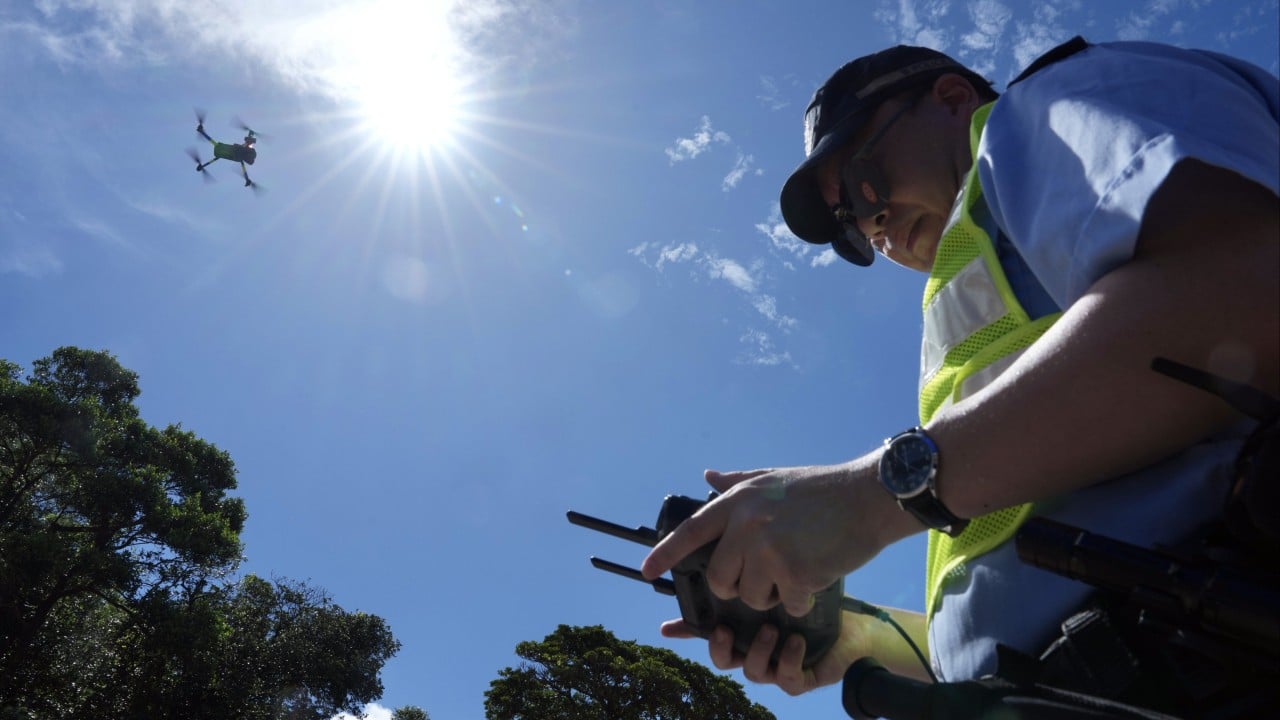
Hong Kong authorities will enforce a strict airspace ban on drones, kites, and captive balloons across key districts during the Interpol General Assembly, establishing temporary restricted flying zones to eliminate low-altitude security blind spots. While official statements frame the measure as standard protocol for high-profile international gatherings, the reality on the ground points to a much broader shift in urban security doctrine. Law enforcement agencies worldwide are grappling with the rapid democratization of low-altitude airspace, where inexpensive consumer hardware can easily bypass traditional perimeter defenses.
Watch the skies over Victoria Harbour during any major diplomatic summit, and you will see the invisible architecture of modern policing at work. For decades, securing a venue meant locking down streets, checking identification at checkpoints, and posting snipers on rooftops. Those methods assume threats travel horizontally. They no longer do.
The Anatomy of a Low-Altitude Lockdown
When the Civil Aviation Department and the Hong Kong Police Force establish a Temporary Restricted Flying Zone, they are drawing an invisible cylinder over the city. Inside this boundary, the rules of everyday recreation vanish. It is not just heavy commercial quadcopters that get grounded. Small unmanned aircraft weighing under 250 grams, children's kites, model aircraft, and helium-filled promotional balloons all fall under the prohibition.
The inclusion of kites and balloons often draws bemused reactions from the public. A child flying a kite on a waterfront promenade hardly poses a tactical threat to international police delegates. Yet from the perspective of radar operators and counter-drone units, clutter is the enemy.
Modern low-altitude detection systems rely on a combination of radio-frequency scanners, electro-optical cameras, and micro-Doppler radar. In a dense urban environment like Hong Kong, where glass skyscrapers bounce radio waves in unpredictable directions, sensors are already working overtime. A cluster of metallic mylar balloons or a large kite drifting near a restricted perimeter creates false positives. Every false alarm forces tactical teams to divert attention, verify the target visually, and potentially scramble response units. By banning everything that floats or flies, security planners strip away the background noise so that anything remaining on their screens is treated immediately as a hostile incursion.
Legal Teeth Behind the Restriction
Hong Kong does not leave compliance to goodwill. Under the Small Unmanned Aircraft Order, operating a drone inside a restricted flying zone without explicit permission is a criminal offense. Offenders face severe penalties, including substantial fines and imprisonment upon conviction.
Law enforcement backs up these statutes with active electronic countermeasures. During major events, specialized police units deploy portable radio-frequency jammers and signal-spoofing equipment. When an unauthorized drone enters the perimeter, operators do not need to shoot it down with kinetic weapons, which would send debris plummeting onto crowded streets below. Instead, they sever the command link between the controller and the aircraft, forcing the drone either to hover in place until its battery dies or to execute a controlled descent into a designated capture zone.
Why Interpol Changes the Threat Calculus
Hosting the Interpol General Assembly is not like hosting a trade expo or a sporting event. The assembly brings together police chiefs, interior ministers, and senior intelligence officials from nearly two hundred member countries. In a single convention center, you have the leadership of global law enforcement concentrated in one place.
For militant groups, state-sponsored intelligence operatives, or lone actors seeking maximum publicity, such a gathering represents an irresistible target. The threat is rarely limited to kinetic attacks. Industrial and political espionage via unmanned platforms has become a persistent headache for host nations.
Consider a hypothetical scenario involving signal intelligence. A commercial drone modified with a lightweight software-defined radio and a high-gain antenna can hover several hundred meters outside a hotel where delegates are staying. Even without breaching the building's physical walls, that payload can intercept unencrypted wireless traffic, map Wi-Fi networks, or attempt to spoof cellular base stations to capture device identifiers from phones inside the rooms. Grounding all civilian aerial activity within a multi-kilometer radius denies adversaries the elevation they need for line-of-sight interception.
The Evolution of Hong Kong Airspace Control
To understand why Hong Kong executes these lockdowns with such precision, you have to look at how the city's regulatory environment has evolved over the past decade. Years ago, Victoria Harbour was a free-for-all for aerial photographers. Hobbyists routinely launched drones from the Tsim Sha Tsui promenade or the Central harborfront to capture sweeping views of the skyline, often flying dangerously close to commercial helicopters and high-rise windows.
That era ended abruptly. The introduction of the Small Unmanned Aircraft Order transformed drone operation from a casual hobby into a tightly regulated aviation activity. Mandatory registration for aircraft above 250 grams, pilot training requirements, and strict altitude ceilings brought order to the skies.
More importantly, the legislation gave authorities the legal framework to rapidly gazette temporary no-fly zones whenever political or security circumstances demand it. We have seen this playbook deployed repeatedly during national anniversaries, visits by senior mainland officials, and major international financial summits. Each deployment serves as a live operational drill, refining coordination between aviation regulators, frontline beat officers, and specialized tactical units.
Collateral Friction in a Vertical City
Security measures of this scale never happen in a vacuum. In a hyper-dense metropolis where land is scarce and vertical space is heavily utilized, shutting down the lower airspace creates immediate friction for legitimate operators.
Commercial drone pilots, who rely on aerial inspections for building maintenance, construction surveying, and media production, face sudden work stoppages. Even when operators hold valid advanced permissions from the Civil Aviation Department, blanket security restrictions typically override standard commercial clearances. Projects get delayed, permits have to be refiled, and insurance windows expire.
There is also the matter of public awareness. Hong Kong is a major transit hub with thousands of tourists arriving daily, many carrying compact travel drones in their backpacks. A visitor unfamiliar with local gazetted notices might unpack a palm-sized drone near the waterfront to take a sunset video, completely unaware that an international policing conference is underway two kilometers away.
While authorities issue press releases, update official drone maps, and post signage in popular parks, information gaps persist. Frontline officers are then placed in the delicate position of distinguishing between a clueless tourist and a deliberate provocateur, all while maintaining zero tolerance near sensitive venues.
The Asymmetric Reality of Modern Urban Security
Critics of heavy-handed airspace bans often argue that determined adversaries do not obey flight restrictions. That is undeniably true. A bad actor intent on disrupting an international summit will not check the Civil Aviation Department's mobile app before launching an attack.
Yet this argument misses the fundamental purpose of a temporary restricted zone. Bans do not stop criminals directly; they create a sterile environment where criminals cannot hide. When law-abiding citizens clear the sky, enforcement becomes binary. Any object detected in the air is automatically unauthorized, stripping away the plausible deniability that makes urban policing so difficult.
Look across the globe, and you will see the exact same doctrine taking hold in Paris, Tokyo, New York, and London. Whether it is the Olympic Games or a United Nations General Assembly, the sky above the host city is no longer treated as public space during major events. It is treated as a contested tactical domain. Hong Kong's decision to ground everything from high-end quadcopters to paper kites is simply the latest confirmation that in modern urban security, total control of the air begins at ground level.


