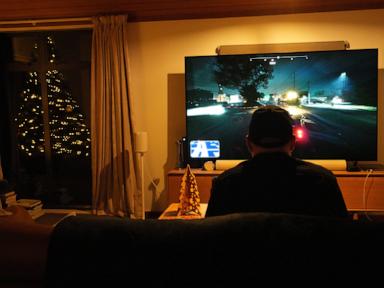
Your group chat did not suddenly break, and your friends are not secretly mad at you. They are almost certainly sitting in darkened living rooms, staring at the neon-soaked streets of Leonida, completely absorbed by Grand Theft Auto VI. Whenever Rockstar Games releases a flagship title, it triggers a measurable, temporary collapse in everyday social attendance, workplace productivity, and casual digital communication. This is not a harmless quirk of nerd culture; it is a massive, predictable reallocation of human attention driven by decades of psychological conditioning, pent-up cultural anticipation, and a modern social ecosystem that makes disappearing behind a closed door easier than ever before.
For years, entertainment executives talked about cultural monocultures as an extinct species. Streaming algorithms fractured television audiences into tiny, incompatible niches, while social media feeds ensured that two people sitting on the same couch rarely watched the same video at the same time. Yet the arrival of a new entry in the Grand Theft Auto franchise consistently overrides that fragmentation. People who haven't touched a game controller since the Obama administration suddenly clear their calendars, burn through accrued paid time off, and treat a software launch with the logistical seriousness of a hurricane preparation.
The Economics of Voluntary Disappearance
To understand why grown adults vanish from their social circles for days or weeks at a time, you have to look at the sheer friction of modern adulthood versus the effortless rewards of a high-budget open world. Going out in the real world has become expensive, loud, and exhausting. A single evening at a moderately priced restaurant or neighborhood bar easily costs upwards of a hundred dollars once you factor in rideshares, inflated drink prices, and tips, often yielding little more than shouted conversation over mediocre music.
Compare that economic reality to an eighty-dollar piece of interactive entertainment. That single upfront purchase buys hundreds of hours of structured, self-paced escapism with zero ongoing social tax. When people weigh the cost of commuting across town to make small talk against the immediate gratification of exploring a meticulously crafted digital playground with the exact same friends via headset, the real world loses. The disappearance you are noticing in your phone's notification tray isn't antisocial behavior; for millions of people, it is simply migrating their social lives to a venue with better acoustics and no cover charge.
The Paid Time Off Phenomenon
Human resources departments across North America and Europe have quietly tracked a recurring anomaly around major entertainment releases for over fifteen years. Sick days spike abruptly on Tuesday mornings, and vague "personal days" cluster tightly around specific Friday launches. Managers who pay attention to entertainment calendars know better than to schedule critical sprint reviews or all-hands meetings during the launch window of a Rockstar title.
Unlike a two-hour blockbuster movie that you can consume on a Wednesday night without disrupting your sleep schedule, a massive open-world crime simulator demands uninterrupted blocks of time. You cannot properly absorb a sprawling narrative, learn complex driving mechanics, and explore hidden corners of a map in twenty-minute increments between answering work emails and folding laundry. Players instinctively know this, so they hoard vacation hours months in advance to construct an artificial, uninterrupted weekend where real-world obligations cannot intrude.
How Rockstar Engineers Total Attention Capture
Plenty of studios spend hundreds of millions of dollars building massive virtual worlds, yet almost none of them trigger this specific kind of cultural blackout. The difference lies in how Rockstar structures environmental storytelling and player agency. Most modern games rely heavily on aggressive, transparent psychological hooks—daily login bonuses, expiring battle passes, and flashing progress bars—that eventually exhaust players and feel like a second job.
Rockstar takes the opposite approach. They build worlds that operate with an internal logic independent of the player's presence, creating the illusion that life continues around every corner even when you put the controller down. When a virtual city feels genuinely alive, leaving it feels like walking out of a party while the best stories are still unfolding.
Friction as a Feature
Modern software design obsesses over removing friction, trying to make every menu, transition, and action instantaneous. Surprisingly, Grand Theft Auto VI and its predecessors deliberately reintroduce specific kinds of friction to slow the player down and deepen immersion. You have to physically drive across town to meet a contact, navigate traffic, listen to the radio, and deal with unexpected roadside chaos along the way.
That forced pacing alters how the human brain processes time. In a fast-paced competitive shooter, twenty minutes feels frantic and repetitive, making it easy to log off after a couple of matches. In a slower, systemic sandbox, three hours can evaporate while you do nothing more than customize a vehicle, get sidetracked by a bizarre street performer, and end up in an unplanned high-speed chase across three counties. By the time you glance at the clock, it is two in the morning, and you have missed four text messages asking if you still want to grab drinks.
The Silent Death of the Casual Hangout
The disappearances triggered by this release also expose a fragile shift in how adults maintain friendships. Two decades ago, if you wanted to play video games with your friends, you often had to physically carry a console or a heavy television to someone's basement, buy pizza, and sit shoulder-to-shoulder on a worn-out couch. Gaming was a physical gathering that reinforced real-world proximity.
Today, high-speed fiber internet and crystal-clear voice chat have completely decoupled social bonding from physical presence. Your friends haven't abandoned you to sit in solitary confinement; they are hanging out in a digital living room that requires zero commute. If you are not inside that specific ecosystem, however, you experience their absence as total radio silence.
Consider a hypothetical example of a typical five-person friend group in their late twenties. Three of them own current-generation consoles and spend four hours every Tuesday and Thursday night driving through Vice City together, laughing over headsets, and catching up on their weeks. The other two friends do not play video games. To the three gamers, the friend group is thriving and more connected than ever. To the two non-gamers, their friends have suddenly become unreachable ghosts who take three days to reply to a simple question about weekend brunch.
The FOMO Feedback Loop
This dynamic creates a powerful fear of missing out that accelerates the social blackout. In the first forty-eight hours after a generational game launches, social media algorithms flood every feed with clips, hidden Easter eggs, inside jokes, and plot spoilers. Anyone who waits a month to play risks having the entire experience ruined by a casual scroll through short-form video apps.
Because the cultural conversation moves at breakneck speed, players feel an urgent pressure to consume the content immediately so they can participate in the shared commentary. Staying home on a Friday night stops feeling like a missed social opportunity and starts feeling like keeping up with mandatory current events. Your friends are ignoring your texts because they are trying to finish a critical story mission before someone spoils the ending on Monday morning.
Why Traditional Entertainment Cannot Compete
Hollywood executives and music industry analysts often express baffled frustration when a single video game outsells the entire domestic box office for a month in just seventy-two hours. That confusion stems from a fundamental misunderstanding of what consumers actually want from their leisure time. Passive entertainment asks you to sit quietly in the dark and watch someone else make decisions. Interactive entertainment hands you the steering wheel.
When people feel powerless over rising living costs, stagnant wages, and unpredictable global news cycles, passive distraction often falls short. A two-hour movie ends, the lights come up, and your problems are waiting right where you left them. An interactive sandbox offers a temporary, controlled environment where risk has no permanent consequences, hard work reliably yields visible rewards, and you possess total autonomy over where you go and what you do.
| Factor | Traditional Night Out | Passive Streaming | Flagship Open-World Gaming |
|---|---|---|---|
| Upfront Cost | High ($60–$150+ per night) | Low ($15–$20 monthly) | Moderate ($70–$80 one-time) |
| Social Interaction | High, requires physical travel | Low, mostly solitary | High, instant via voice chat |
| Sense of Agency | Moderate, constrained by budget | Zero, purely observational | Very high, player-driven |
| Time Distortion | Predictable, ends at closing time | Moderate, binge-watching risk | Extreme, hours pass unnoticed |
The Industry Ripple Effect Nobody Wants to Admit
While casual observers laugh about empty bars and unanswered texts, the business world treats a Rockstar launch like an economic weather event. Rival game publishers routinely delay their own releases by months to avoid launching anywhere near a Grand Theft Auto window, knowing full well that players will not split their time or their wallets. Even streaming platforms and live sports broadcasts notice subtle dips in late-night viewership during the first week of release.
Small businesses in college towns and entertainment districts feel the pinch most acutely. Bartenders, delivery drivers, and late-night diner cooks have long noticed an anecdotal lull in foot traffic during major game launches, followed paradoxically by surges in takeout orders. People still need to eat while they explore digital Florida, they just refuse to put on shoes and leave the house to do it.
The Workplace Productivity Myth
Corporate leaders frequently panic over reports that major entertainment releases cost the economy billions of dollars in lost productivity. Those sensationalist estimates almost always rely on flawed math that assumes every hour spent playing a game would otherwise have been spent generating corporate revenue. The reality is far less dramatic.
Most people do not abandon critical responsibilities when a big game drops; they simply trim the fat from their routines. They skip mindless doomscrolling, put off organizing the garage, ignore non-urgent group chats, and trade two hours of sleep for extra playtime. The work still gets done, even if your coworker looks noticeably pale and overly caffeinated during the Wednesday morning stand-up.
Navigating the Temporary Blackout
If you find yourself on the outside looking in while your entire social circle disappears into Leonida, pushing harder for traditional plans will only breed mutual frustration. Trying to guilt friends into leaving their consoles for an expensive, noisy happy hour during launch week is a losing battle.
The smartest move is to understand the lifecycle of these cultural spikes. The initial, all-consuming frenzy rarely lasts longer than two to three weeks. Once the main narrative wraps up and the novelty of the map settles into familiarity, the late-night marathon sessions gradually taper off, and people slowly re-emerge into the sunlight blinking and hungry for real food.
If you want to reach your missing friends right now, stop sending open-ended "what are you up to this weekend" texts that require them to pause a cutscene and formulate a schedule. Send low-friction messages that acknowledge where they are, or plan something concrete at least three weeks out on the calendar. By then, the digital dust will have settled, the initial hype will have cooled, and your group chat will finally come back to life—right up until the online multiplayer mode drops and everyone vanishes all over again.