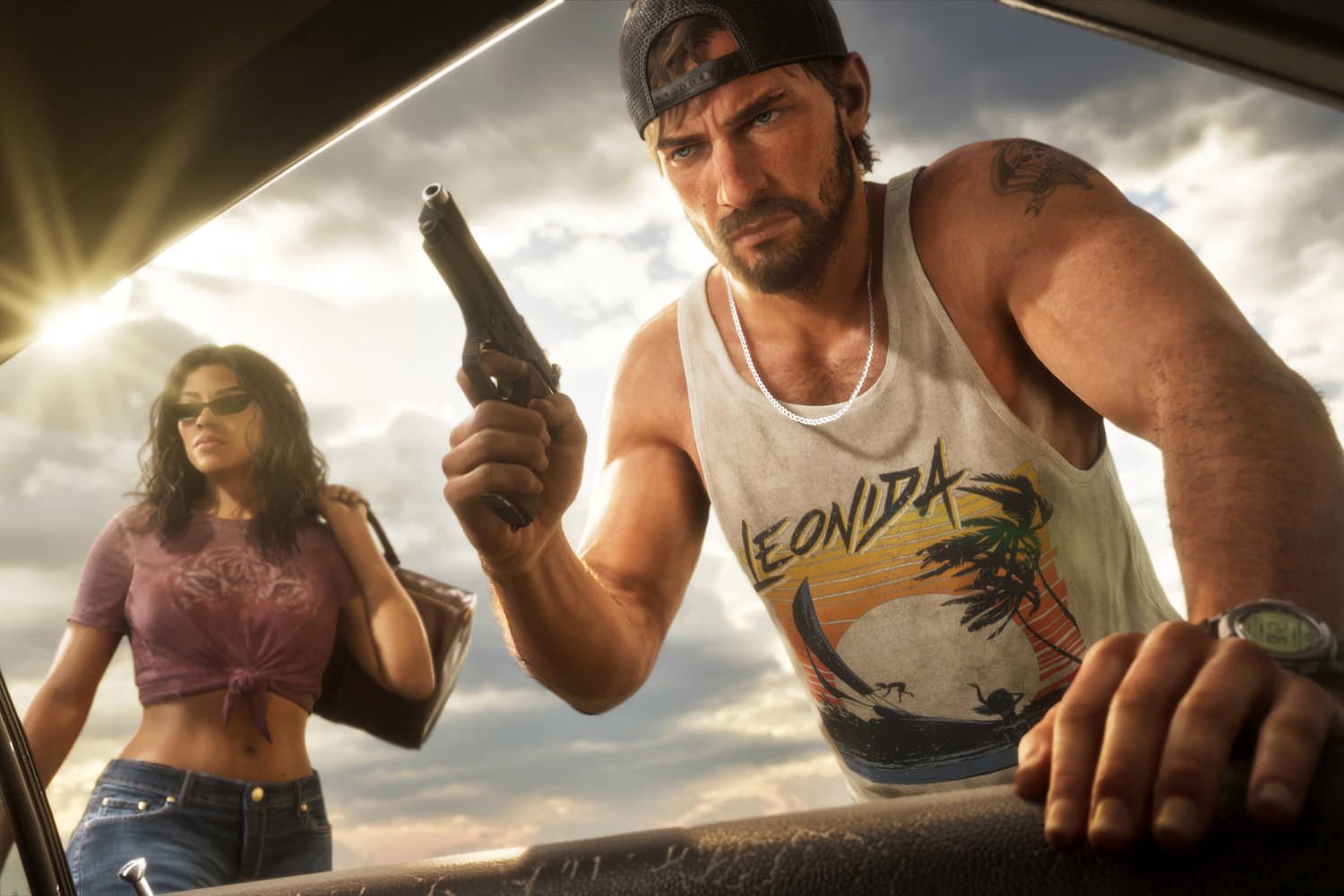
Thirteen years after Grand Theft Auto V first hit shelves on the PlayStation 3 and Xbox 360, Rockstar Games and parent company Take-Two Interactive are finally putting Grand Theft Auto VI in front of the public, carrying the financial weight of an entire struggling entertainment sector on its back. The launch is no longer just a routine sequel drop for a beloved franchise. It has morphed into a high-stakes referendum on whether bloated, decade-long AAA development cycles can still turn a profit when the audience itself has fundamentally changed how it consumes media.
Most coverage of this release treats the staggering thirteen-year gap between mainline entries as a badge of honor, proof of an uncompromising commitment to artistic perfection. That narrative misses the structural reality of modern game production. Rockstar did not spend thirteen years calmly polishing a single vision in a vacuum. The company spent the first half of that decade printing billions of dollars from Grand Theft Auto Online, a live-service cash machine that effectively eliminated any immediate financial pressure to ship a successor. When the studio finally pivoted full-scale resources toward Vice City and the state of Leonida, the technical demands of current-generation hardware, combined with a massive internal cultural overhaul, turned a standard development pipeline into an industrial marathon. If you found value in this piece, you should read: this related article.
The Invisible Cost of the Thirteen-Year Gap
To understand why Grand Theft Auto VI carries unprecedented risk, you have to look at the economics of the thirteen years that preceded it. When GTA V launched in September 2013, a top-tier blockbuster game could be built in three to four years by a few hundred people working across two or three regional offices. Today, building a photorealistic, hyper-reactive open world requires thousands of developers, animators, audio engineers, and quality assurance testers spread across global studios, working in lockstep for nearly a decade.
Every year a project stays in active production without generating revenue, the break-even threshold climbs higher. Industry analysts and financial disclosures from Take-Two Interactive point toward a production and marketing budget that dwarfs anything previously attempted in interactive entertainment, easily stretching into the hundreds of millions—and potentially crossing the billion-dollar mark when accounting for multi-year studio overhead and global promotional campaigns. For another perspective on this development, refer to the latest update from The New York Times.
The Live-Service Trap
Rockstar’s greatest triumph is also its heaviest anchor. Grand Theft Auto Online transformed the parent company’s balance sheet by turning a one-time $60 software purchase into a recurring digital economy built on Shark Cards and subscription tiers. For over a decade, millions of players logged in weekly to run criminal enterprises, race custom vehicles, and buy virtual real estate.
This creates a terrifying migration problem for Take-Two executives. When GTA VI launches, the company does not simply need players to buy the new box; it needs them to abandon years of accumulated digital wealth, social crews, and progress in Los Santos to start over in Leonida. If the next online component feels bare-bones at launch—a common pitfall for sequels replacing mature live-service titles—players could easily pocket the single-player campaign and retreat to the older game, fracturing the user base and stalling recurring revenue growth right when investors expect an immediate spike.
How Cultural Shifts Rewrote the Satire Playbook
Beyond spreadsheets and server architecture lies a creative dilemma that few studios have ever had to navigate at this scale. The Grand Theft Auto franchise built its empire on sharp, unapologetic parody of American excess, politics, media, and consumerism. Its humor relied on exaggerated caricatures that felt subversive in 2002 and pointed in 2013.
The world of 2026 is vastly harder to satirize than the world of 2013. Reality has spent the last decade outpacing fiction, leaving writers with very little room to exaggerate modern political absurdity, influencer culture, or viral internet stunts without simply holding up a mirror to Tuesday morning's news feed.
Internal restructuring at Rockstar complicated this creative balancing act even further. Following intense public scrutiny in 2018 over extreme crunch culture and hundred-hour workweeks, studio leadership overhauled its workplace environment. Senior creative voices departed—most notably co-founder and lead writer Dan Houser, alongside longtime producer Leslie Benzies and veteran writer Lazlow Jones. The studio replaced frat-house intensity with corporate stability, better work-life balance, and a more diverse writing room.
That transformation saved the company from internal burnout, yet it leaves an unavoidable question hanging over the finished product. Can a corporate-approved, committee-vetted production pipeline retain the razor-sharp, anarchic bite that made Grand Theft Auto a cultural phenomenon in the first place? Early trailers lean heavily into Florida-man viral madness, TikTok-style livestreams, and social media clout-chasing. It looks vibrant and hyper-specific, but sustaining that satirical edge across a forty-to-sixty-hour narrative without feeling dated by the time players reach the credits is a monumental writing challenge.
The Hardware Bottleneck and Technical Reality
Expectations around visual fidelity and world simulation have reached fever pitch, fueled by years of internet rumor mills and frame-by-frame trailer breakdowns. Players expect every building to be enterable, every non-player character to follow a unique daily routine, and every vehicle collision to deform metal with surgical accuracy.
Hardware reality imposes strict limits on those fantasies. Even on the PlayStation 5, Xbox Series X, and mid-cycle hardware upgrades, developers must make brutal compromises between frame rate, resolution, and world density. A massive, bustling city filled with hundreds of independent AI routines, dynamic weather systems, and ray-traced lighting pushes console CPUs to their absolute thermal limits.
Consider a hypothetical scenario involving a high-speed police pursuit down a crowded coastal highway at sunset. To render that single moment seamlessly, the game engine must simultaneously stream high-resolution textures off the solid-state drive, calculate physics for dozens of independent vehicles, run pathfinding algorithms for fleeing pedestrians, process spatial audio reflections off nearby concrete, and render volumetric light through exhaust smoke—all within 16.6 milliseconds per frame to maintain a stable 60 frames per second, or 33.3 milliseconds for 30 frames per second.
If Rockstar prioritizes visual density over frame rate, PC enthusiasts and competitive console players will complain about sluggish controls. If they strip back crowd density to hit higher frame rates, the world risks feeling sterile compared to the promotional footage. Furthermore, Rockstar’s historical strategy of delaying the PC version by a year or more to double-dip on sales means the most powerful consumer hardware will not even be part of the initial launch conversation, forcing the flagship release to live or die on fixed console architectures.
An Industry Holding Its Breath
The sheer gravitational pull of Grand Theft Auto VI has warped the entire video game calendar around itself. Over the past eighteen months, rival publishers quietly pushed releases out of the autumn window, terrified of having their marketing budgets obliterated and their player counts swallowed whole by Rockstar’s launch.
This is unhealthy for the broader ecosystem. An industry that relies on a single release every thirteen years to rescue quarterly hardware sales, boost digital storefront traffic, and validate the $70-to-$80 retail price point is operating on borrowed time.
- Retailers and console manufacturers are counting on the game to drive a massive wave of hardware upgrades from holdouts still playing on older systems.
- Third-party publishers are watching closely to see if consumers will accept aggressive pricing tiers, deluxe early-access windows, or expanded subscription models without triggering a massive PR backlash.
- Wall Street analysts have already baked record-breaking first-week sales figures into Take-Two’s stock valuation, leaving virtually zero margin for technical hiccups, server outages, or mixed critical reception.
When a single piece of entertainment carries expectations this absolute, merely being a great video game is no longer enough. A 9 out of 10 review score would be framed by financial markets as a disappointment. Anything short of an immediate, frictionless cultural takeover will trigger panicked headlines about the death of the blockbuster model.
The Illusion of Infinite Growth
Ultimately, the arrival of Grand Theft Auto VI exposes the core contradiction at the heart of modern AAA game development. The audience demands bigger maps, deeper mechanics, higher frame rates, and zero microtransaction friction, while the cost of building those experiences has grown exponentially faster than the size of the gaming audience itself.
There are only so many hours in a day, and Grand Theft Auto VI is not just competing against rival shooters or open-world RPGs. It is competing against Fortnite, Roblox, TikTok, Netflix, and the lingering shadow of Grand Theft Auto V itself. Capture the attention of the casual audience, and the financial gamble pays off in spectacular fashion, cementing Rockstar’s dominance for another decade. Stumble on launch stability, misjudge the humor, or fumble the transition into the next online ecosystem, and the resulting shockwave will force every major publisher in Los Angeles, Tokyo, and Paris to fundamentally rethink how big-budget games are financed and built.
The trailers are over, the countdown clocks have hit zero, and the marketing machine has done everything money can buy—now the code has to survive contact with millions of players at once.