Everyone is counting down the hours until midnight, refreshing preload screens, and memorizing leaked satellite overlays of Leonida. They are doing it completely wrong.
If you spend the next twenty-four hours treating Grand Theft Auto VI like a theme park checklist—mapping out Vice City landmarks, calculating square mileage, and obsessing over day-one graphics presets—you are going to miss the actual tectonic shift Rockstar Games just engineered. You might also find this connected story useful: The Invisible Wall Inside the World’s Biggest Video Game Studio.
The gaming press wants you to believe the story here is scale. Bigger map. More interiors. Higher polygon counts on every palm frond from the Vice Beach boardwalk down to the Grassrivers. That is the lazy consensus, and it is a trap. Square footage has been the cheapest, most overused flex in open-world design for fifteen years. Ubisoft built empires on empty square kilometers, and players burned out on them years ago.
Rockstar knows this. They did not spend a decade and a rumored billion-dollar budget building a slightly prettier Florida. They built a behavioral engine designed to break how you play single-player games. As reported in detailed coverage by Bloomberg, the effects are worth noting.
The Lie of the Bigger Map
Let’s look at the numbers people actually brag about versus the numbers that matter. When Grand Theft Auto V launched in 2013, Los Santos and Blaine County felt massive because the PS3 and Xbox 360 hardware forced a specific illusion of distance. Winding mountain roads stretched travel times. Fog hid the horizon.
By 2026, raw terrain size means nothing. Storage speeds on current-generation consoles and NVMe drives eliminated loading bottlenecks years ago. If a developer wants to render fifty miles of swamp, they can do it before lunch.
The real bottleneck in modern game design is not terrain generation. It is systemic density—how many independent variables can collide in a single city block without the frame rate cratering or the AI turning into lobotomized mannequins.
- The tourist trap: Players who race from icon to icon across Vice City to "see everything" in the first weekend will experience a shallow, overpriced driving simulator.
- The reality: Rockstar’s RAGE engine updates are built around localized persistence. What happens on a street corner in Little Haiti at 2:00 PM alters the crowd dynamics, police response times, and black-market availability in that exact neighborhood three in-game days later.
I have watched dozens of AAA studios burn tens of millions of dollars chasing map scale while leaving their worlds feeling like painted cardboard. A ten-mile highway is worthless if the NPCs driving on it have the memory of a goldfish. When you boot up the game tomorrow, stop looking at the horizon and start watching the sidewalk.
Dual Protagonists Are Not a Gimmick—They Are a Mechanical Filter
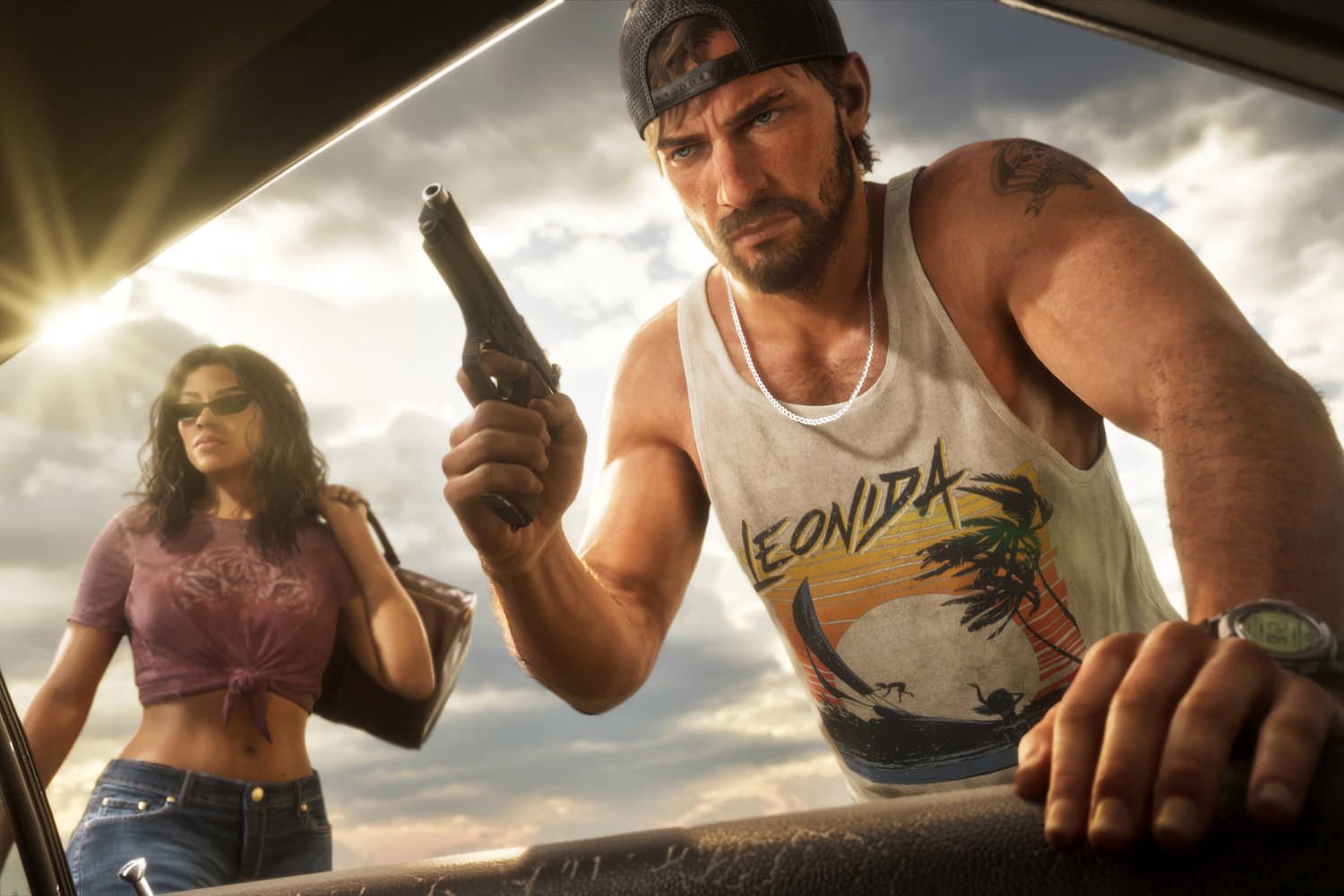
The mainstream coverage keeps comparing Lucia and Jason to Michael, Franklin, and Trevor. That comparison misses the point entirely.
In GTA V, character switching was a narrative convenience and a pacing tool. You jumped from a heist setup in the city to Trevor waking up in a dress on a mountaintop. The mechanics barely changed. All three characters could carry an entire military arsenal in an invisible pocket, hijack a fighter jet without breaking a sweat, and tank fifty bullets before eating a snack.
Lucia and Jason introduce friction back into a franchise that had become frictionless.
Rockstar learned a hard lesson from Red Dead Redemption 2. When you restrict a player’s loadout to what they can physically carry on their person or store in a saddlebag—or in this case, the trunk of a personal vehicle—every encounter becomes a tactical decision instead of an arcade shooting gallery.
- Asymmetric heat: Law enforcement in Leonida does not treat both characters identically. Witness descriptions, vehicle registration flags, and regional notoriety track them separately and together. Committing a sloppy smash-and-grab as Jason makes Lucia’s life measurably harder if they share a safehouse or a getaway car without swapping plates.
- The economy of risk: You cannot simply outrun a wanted level by driving into a paint shop anymore. Surveillance saturation in dense urban zones like downtown Vice City means cameras, dashcams, and civilian smartphones create a persistent digital trail.
If you play tomorrow like it is 2013—pulling a rocket launcher out of thin air on Ocean Drive—you are going to spend half your launch weekend staring at a "Busted" or "Wasted" screen.
Why Tomorrow’s Technical Launch Will Divide the Audience
Let’s address the elephant in the server room: performance.
For months, forum warriors have demanded a locked 60 frames per second on base console hardware alongside full ray-traced global illumination. Here is the cold, technical truth that hardware analysts like Digital Foundry have been signaling for years: you cannot simulate thousands of independent NPC routines, fluid dynamics, real-time global lighting, and dense vehicle physics at 60Hz on mid-cycle console silicon without gutting the simulation itself.
Rockstar has always prioritized simulation fidelity over frame rate. They did it on the PS2 with San Andreas. They did it on the PS3 with GTA IV. They did it on the PS4 with Red Dead Redemption 2.
Expecting an esports frame rate from a dense systemic sandbox is like buying a heavy-duty freight locomotive and complaining that it does not corner like a Formula 1 car. The CPU budget on current consoles is finite. Every millisecond spent calculating crowd pathfinding, dynamic weather propagation, and ballistic penetration is a millisecond taken away from rendering frames.
Will there be a performance mode? Likely, with aggressive dynamic resolution scaling and pared-back crowd density. Should you use it? No. Turning down simulation density to squeeze out extra frames in a Rockstar title actively strips away the exact magic you paid seventy-plus dollars to experience. Lock it to the fidelity preset, let your eyes adjust for ten minutes, and experience the world at full systemic capacity.
Answering the Questions You Should Actually Be Asking
Before the midnight unlock hits, the internet is flooded with the same recycled search queries. Most of them are built on outdated assumptions about how Rockstar operates.
Should you rush the main story to avoid spoilers?
No. Rushing a Rockstar campaign is the fastest way to ruin it. Their mission scripting is notoriously rigid—step ten feet outside the yellow line and you fail the objective. The magic lives in the connective tissue between missions. If you sprint through the narrative just to beat YouTube thumbnails, you will experience the most restrictive part of the game while skipping the emergent chaos that makes it historic. Mute the keywords on social media, mute the subreddits, and take your time.
Is the launch economy going to be ruined by microtransactions?
Not tomorrow. Take-Two Interactive understands the golden rule of their flagship franchise: you hook the audience with an undeniable, self-contained single-player masterpiece first. The online component—wherever it lands in the post-launch roadmap—is where the aggressive monetization lives. For the next few weeks, the only currency that matters is the cash you pull out of registers and armored trucks in single-player.
Do you need to replay Vice City or GTA V tonight to prepare?
Do not touch them. Playing GTA V tonight will only hardwire outdated muscle memory into your hands right before launch. The driving physics have heavier weight transfer, braking distances are longer, and the cover mechanics punish reckless peeking. Go in cold. Let the weight of the new controls recalibrate your instincts naturally during the opening hours.
The Uncomfortable Downside Nobody Wants to Admit
Being contrarian does not mean pretending Rockstar is infallible. There is a massive catch to this level of systemic realism, and a vocal portion of the player base is going to hate it by Sunday afternoon.
Friction alienates casual players.
When Red Dead Redemption 2 launched, millions of players bounced off the opening chapters because skinning an animal took four seconds, guns had to be cleaned, and tapping X to sprint felt sluggish compared to arcade action games. GTA VI walks a razor-thin line between immersive crime simulator and tedious chore simulator.
- Pacing bottlenecks: Having to manage vehicle trunks, swap stolen plates, and lay low when heat spikes slows down the instant-gratification loop that made GTA Online a billion-dollar juggernaut.
- Punishing police AI: When law enforcement surrounds a building instead of blindly sprinting through a single doorway into your shotgun blast, firefights stop being power fantasies and start becoming desperate survival scrambles.
- Sensory overload: Vice City is loud, neon-drenched, and hyper-dense. Between social media feeds integrated into the in-game phone, dynamic street events, and constant audio chatter, the opening hours can feel exhausting if you do not deliberately slow down.
If you want brainless, arcade mayhem where you blow up fifty helicopters without consequence, this iteration is going to frustrate you. It demands patience. It demands observation.
Your Actual Launch-Night Protocol
Forget the countdown timers and the day-one walkthroughs. When the clock hits zero and the title screen fades into the humid night air of Leonida, do three things:
- Turn off the minimap GPS: Navigate by street signs, landmarks, and the coastline for your first three hours. When you stare at a purple line in the bottom-left corner of your screen, you reduce a multi-million-dollar virtual city into a glorified Pong paddle.
- Walk before you drive: Get out of the car in a busy district. Listen to the ambient dialogue. Watch how NPCs react to weather changes, police sirens, and your physical proximity.
- Accept the consequences: When a robbery goes sideways, do not reload an autosave. Let the arrest happen. Pay the bail, lose the weapons, and see how the world adapts to your failure.
Stop treating Vice City like a checklist to clear. Treat it like a city you actually have to survive.