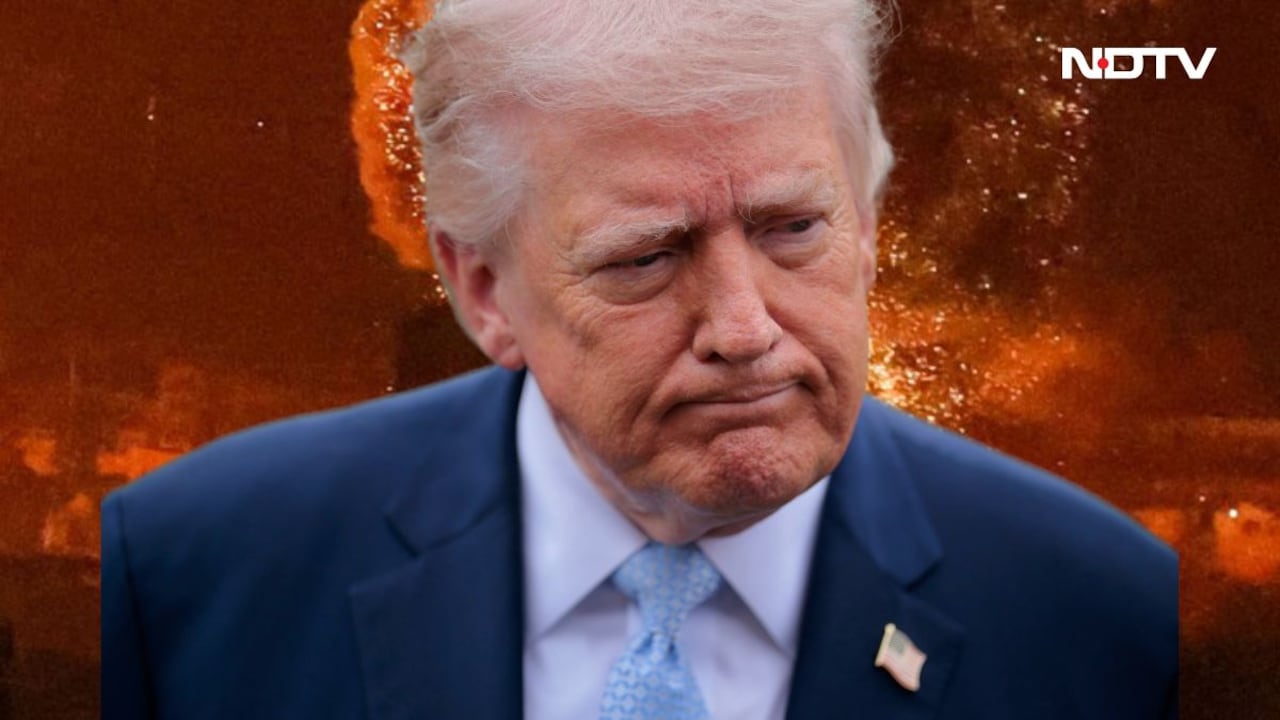
President Donald Trump vowed on Wednesday that the United States is going to "beat the fucking shit" out of Iran following a ballistic missile barrage targeting American positions at the Muwaffaq Salti Air Base in Jordan. This explosive rhetoric arrived hot on the heels of a collapsing diplomatic truce and a rapidly expanding theater of regional combat that defies easy containment. According to United States Central Command, the Islamic Revolutionary Guard Corps launched multiple ballistic missiles from Iranian territory in a midnight strike that gave American personnel mere minutes to respond. While Patriot batteries and air defense networks successfully intercepted the incoming ordinance, leaving zero immediate casualties, the political fallout has shredded any remaining illusions of a durable regional standstill.
Veteran intelligence analysts watching the situation unfold from Washington and European capitals recognize a familiar, highly volatile pattern. When direct state-on-state friction mixes with proxy network activation across Iraq, Syria, and the Gulf waterways, the margin for operational error shrinks to zero. Decades of watching successive administrations manage Tehran reveal a structural flaw in how Washington calculates deterrence. Verbal bravado and transient carrier group movements rarely alter the strategic calculus of a regime hardened by decades of economic isolation and asymmetric warfare.
The Anatomy of a Fractured Ceasefire
The path to this week's desert showdown was paved with broken diplomatic tracks and conflicting perceptions of a pause. Barely days before the Jordanian base incident, the White House signaled a temporary scaling back of air operations, framing the move as an opening for backchannel negotiations concerning the Strait of Hormuz. Tehran, however, viewed the landscape differently. Iranian military leadership maintained that no formal armistice had been agreed upon, pointing to ongoing maritime disputes and unacknowledged naval clashes in regional waters as active fronts.
This fundamental disconnect highlights a dangerous diplomatic hazard. When one side declares a unilateral humanitarian or tactical pause for domestic political consumption while the adversary interprets it merely as an operational regrouping window, conflict resumption becomes mathematically guaranteed. The midnight launch against American facilities in Jordan was not an isolated anomaly, but rather the predictable outcome of a stalled diplomatic process lacking mutual terms of engagement.
Behind closed doors, defense planners have long warned about the sustainability curve of prolonged regional air defense campaigns. Intercepting sophisticated ballistic missiles using high-end surface-to-air inventory creates an asymmetrical economic drain. Each defensive interceptor costs millions of dollars, while the incoming threat architecture relies on increasingly affordable mass production. When multiplied across multiple fronts involving allied partners like Saudi Arabia and regional logistics hubs, the logistics pipeline experiences severe strain long before political objectives are met.
Proxy Networks and the Iraqi Spillover
Simultaneously, the theater expanded northward as American and Saudi aircraft struck logistics and weapons depots tied to Iran-backed Shia militias inside Iraq. Describing these proxy groups as a cancer on global stability, the White House insisted these retaliatory strikes were coordinated closely with Baghdad. Yet, local political realities inside Iraq paint a far messier picture. Baghdad finds itself pinned between Washington's security demands and the heavy domestic political footprint of armed factions loyal to the Islamic Revolutionary Guard Corps ideological axis.
For a hypothetical illustration of this dilemma, consider a local security commander in central Iraq attempting to balance official state directives with neighborhood militias who command parallel administrative power. Direct foreign airstrikes on local logistics depots, even when targeted at illicit drone assembly sites, ripple through domestic parliamentary politics, empowering hardline factions and weakening fragile central governance structures.
The strategy of punishing state actors through proxy degradation assumes clear lines of command and control that rarely exist in practice. Tehran exercises strategic influence over these networks through funding, guidance, and specialized hardware, but operational autonomy at the tactical level often means local commanders can trigger escalations independently of central orders from Tehran.
The Logistics of Endless Confrontation
As rhetoric reaches a fever pitch and political stakes mount, the hard reality on the ground demands a sober assessment of military capacity. Pushing rhetoric into maximalist threats creates immediate audience engagement, but it backs executive decision-makers into a corner where inaction looks like weakness, yet full-scale war carries catastrophic economic and human tolls.
The immediate days ahead will test whether Washington and Tehran can step back from the brink or if the current spiral of retaliatory missile exchanges and targeted airstrikes hardens into a permanent state of open warfare. Intelligence assessments suggest that neither side desires a total regional conflagration, yet both remain trapped inside a feedback loop of mutual mistrust and escalatory posturing.
The tactical success of intercepting incoming ballistic missiles over Jordan provided a temporary shield against disaster, but defensive architecture cannot substitute for a cohesive, long-term diplomatic strategy. Until Washington confronts the structural limits of deterrence by volume and addresses the root mechanisms driving proxy proliferation, the cycle of sudden midnight strikes and fiery threats will continue to dictate the rhythm of Middle Eastern geopolitics.