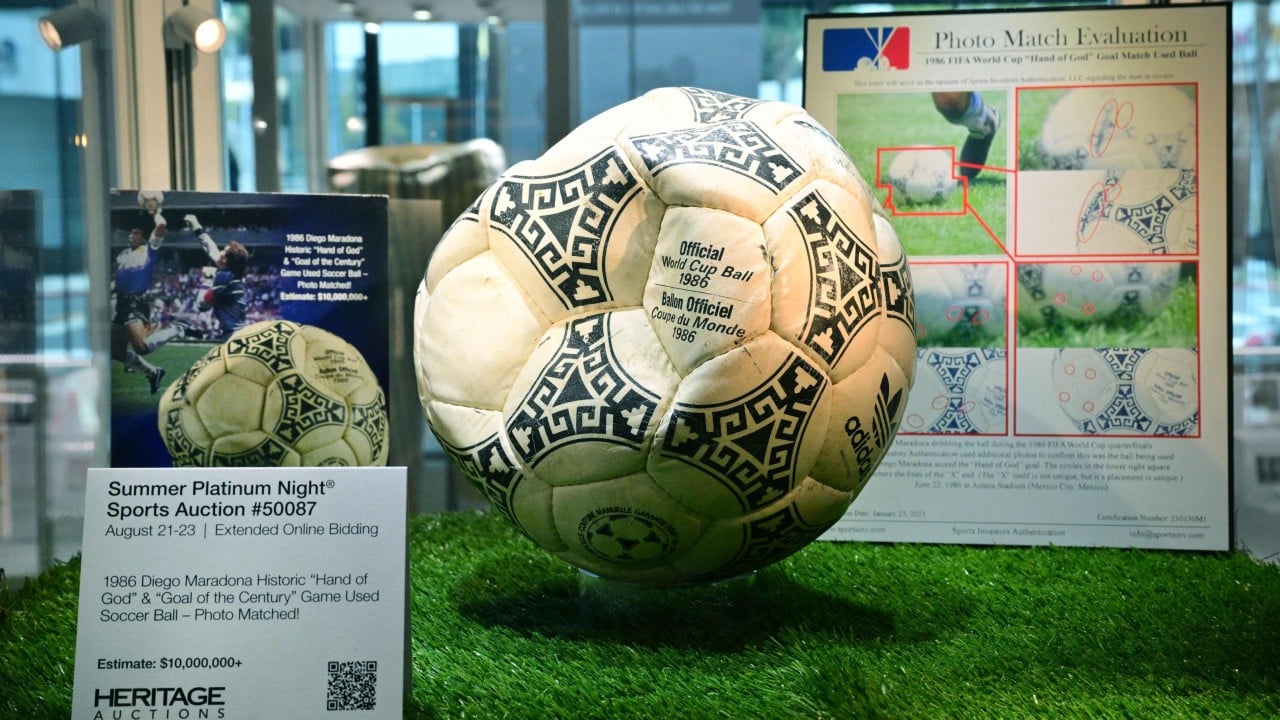
The official Adidas Azteca leather sphere that bore witness to the most cynical punch and the most sublime individual run in the history of international association football did not fetch ten million dollars. It fetched three million three hundred and fifty thousand dollars.
On a Saturday night in Dallas, Heritage Auctions dropped the hammer on the item that defined the 1986 World Cup quarter-final between Argentina and England. Auctioneers had pitched the artifact as an eight-figure asset. They envisioned a bidding war that would shatter records. Instead, the market offered a sharp, sobering correction. The final transaction price landed nearly seven million dollars below expectations, exposing the fragile economics of high-end sports memorabilia and the peculiar laws governing what collectors are actually willing to pay for historical infamy. Don't forget to check out our previous article on this related article.
To understand why a piece of sporting history carrying such immense cultural weight stalled out relative to its hype, one must look past the folklore of the Estadio Azteca. The pricing failure was not an accident. It was a masterclass in market overreach.
The Anatomy of a Ten Million Dollar Miscalculation
Auction houses love a clean narrative. Tunisian referee Ali Bin Nasser guarded the match ball for thirty-six years before parting with it in 2022, when it commanded two point three seven million dollars at a London auction. When the asset changed hands again, the subsequent attempt to flip it through online bidding failed to clear the reserve price. By the time Heritage positioned the ball for its summer showcase, the baseline had shifted. If you want more about the context here, The Athletic provides an in-depth breakdown.
The valuation team anchored their high-end estimates to entirely different asset classes. They looked at Diego Maradona’s match-worn blue jersey from the exact same fixture, which fetched an eye-watering nine point three million dollars at Sotheby’s. They looked at soaring baseball valuations, such as Shohei Ohtani’s historic home run ball fetching over four million dollars, or historic Babe Ruth garments commanding twenty-four million.
A jersey is personal. A jersey is worn on the skin, soaked in sweat, and intimately tied to the human form of the athlete who wore it. A football, by contrast, is an anonymous piece of equipment kicked by twenty-two players for ninety minutes. It touched Peter Shilton’s gloves. It brushed the turf. Most importantly, it made contact with Maradona's left fist.
Collectors understand this distinction intimately, even if auctioneers pretend they do not. An anonymous leather sphere lacks the visceral intimacy of a textile artifact. When the opening bid was set at two point five million dollars, the market recognized the ceiling long before the auctioneer drew breath.
The Geopolitics and Timing of Heritage Speculation
The timing of the sale carried its own hidden vulnerabilities. The auction block was timed to ride the coattails of global football excitement. Yet, relying on international tournament fervor cuts both ways. Argentina entered the broader sporting consciousness of the mid-2020s with immense weight, but when the national team stumbled or when broader macroeconomic conditions tighten discretionary spending on luxury collectibles, hyper-inflated valuations are the first casualties.
Furthermore, the item suffers from a fundamental narrative split. Half of its legacy is built on blatant cheating. When Maradona leaped into the Mexico City air on June 22, 1986, and used his hand to steer the ball past Peter Shilton, he birthed a permanent cultural grievance for English football fans. Four minutes later, he redeemed the controversy by scoring the Goal of the Century, weaving past five defenders on a seventy-meter run.
This duality creates a fragmented buyer pool. A British collector with deep pockets is rarely inclined to spend eight figures celebrating a moment where their national team was openly defrauded by a refereeing blind spot. Conversely, Argentine collectors, while fiercely devoted to the memory of El Pibe de Oro, operate within entirely different domestic economic realities that preclude bidding wars in the tens of millions of dollars. The target demographic was whisper-thin.
What Three Million Dollars Actually Buys in Modern Sport
Despite failing to meet fantastical projections, three point three five million dollars is not a failure by any rational metric of value. It represents a substantial upward tick from the two point three seven million dollars paid just four years prior. The market did not reject the item; it simply refused to indulge corporate fantasy pricing.
The sale confirms that authenticated artifacts carrying undisputed provenance will always command institutional interest. The ball had been meticulously photo-matched by experts, backed by signed documentation from the match referee, and vetted through decades of photographic archives. Its authenticity was never in doubt.
Yet, the transaction serves as a warning shot to the speculative tier of sports memorabilia. We are reaching a saturation point where auction houses attempt to manufacture historical significance through aggressive PR campaigns rather than organic market demand. When every historic match ball is marketed as a generational asset, the term loses its currency.
Diego Maradona remains a secular deity in Buenos Aires and a polarizing folk hero across the globe. His legacy is permanent, etched into the grass of the Azteca and the collective memory of anyone who ever watched him play. But the market for his possessions operates on cold calculus, not divine intervention. The Hand of God ball found its true price, and in doing so, it brought a hyper-inflated market back down to earth.