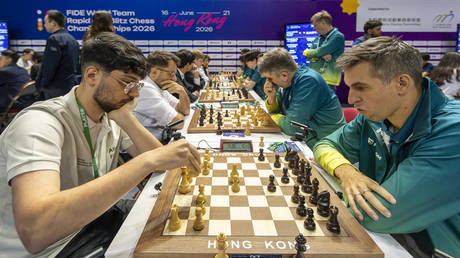
Silence has a weight in a tournament hall. It is not the absence of sound, but a dense, compressed atmosphere where every intake of breath feels like a disruption. Two players sit across a carved wooden battlefield, their eyes locked on a grid of sixty-four squares, wrestling with futures that hang on the placement of a single pawn.
Then, outside those doors, the real world breaks in.
The International Chess Federation recently made its stance final. Russian chess teams remain barred from the 2026 Olympiad. For the casual observer, it is a line item in a news cycle. For the grandmaster who spent decades memorizing opening theory in drafty Soviet-era sports schools, it is an absolute erasure.
Consider a hypothetical player, a young master from a provincial town near the Ural Mountains. Let us call him Dmitri. He does not control geopolitics. He does not sign decrees, fund campaigns, or draw borders. He only knows the Sicilian Defense, the nuances of rook endings, and the bitter taste of cold instant coffee during a six-hour match. Yet, when the governing bodies draw a hard line across the map, Dmitri finds his entire life's architecture collapsing. His passport becomes a barrier. His rating, earned through sweat and sacrifice, becomes an irrelevance.
This is what happens when administrative bans hit the ground. They do not target power; they target people whose entire identity is bound to a checkered board.
Competitive isolation changes the chemistry of a sport. Chess has always functioned as a global dialect, a universal language where a teenager from Buenos Aires and a veteran from Moscow can communicate through sacrifices, blunders, and brilliant counter-attacks without speaking a single shared word. When you lock one of the historic powerhouses out of the room, the conversation becomes impoverished. You are left practicing in an echo chamber.
History shows us that competitive walls rarely yield the intended harmony. During the Cold War, the board was a proxy battlefield, yet the players still sat face-to-face. Bobby Fischer and Boris Spassky did not just play chess in Reykjavik; they acted as human bridges between ideological monoliths that threatened to turn the planet to ash. The board forced them to look each other in the eye.
Now, the 2026 Olympiad approaches with a glaring vacancy. The Russian teams, historically dominant across both the open and women's sections, are locked outside.
To understand why this stings so deeply, you have to understand the psychology of a professional competitor. Training for an Olympiad is an act of consuming devotion. It means waking up at dawn to analyze engine lines, spending months dissecting the subtle psychological profiles of potential opponents, and sacrificing personal relationships for the microscopic chance of holding a gold medal. When that goal is administratively canceled, the psychological fallout is devastating.
Imagine spending four years preparing for a marathon, lacing up your shoes at the starting line, only to be told your nationality disqualifies you from running. The track is still there. The finish line is still painted in bright white. But you are ordered to stay behind the barrier.
Critics will argue that actions have consequences, that sports cannot remain insulated from the tragedies unfolding in the real world. That argument carries a cold, logical truth. But it misses the human tragedy happening underneath the institutional decree. Grandmasters are caught in a crossfire of decisions made in boardrooms thousands of miles away from the nearest chess clock.
The tournament will go on. Games will be played in 2026. Trophies will be raised, anthems will play, and new champions will etch their names into the history books.
Yet, every expert watching the top boards will feel the ghost of an absence. They will look at certain complex, brilliant tactical sequences and wonder how a particular Russian prodigy would have handled the pressure. They will look at the final standings and asterisk the triumph with the sobering reality that the tournament was played with an empty chair at the table.
Silence fills that chair now. It is heavy, cold, and permanent, waiting for a day when the pieces can move again, and humans can finally remember how to speak across the board.