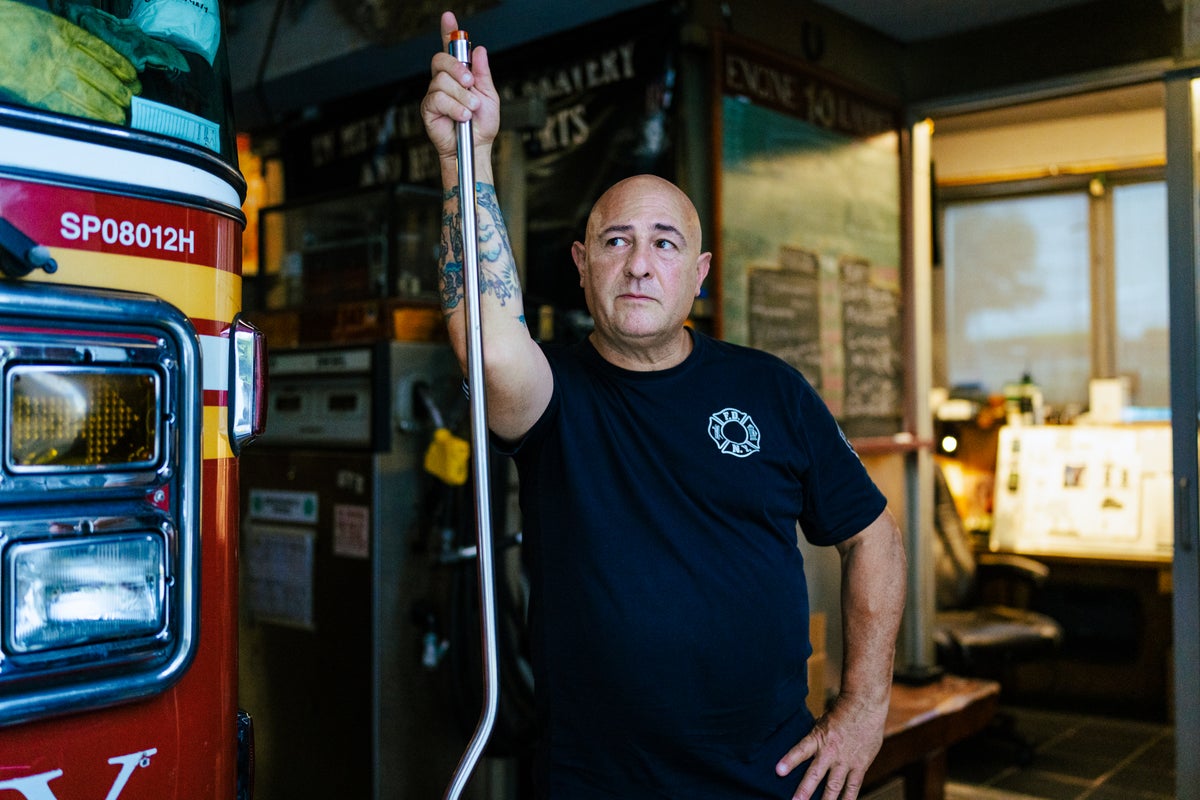
The heavy red doors of Ten House, sitting directly in the shadow of where the World Trade Center towers once pierced the Manhattan sky, conceal an institutional memory that is rapidly fading into history. For decades, fire stations across New York City have functioned as tight-knit surrogate families, living quarters where meals are cooked collectively, gear is checked with silent routine, and trust is absolute. Yet within Engine 10 and Ladder 10, that culture carries an exceptional, agonizing weight. Sal Argano walks across the apparatus floor today as an anomaly. He is the final active-duty firefighter still stationed there who was assigned to the house when the calendar turned to September 2001.
Survival in catastrophic events often comes down to an arbitrary flick of administrative scheduling, a random rotation that pulls one man away while sending his brothers into the crucible. Argano missed the initial dispatch on that Tuesday morning because a routine transfer had temporarily placed him elsewhere. That administrative twist spared his life while wiping out an entire cohort of colleagues who rolled out of those very bay doors into history and eternity. Two and a half decades later, that twist of fate has left him occupying a solitary space between past grief and present reality. He is a living bridge to an era that the rest of the world increasingly views through museum glass and anniversary documentaries.
Understanding what it means to be the last man standing requires looking closely at the mathematics of loss within the Fire Department of New York. On that single morning, 343 members of the department made the ultimate sacrifice, an unprecedented structural collapse that forever altered the psychological landscape of emergency response. Firehouses like Ten House bore an unimaginable brunt. When the dust settled, the roster was decimated. Replacements arrived in waves over the ensuing months and years, young probationary firefighters eager to serve, yet stepping into a vacuum of institutional knowledge and phantom pain.
The physical architecture of a fire station changes when the veterans disappear overnight. Every rookie who walks through the door absorbs the mythology of the place, but they do not share the muscle memory of the lost generation. They learn about the layout of lower Manhattan skyscrapers from manuals and updated digital mapping systems, rather than the intuitive, boots-on-the-ground familiarity of men who knew every rivet and stairwell of the original Twin Towers. Argano has watched generations of new faces cycle through the bunchems and the kitchen table. He has witnessed young men arrive fresh out of the academy, complete their tours, promote, retire, or transfer out, while he remains anchored to the exact geographic coordinates of his deepest trauma.
Survivor guilt is rarely a loud, cinematic breakdown. Most often, it manifests as a quiet, relentless internal audit. Why him? Why not the man standing next to him in line? Argano admits to thinking about that rotation constantly. It is an uninvited guest that sits at the kitchen table during quiet night shifts when the city outside quiets down and the sirens grow sparse. Psychologists who specialize in first responder trauma note that cumulative chronic stress and survivor syndrome do not diminish simply because years accumulate on the calendar. Instead, they compound as the survivor ages, watching younger colleagues treat the defining catastrophe of his generation as a historical event found in a textbook rather than a lived memory.
The neighborhood surrounding Liberty and Church Streets has transformed beyond recognition over the past twenty-five years. Glass-and-steel monoliths replaced the smoking ruins of Ground Zero, and hordes of tourists now stream past the Ten House memorial wall daily, snapping photographs and reading names etched in bronze. For a veteran firefighter, this relentless commercialization and sanitization of a sacred space creates a strange dissonance. The world moved on to corporate rebuilds and urban tourism, while inside the firehouse, the clock remains permanently fixed to the morning the sky fell.
Managing the psychological burden of being a sole survivor involves an invisible form of emotional labor. Every September, the media descends upon Ten House like clockwork, shoving microphones into faces and asking men to excavate their worst moments for the consumption of an audience that will pack away the remembrance ribbons by sundown. The rest of the year offers little reprieve, as every routine run into a high-rise building or heavy smoke condition triggers the visceral mechanics of memory. Modern firefighting equipment has improved, and tactical protocols have evolved significantly since 2001 based on the lessons bought with blood that day, but the underlying vulnerability of the profession remains unchanged.
As Argano approaches the twilight of his career, his impending departure will mark a definitive closing of the book for Ten House. When the last of the 2001 personnel hangs up his bunker gear for good, the firehouse will enter a completely post-survivor era. The institutional memory will pass entirely into text, photographs, and oral histories handed down through second- and third-hand accounts. That transition raises difficult questions about how organizations maintain their soul once the direct witnesses are gone.
The physical scars of that era are matched by the hidden health crises that continue to claim first responders decades later. Toxic particulate matter hung in the air over lower Manhattan for months, a lethal cocktail of pulverized concrete, asbestos, heavy metals, and burning jet fuel that settled deep into the lungs of everyone who worked the pile. Thousands of rescue workers have since fallen ill to respiratory diseases and cancers linked directly to that exposure. Surviving the initial collapse was only the first hurdle; beating the slow-moving physiological fallout has proven to be an equally brutal secondary battle of attrition for the department.
Through it all, the apparatus floor stays ready. Bells ring out, diesel engines rumble to life, and the heavy red doors lift to let another crew out into the traffic of a relentless city. Sal Argano pulls on his boots, standing in a room full of ghosts and newcomers alike, carrying a lineage that few living humans can comprehend. The shift continues, uninterrupted by the passage of time or the weight of history.