Gravity is a violent introduction to the universe.
For a creature born six feet in the air, the first day of life begins with a drop. There is no gentle transition from the warm, fluid silence of the womb to the sun-baked dust of the savannah. There is only a sudden, lung-searing gasp of dry wind, a bewildering array of shapes moving against
The Long Fall To Life
news, lifestyle
Gravity is a violent introduction to the universe.
When a giraffe gives birth, she does not lie down in a sheltered den or a soft meadow. She stands. Towering six feet above the scorched earth, she carries her calf for fifteen months in the high air of the savanna, enduring the searing heat, the stalking predators, the quiet endurance of the wild. And then, when the time comes, she delivers her young while standing upright.
The first thing a newborn giraffe experiences is a six-foot drop.
It is a sudden, unceremonious eviction from the warm, liquid safety of the womb straight onto sun-baked dirt. There is no cushion. There is no gentle lowering. Just a long, terrifying fall, a tangle of gangly limbs hitting the ground with a dull thud, and a sharp gasp of dry air filling uninitiated lungs.
For anyone who watched television anchor David Muir share the footage captured by wildlife conservationists, the moment was undeniably mesmerizing. A calf taking its first shaky, trembling steps into the world, guided by the immense, quiet patience of a mother who knows the clock is ticking. In the wild, vulnerability is a neon sign. A newborn lying still on the open plains is an invitation. Hyenas, lions, leopards—they are always watching, calculating the margins of life and death.
Every second matters.
Within minutes of that violent landing, the calf must do something that defies every instinct of muscle and bone: it must stand up.
Consider the anatomy of the challenge. A newborn giraffe stands roughly six feet tall even before its neck stretches toward the acacia trees. Its legs are absurdly long, thin as broom handles, trembling with the fatigue of birth and the shock of impact. When the little one first tries to push itself up, the knees buckle. The hooves slide apart on the loose dust. It pitches forward, collapses, and lies still for a heartbeat, gathering whatever ancient strength is encoded in its DNA.
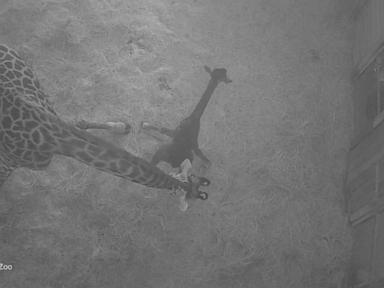
The mother watches. She does not smother the calf with affection, nor does she scream in panic. Instead, she steps closer. She places her massive, hoofed foot gently near the infant, offering a physical barrier against the sloping ground, a steady pillar in a world that is spinning too fast. Then, with a tenderness that defies her massive proportions, she nudges the baby.
Get up.
It takes multiple attempts. Each failure looks agonizingly final. The legs wobble like loose scaffolding. The head, heavy and uncoordinated, lolls back and forth. Tourists and casual viewers watching the clip on evening news segments often marvel at the physical grace of the species, forgetting the brutal mechanics required to achieve it. Grace is not an inheritance; it is a survivor's reward.
When the joints finally lock, when the trembling stops for just long enough to distribute the weight across four impossibly thin stilts, the calf stands. It is a victory witnessed by few outside the harsh theater of nature.
Yet, standing is only the first trial.
The savanna does not wait for grace to be perfected. A standing calf is visible for miles. The herd is restless; resources are scarce, and lingering in one spot draws unwanted attention from the periphery. Within an hour of birth, the mother must convince her newborn to walk. She nudges it forward, pacing slowly, forcing the long legs to swing one after another in a clumsy, endearing rhythm that looks like a marionette learning to dance without strings.
There is an unspoken poetry in this brutal efficiency. Life demands immediate competence from those who have the least capacity to give it.
When David Muir broadcast those initial, clumsy strides to millions of viewers across screens in quiet living rooms, he was showing more than just a cute animal video. He was broadcasting an elemental truth about existence. We are all, in our own ways, dropped onto hard ground without warning. We are handed challenges that feel too heavy for our frames, expected to stand up before our legs have learned how to hold us, and forced to walk before we know where we are going.
The mother giraffe does not catch her baby as it falls. She cannot soften the impact of reality. What she does instead is far more powerful: she stands right beside it, massive and unyielding, ready to nudge it back toward its own feet the moment it stumbles.
The sun dips low over the dry grass, casting long, bruised shadows across the plains. The herd moves slowly toward the tree line, a procession of towering silhouettes against a painted sky. Among them, walking with a slightly unsteady but determined gait, is a new life that survived the fall.