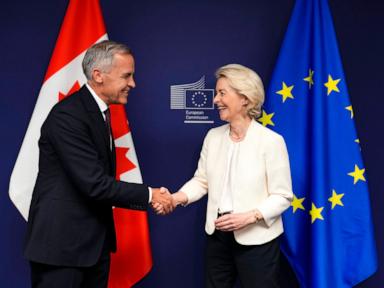
Canadian Prime Minister Mark Carney has pushed forward an unexpected geopolitical realignment, opening talks for Canada to become the first associate member of the European Union as a high-stakes countermeasure against crippling trade tariffs and annexation threats from Washington. This seismic policy shift, unfolding amid a deepening trade war with the United States, represents a desperate economic pivot by Ottawa to secure its supply chains, protect its industrial base, and reduce a staggering dependence on its southern neighbor. But beneath the diplomatic headlines lies a grinding bureaucratic and political battle over sovereignty, regional resistance within Europe, and the harsh realities of transatlantic logistics.
For decades, the border between Canada and the United States functioned as an afterthought for commerce. Goods moved with minimal friction across the 49th parallel, treating two sovereign nations as an integrated economic engine. That engine has seized up. When the White House weaponized tariffs, threatened sweeping import bans, and revived rhetoric regarding northern annexation, Ottawa realized the baseline assumption of continental security was broken.
The summit in Montreal served as the theater for this dramatic departure. Prime Minister Carney and European Commission President Ursula von der Leyen stood side by side to outline a framework that would anchor Canada closer to Brussels than any non-European state has ever managed. Yet, the road from political theater to institutional reality is fraught with obstacles that few commentators are willing to acknowledge.
The Anatomy of Economic Vulnerability
Bilateral trade dependence is an addiction that cannot be broken overnight. Statistics reveal the gravity of the crisis. Approximately seventy-two percent of all Canadian exports head south, accounting for roughly twenty percent of the nation's total gross domestic product. When a superpower alters its trade posture with arbitrary penalties, the shockwave hits every corner of the Canadian economy, from automotive assembly lines in Ontario to energy corridors in the West.
The U.S. tariff regime targeted steel, aluminum, and manufactured goods with surgical malice. For workers in industrial sectors, the fallout was immediate. Plants idled. Margins evaporated. The federal government faced mounting panic from provincial premiers who watched local tax bases wither under the weight of trade hostility.
Ottawa needed a counter-weight of massive proportions. Turning to Europe was the only viable geopolitical play, but it required abandoning decades of diplomatic inertia. The Comprehensive Economic and Trade Agreement, known as CETA, had already lowered numerous barriers years prior, but it was never designed to withstand a full-scale economic assault from Washington. CETA was a trade deal. Associate membership is an institutional entangling.
Inside the European Resistance
Brussels is not a monolith. While the European Commission under von der Leyen welcomed the Canadian overture as a bold defense of multilateralism, individual member states recoiled at the procedural nightmare.
Germany, France, Italy, and Greece quickly signaled deep skepticism. The hesitation stems from a fundamental fear of diluting the European Union's complex internal architecture. Countries spend decades enduring punishing accession criteria, structural reforms, and judicial harmonization to earn full membership. Extending an unprecedented "associate" status to a North American G7 nation creates a dangerous precedent.
Diplomatic cables leaked during the late October negotiations exposed intense friction. Several capitals pushed back against the very phrasing of the proposal, forcing diplomats to water down initial joint statements from "associate membership" to commitments toward an "ever-closer association".
This linguistic retreat matters. It highlights the reluctance of European capitals to offer legal guarantees or defense obligations that could drag them into North American geopolitical disputes. Europe faces its own continental pressures, including security crises on its eastern flank and rising internal political fragmentation. Taking on Canada as a quasi-member introduces liabilities without offering the geographic cohesion that binds traditional EU states.
The Logistics of Transatlantic Reorientation
Proponents of the partnership speak of shared values, democratic resilience, and market diversification. Skeptics point to a map.
Ocean freight cannot replace continental trucking corridors overnight. Canada's physical infrastructure is built north-south, not east-west. Rail lines funnel resources toward the American market. Pipelines feed American refineries. Shifting supply chains toward European ports requires billions in capital expenditure and years of heavy construction.
Consider the automotive sector. Modern car manufacturing relies on parts crossing the border multiple times before a vehicle rolls off the assembly line. Shipping components across the Atlantic for subassembly and returning them to North American consumers violates every rule of economic efficiency.
Furthermore, regulatory alignment poses a monumental hurdle. The European Union operates under strict directives regarding data protection, environmental standards, and agricultural safety. Canada's regulatory framework has historically aligned more closely with North American standards. Harmonizing with Brussels while maintaining integration with the United States creates an impossible compliance loop for domestic corporations. Companies would find themselves trapped between two contradictory legal universes, driving up administrative overhead and killing competitiveness.
Political Survival in Ottawa
Domestic politics dictated the timing and intensity of Carney’s European pivot. Public anxiety reached a fever pitch as trade hostilities escalated. Citizens watched essential research grants get canceled by Washington, while threats of annexation shifted from fringe rhetoric into mainstream political commentary.
Yet, Canadian unity is rarely monolithic. Western provinces, particularly Alberta, viewed eastern-led federal initiatives with deep suspicion. However, public sentiment delivered a surprise during recent local referendums, where a decisive majority of Albertans rejected separatist impulses and voted to remain firmly within the federation. The external threat galvanized public support around national survival, giving Carney the political capital to look across the Atlantic.
Critics argue this entire diplomatic maneuver is a smoke-and-screen exercise designed to boost domestic morale and extract concessions from Washington. If Canada appears capable of pivoting away from the North American market, American negotiators might think twice before maintaining destructive tariffs.
This theory has merit, but it carries severe risks. Bluffing with superpowers is a high-stakes poker game. If Washington calls the bluff and Ottawa fails to deliver concrete European integration, the federal government will look weak, isolated, and economically vulnerable.
The Ghost of Past Trade Shifts
Canada has faced continental crossroads before. During the late nineteenth century, the National Policy attempted to insulate the young dominion from American economic dominance by building east-west rail links and imposing protective tariffs. That experiment yielded mixed results because geography ultimately dictates economics. Goods flow along the path of least resistance. Water runs downhill. Population centers align with proximity.
Attempting to review and reverse a century of deep integration defies the fundamental laws of economic gravity. When factories in Ontario depend on raw inputs from Ohio and Michigan, substituting those inputs with materials from Germany or Poland introduces friction that can cripple profit margins. Business owners do not make purchasing decisions based on geopolitical solidarity; they calculate ledger sheets.
To make an associate relationship functional, Ottawa must subsidize infrastructure on an unprecedented scale. Deep-water ports on the St. Lawrence Seaway and the Atlantic coast require modernization. Rail corridors must be doubled in capacity to handle east-west freight without bottlenecks. Without these physical upgrades, any diplomatic framework signed in Brussels will remain an empty shell, good for press conferences but useless for cargo handlers.
Furthermore, the defense dimension cannot be ignored. Europe is currently rearming in response to its own security threats. If Canada seeks closer institutional ties with the European defense apparatus, it must contribute tangible military assets. Decades of chronic underfunding have left the Canadian Armed Forces strained, underequipped, and struggling with recruitment. Aligning with European security architectures means writing checks that federal budgets have historically refused to cash.
The Cost of Living Beyond the Continental Orbit
Strategic autonomy is an expensive pursuit. For generations, Canada enjoyed the luxury of American defense umbrellas and frictionless continental trade, allowing it to underinvest in its own military capabilities and export infrastructure.
That era has closed. True associate status with Europe, whatever legal form it ultimately takes, demands financial commitments. It requires boosting defense spending to meet NATO obligations, upgrading maritime ports to handle high-volume container traffic directly with Rotterdam and Antwerp, and rewriting complex trade treaties that currently require unanimous ratification by individual European legislatures.
The alternative is worse. Surrendering to economic coercion from Washington means accepting a subordinate status where national sovereignty is eroded piecemeal. Carney's administration chose the harder path, betting that long-term diversification outweighs short-term disruption.
As bilateral committees begin the arduous task of drafting what an ever-closer association actually means in legal text, the reality of the challenge sets in. The Atlantic Ocean is wide, bureaucratic Brussels is slow, and the American market remains an inescapable gravity well.
Canada Pursuing European Union Associate Status
This video outlines the foundational mechanics behind Ottawa's unexpected diplomatic push to secure closer trade and defense ties with European leaders.
Ottawa's gamble will not be judged by the rhetoric delivered at high-profile summits, but by whether cargo ships loaded with Canadian goods sail east while the southern border remains hostile.