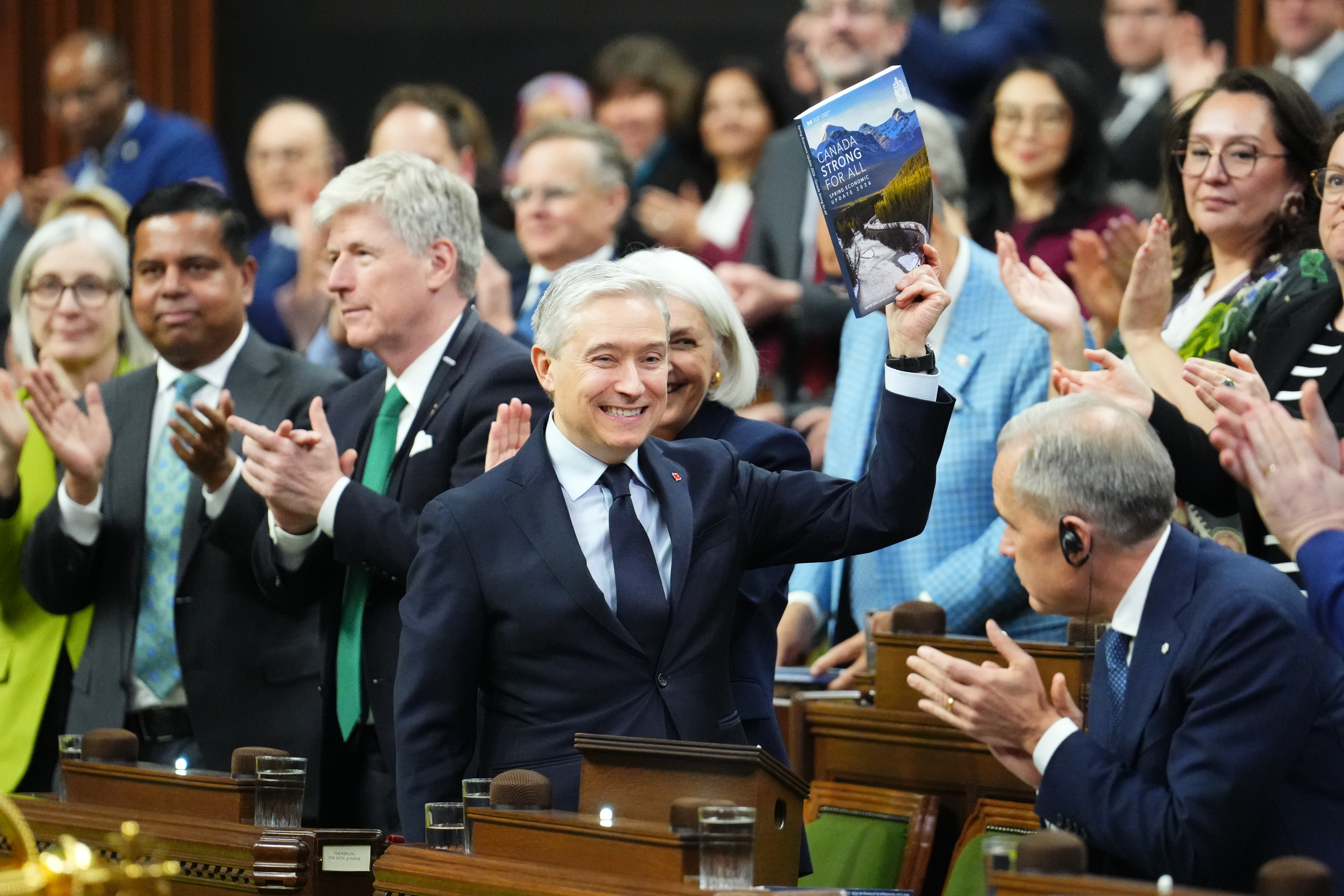
Mark Carney’s recent spring economic update was presented as a blueprint for growth, but beneath the polished delivery lies a troubling set of figures that suggest Canada is doubling down on a low-productivity model. While the headlines focused on billion-dollar pledges for AI and housing, the real story is found in the widening gap between government spending and private sector investment. The numbers don't lie. Canada’s GDP per capita has been shrinking for several consecutive quarters, a trend that this latest update fails to reverse despite the optimistic rhetoric.
We are witnessing a structural shift where the state is attempting to command economic outcomes through targeted subsidies rather than broad-based incentives. This isn't just a policy choice; it is a fundamental gamble on the efficiency of bureaucratic capital allocation.
The Productivity Trap Hidden in Plain Sight
For decades, the standard for a healthy economy was a balance between public infrastructure and private innovation. That balance is now gone. The spring update reveals a reliance on government-led growth that essentially cannibalizes the private sector’s ability to compete.
When the federal government announces a $2.4 billion package for artificial intelligence, it sounds like progress. However, this capital is often tied to specific mandates and compliance frameworks that slow down the very speed-to-market that tech firms require. Instead of letting the market find the winners, the government is trying to build them in a lab. The result is often "zombie firms" that survive on grants rather than value creation.
Why Capital is Fleeing the Border
Money goes where it is treated best. Currently, it is not being treated well in Canada. The spring update’s adjustments to capital gains taxes are perhaps the most damaging signal to global investors. By increasing the inclusion rate for corporations and individuals with high gains, the government is essentially raising the cost of exit for entrepreneurs.
Think of a hypothetical startup founder. If they spend ten years building a company and face a significantly higher tax bill upon sale compared to a founder in Texas or Singapore, the logical move is to relocate the business before it becomes successful. This isn't theoretical. We are seeing a steady drain of intellectual property and leadership to jurisdictions that reward risk rather than penalizing it.
The Housing Math That Still Does Not Add Up
Housing remains the primary anchor dragging down the Canadian economy. The spring update promised a massive injection of supply, yet the math remains stubbornly disconnected from reality. To meet current demand and restore affordability, Canada needs to build roughly 3.5 million additional homes by 2030.
The update’s funding for pre-fabricated housing and secondary suites is a drop in the bucket. The real bottlenecks—municipal zoning, high interest rates, and a shortage of skilled trades—cannot be solved with a federal checkbook alone. In fact, by pumping more subsidized credit into the system without fixing the supply constraints, the government risks keeping prices artificially high.
The Infrastructure Deficit
We cannot build homes if we cannot move people or power. The update mentions "green" infrastructure, but the timelines for major projects like mines or pipelines remain bogged down in regulatory uncertainty. An investor looking at a twenty-year horizon for a copper mine in Ontario sees a wall of red tape that no amount of spring-update "streamlining" has yet dismantled.
The Interest Rate Mirage
The Carney-aligned vision relies on the assumption that interest rates will eventually settle into a "new normal" that allows for manageable debt servicing. This is a dangerous assumption. With the federal debt-to-GDP ratio hovering at levels that leave little room for error, even a slight sustained increase in global bond yields could force a choice between austerity and currency devaluation.
The government is currently spending more on debt interest than it is on many core social programs. This is "dead money." It doesn't build roads, it doesn't hire nurses, and it certainly doesn't innovate. Every dollar sent to bondholders is a dollar taken out of the productive economy.
A Nation of Rent Seekers
The most subtle but dangerous takeaway from the spring update is the shift toward "rent-seeking" behavior. When the government becomes the largest source of available capital, businesses stop looking for customers and start looking for lobbyists. They spend their energy navigating tax credits and grant applications rather than improving their products.
This cultural shift is hard to quantify but easy to observe. Go to any major industry conference in Canada, and you will hear more talk about "government alignment" than about "market disruption." This is the hallmark of a stagnant economy. It is a system that protects the incumbents and punishes the upstarts.
The Missing Middle of Canadian Business
Canada has a few massive banks and telecom giants, and many tiny startups. What it lacks is the "Mittelstand"—the mid-sized, export-oriented companies that drive the German or Swiss economies. The spring update does nothing to address the "scaling gap." It provides seed money but creates a tax and regulatory environment that makes it nearly impossible for a company to grow from 50 employees to 500 without being acquired by a foreign entity.
Inflation is a Policy Choice
While the Bank of Canada fights inflation with the blunt instrument of interest rates, the federal fiscal policy is pulling in the opposite direction. Continued high spending during a period of supply constraints is inflationary by definition. The spring update, by adding billions in new spending, essentially forces the central bank to keep rates higher for longer.
It is a tug-of-war where the taxpayer is the rope. One side of the government is trying to cool the economy, while the other side is pouring gasoline on the fire to win votes. This lack of coordination creates a volatile environment where business planning becomes impossible.
The False Promise of the AI Subsidy
Let’s look closer at the $2 billion-plus earmarked for AI. In a global market dominated by trillion-dollar giants like Microsoft, Google, and Nvidia, a $2 billion government fund is rounding error. More importantly, AI is not something you can buy off a shelf and install like a piece of software. It requires a massive amount of cheap, reliable energy—something Canada is currently making more expensive through carbon pricing and the slow phase-out of traditional power sources without adequate replacements.
Without the underlying power grid and the data center infrastructure, these AI grants will likely result in Canadian researchers using government money to buy computing power from US-based cloud providers. The wealth transfers south; the debt stays here.
The Burden on the Next Generation
Ultimately, the spring update is an exercise in intergenerational wealth transfer. We are borrowing from the future to subsidize the present. The young professionals in Vancouver or Toronto who cannot afford a home are also the ones who will be tasked with paying down the debt being accrued today.
They are being handed a bill for a party they weren't invited to. When you look at the migration patterns of Canadians aged 25 to 35, the data shows an increasing number are looking for the exit. They are moving to the US, to Europe, or to the Middle East—anywhere where the math of hard work actually results in ownership and savings.
Real Growth vs. Statistical Noise
Governments love to cite total GDP growth because it is easy to inflate through population increases. If you add a million people to a country, the total economy will likely grow. However, if the GDP per person is falling, everyone is getting a smaller slice of a slightly larger pie.
Canada has been masking its underlying economic weakness with record-high immigration levels. While immigration is a net positive for cultural and long-term demographic reasons, using it as a short-term patch for labor shortages and GDP growth is a strategy with diminishing returns. It puts immediate pressure on the housing market and healthcare systems that the spring update’s funding cannot possibly match in real-time.
The Path to Actual Recovery
If we wanted a real economic update, it wouldn't involve more spending. It would involve a massive simplification of the tax code. It would involve the elimination of internal trade barriers between provinces, which currently cost the Canadian economy billions in lost efficiency. It would involve a regulatory environment that permits a bridge or a mine to be built in months, not decades.
None of those things require a billion-dollar line item. They require political courage. They require the government to admit that it is not the engine of the economy, but rather the tracks upon which the engine runs. Currently, the tracks are broken, and the conductor is busy painting the train a new color.
The spring update confirms that the current leadership believes the problem is that they haven't spent enough yet. They are doubling down on a strategy that has already resulted in a decade of stagnant wages and a housing crisis. Until the fundamental math of investment and productivity is addressed, no amount of "updates" will change the trajectory.
The numbers are clear, and they are pointing toward a slow, managed decline. Unless the private sector is unshackled from the burden of being the government's primary funding source, the "spring" promised in this update will likely be a very long winter.
Stop looking at the announcements. Start looking at the outflows of capital. The smartest money in the room is already halfway to the door.


