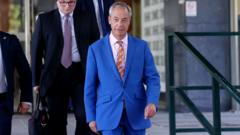
The British political establishment is having another collective meltdown over VIP security. This time, the outrage machine is fueled by Robert Jenrick’s assertion that the government is failing Nigel Farage by denying him taxpayer-funded protection from the Executive Committee for the Protection of Royalty and Public Figures (RAVEC). It is a classic piece of political theater: a populist leader plays the victim, an ambitious rival plays the defender, and the media laps up the narrative that the state is dropping the ball.
They are all asking the wrong question.
The debate shouldn't be about whether Nigel Farage deserves a taxpayer-funded ring of steel. The real question is why any modern political figure thinks outsourcing their personal safety to a sluggish, bureaucratic state apparatus is a winning strategy in the first place. The political consensus says public figures are entitled to blank-check state protection the moment they become disruptive. The reality? Relying on state-vetted security is an archaic, inefficient gamble that puts optics above actual safety.
The High Cost of Free Security
Politicians view RAVEC protection as the ultimate status symbol. It says I am important enough to be targeted, and you are paying for it. But anyone who has worked inside security operations knows that state-funded protection is bound by the worst parts of public sector inertia.
RAVEC operates on rigid, institutional risk matrices. They assess threats based on historical data, bureaucratic threat levels, and civil service consensus. They do not move at the speed of internet-era radicalization. When a politician relies on the Home Office for protection, they are buying into a system hamstrung by budget allocations, human resources disputes, and strict operational guidelines that value protocol over agility.
Worse, state security turns politicians into prisoners of the state apparatus. Every movement must be logged. Every spontaneous interaction with voters—the very lifeblood of a populist campaign—is scrubbed or vetoed by risk-averse civil servants. For a politician like Farage, whose entire brand is built on being an unvetted man of the people holding a pint in a crowded pub, a formal RAVEC detail is a political death sentence. It builds a physical wall between the leader and the electorate, destroying the authenticity that won them votes in the first place.
The Privatization Paradox
Let's address the argument Jenrick and his allies throw around: that it is a failure of democracy if a major political figure cannot campaign safely.
Democracy requires free speech and free movement, but it does not guarantee a risk-free existence. When Reform UK raised millions in campaign donations, they demonstrated a highly efficient fundraising machine. To then demand that the everyday taxpayer—many of whom vehemently oppose Farage's platform—subsidize his private security detail is a bizarre contradiction in capitalist, small-state ideology.
If a political movement is viable enough to disrupt the status quo, it must be viable enough to secure its own leadership.
Private security is fundamentally superior to state-run operations for high-profile political disruptors. Here is why:
- Customized Risk Appetites: Private firms work for the client, not the Home Office. If a politician wants to walk into a hostile crowd, a private detail calculates how to facilitate that safely, rather than issuing a bureaucratic "no."
- Rapid Asset Deployment: Private intelligence teams track digital threats on fringe forums without waiting for a cross-departmental committee to sign off on a new threat assessment level.
- Anonymity and Blend: State protection details stick out. They use specific vehicles, specific communication gear, and a highly visible posture. Private details can leverage low-profile, plain-clothes specialist teams that mitigate threats before they materialize without turning a local high street into a military zone.
The downside to the private approach is obvious: it costs money, and when a security failure happens on a private watch, there is no government department to blame. But for a true political outsider, that independence is worth every penny.
Dismantling the Right to Protection Premise
The public often asks: Shouldn't the state protect anyone who faces heightened risk due to their public service?
The brutal, honest answer is no. The state cannot scale to protect every controversial voice in the digital age. The moment you extend RAVEC protection to Farage based on his poll numbers or media footprint, you open a logistical floodgate. Do we protect every controversial journalist? Every high-profile activist? Every online influencer who receives death threats?
To suggest the government is "failing" Farage is to misunderstand the purpose of state resource allocation. The police are there to maintain general public order, investigate crimes, and protect the institutional mechanics of government—the crown, the executive, the judiciary. They are not a concierge bodyguard service for politicians who choose to court controversy as a core campaign strategy.
The Illusion of Absolute Safety
Politicians like Jenrick use these security rows to score cheap points against the government of the day, painting them as weak on law and order. It is a cynical play. No amount of state funding, no number of RAVEC officers, and no level of threat intelligence can guarantee absolute safety in an open society.
Look at history. Some of the most heavily protected leaders on earth have faced breaches because institutional complacency is a feature of state monopolies. When security becomes a box-ticking exercise managed by a government department, vulnerabilities multiply.
Stop begging the Home Office for a security blanket. If you want to challenge the establishment, stop asking the establishment to protect you from the consequences of that challenge. True political independence means funding your own perimeter, managing your own intelligence, and accepting that the price of disrupting the system is that you no longer get to rely on the system to keep you safe. Buy your own armor.