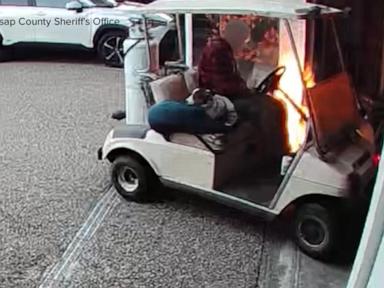
Every local news broadcast across the country just hyperventilated over a guy in Kitsap County, Washington, rolling up to a suburban home on a golf cart with a dog riding shotgun, casually torching a garage, and getting caught on high-definition video. The media treats these clips like digital reality TV. They want you to marvel at the footage, gasp at the audacity, and sleep soundly knowing the perpetrator got caught because ring cameras are everywhere.
It is a comforting narrative. It is also a complete delusion.
We have built an entire societal coping mechanism around the worship of post-incident surveillance. Millions of people stare at security feeds thinking high-resolution recording equals high-level security. It does not. Cameras do not stop arsonists. Cameras do not prevent property destruction. Cameras simply provide a cinematic autopsy for a crime that already happened.
The Surveillance Illusion
Let us look at the baseline facts of the Washington state incident. A 47-year-old man used a slow-moving, electric-or-gas neighborhood cruiser to commit a felony, caused two hundred thousand dollars in structural and vehicular damage, nearly ran over a witness, and managed to torch a stranger's garage while someone was home.
Sure, the camera captured it all in crisp detail. Wonderful. The homeowner still had a burning building. The neighbor still had to dodge a lunatic in a recreational vehicle.
We suffer from a massive institutional failure of logic. We mistake documentation for deterrence.
When security companies sell you a multi-camera layout, they sell you the fantasy of minority report-style crime prevention. They imply that the red recording light blinking on your soffit acts as a psychic shield against malicious actors. Reality check: criminals do not care about your lenses if response times are measured in twenty-minute increments. A guy operating out of a golf cart with a dog as a co-pilot is not calculating the megapixels of your setup; he is calculating how long it takes local law enforcement to navigate suburban traffic.
Anatomy of a Lazy Consensus
The lazy consensus in modern crime reporting follows a predictable script.
- Shocking video emerges.
- The public shares it on social media for viral outrage.
- Authorities catch the suspect because modern tech makes identification easy.
- Everyone pats themselves on the back for living in a high-tech Panopticon.
This narrative misses the entire point of physical security. If your primary security strategy relies on the police identifying your attacker from a clean 4K clip after your house is already on fire, you have already lost. You are treating the symptom while ignoring the systemic rot of reactive infrastructure.
Imagine a scenario where cities spent half as much energy hardening physical perimeters, updating local rapid-response grids, and implementing active neighborhood defense protocols as they spend uploading raw footage to YouTube for clicks. The golf cart arsonist would not have made it past the driveway. Instead, we rely on passive witnesses and digital footprints, turning neighbors into amateur forensic detectives while their property turns to ash.
The Uncomfortable Truth About Modern Policing and Tech
Let us address the elephant in the room: hardware manufacturers love crime waves. Every time a bizarre incident involving a golf cart, a torch, and an unsuspecting homeowner hits the news cycle, security stock ticks upward. Panic is a lucrative business model.
The security industry pushes the myth that more data streams equal more safety. But human beings cannot monitor endless feeds, and artificial intelligence alert systems cry wolf so often with stray cats and rustling tree branches that homeowners learn to ignore them. When a real threat rolls up at three miles per hour in a vehicle meant for the back nine, the notification gets buried under a hundred false alarms.
If you want actual security, throw out the passive mindset.
- Harden the Perimeter: Cameras record the tragedy; physical barriers prevent it. Invest in heavy-duty gates, shatter-resistant glazing, and fire-rated exterior barriers.
- Active Deterrence over Passive Recording: If your security system does not emit an active, deafening deterrent or deploy immediate friction against an intruder within the first three seconds, it is just a digital scrapbook for insurance adjusters.
- Redefine Community Awareness: The neighbor who intercepted the Washington arsonist did not do so because of an app notification; they did so because they were physically present and paying attention. Technology outsourced our hyper-local vigilance to silicon chips, and our neighborhoods are less safe for it.
The viral video of the golf cart criminal is not a triumph of modern surveillance. It is a monument to our collective vulnerability, dressed up as entertainment so we forget how exposed we actually are. Stop watching the replay. Fix the gate.