The Fetish for Skeletons
Archeology has a bad habit of staring directly at human remains and missing the entire forest for a single femur.
When researchers uncovered 37 skeletons beneath a massive 1,000-pound stone vessel at Site 1 on the Plain of Jars in Laos, mainstream headlines rushed to declare the century-old mystery on the verge of being solved. The consensus narrative was predictable, neat, and utterly uninspired: We found human bones near big stone pots, so the pots must be ancient burial urns.
That is a lazy conclusion driven by sensationalist media and archeological confirmation bias.
Finding human remains next to an ancient megastructure does not prove the structure was built to hold them. If future researchers dug up the ruins of Grand Central Station 2,000 years from now and found 40 bodies buried under the concourse, would they conclude the terminal was built as a giant tomb? Of course not. They would recognize that human beings routinely re-use, repurposed, and desecrated prominent sites long after the original builders disappeared.
The rush to label the Plain of Jars as a giant necropolis ignores glaring logistical contradictions, mechanical reality, and basic human behavior.
The Logistical Absurdity of the Burial Hypothesis
Let's look at the actual physics of what we are dealing with.
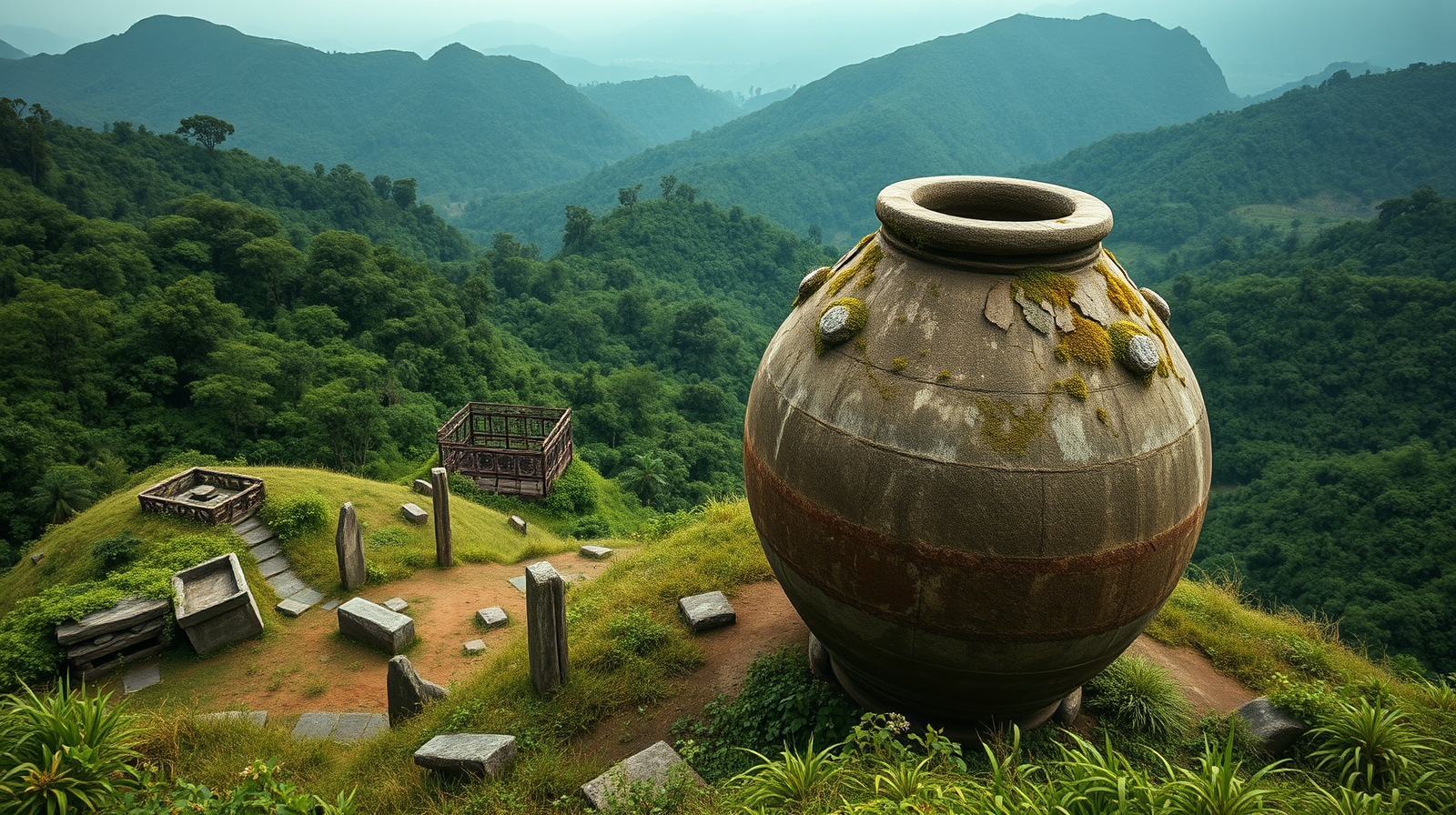
The Plain of Jars consists of thousands of hollowed-out megalithic stone vessels scattered across the Xiangkhoang Plateau. They weigh between one and thirty tons. They were carved primarily from sandstone, conglomerate, and granite, often quarried miles away from their resting places and hauled across steep, mountainous terrain.
Ask yourself a simple engineering question: Why would an Iron Age culture expend hundreds of thousands of man-hours to quarry, carve, and transport thirty-ton stone vessels up mountains just to burn or decompose a corpse inside them?
They wouldn't. The math doesn't work.
The Standard Archeological Claim
Mainstream researchers argue that the jars served as primary or secondary burial vessels—essentially giant urns where bodies were left to decompose before the bones were removed, buried nearby, or incinerated.
The Reality Check
- Volume vs. Utility: A three-ton jar with an opening barely wide enough for a torso is an exceptionally stupid design for a decomposing vat.
- Lid Mechanics: Out of thousands of jars, only a fraction have stone lids. Why build a permanent, indestructible vessel to decompose bodies in the open air without a seal?
- Subsequent Use Bias: Radio-carbon dating places the skeletal remains between the 9th and 13th centuries AD, while optically stimulated luminescence (OSL) dating on the sediment beneath the jars suggests the stone structures were placed there centuries—if not over a millennium—prior.
I've evaluated physical infrastructure projects where legacy assets were repurposed by secondary users who had no idea how the original systems functioned. The same principle applies here. The people buried around those jars were not the master engineers who built them. They were squatters occupying a sacred or mysterious landscape long after the original utility of the site was forgotten.
What the "People Also Ask" Columns Get Completely Wrong
If you search the web for information on Laos' megaliths, you run into a wall of sanitized, low-friction answers designed for tourists rather than critical thinkers.
"Are the Plain of Jars human burial sites?"
The brutal answer: No, they are human burial sites the same way an abandoned bank vault is a homeless shelter. It might be used for that purpose right now, but that is not why it was constructed. Calling the Plain of Jars a cemetery is a cop-out that saves academics from admitting they have no idea how these communities managed large-scale stone masonry and hydraulic control thousands of years ago.
"How were the stone jars made?"
The brutal answer: The media loves to focus on iron chisels, but the real challenge wasn't carving—it was logistics and site alignment. Moving 30-ton conglomerate blocks across swollen river valleys without draft animals or paved roads requires sophisticated civil engineering. Focusing on the bones inside the jars completely ignores the massive regional supply chain required to create them.
The Monsoonal Trade Network Hypothesis
If the jars weren't built as gloriously inefficient coffins, what were they?
Follow the geography, not the bones.
The Xiangkhoang Plateau sits along crucial overland trade routes connecting the Mekong River basin to the Gulf of Tonkin. It is a land characterized by extreme seasonal shifts: months of torrential monsoon downpours followed by harsh, bone-dry droughts.
Imagine a scenario where ancient trade caravans, carrying salt, metals, and exotic goods across Southeast Asia, needed reliable supply depots.
To survive, you need three things:
- Water storage during dry seasons.
- Food preservation (such as salt-cured goods or fermented liquids).
- Monumental markers to signpost trade routes across dense, unforgiving terrain.
Stone does not rot. Wood does. If you carve a wooden vat to capture rainwater or ferment commodities, it degrades within a decade. Carve it out of sandstone, and it lasts ten thousand years. The wide bodies and narrow necks of many jars match the geometry of industrial storage vats seen in other ancient civilizations worldwide.
The discovery of human remains at Site 1 proves only one thing: centuries after the trade networks collapsed and the original utility faded, local populations treated the ancient, indestructible stone monuments with superstitious awe. They buried their dead near them because human beings have always wanted to attach their mortality to things that do not decay.
The Blind Spot in Modern Archeology
The primary flaw in how we analyze ancient sites is our insistence on spiritualizing every physical artifact.
When archeologists find a structure they can't immediately explain using modern economic logic, they label it "ritualistic" or "funerary." It is the ultimate get-out-of-jail-free card for academics.
- Found a ditch? Ritual moat.
- Found a flat stone? Sacrificial altar.
- Found a stone container near a grave? Mortuary vessel.
This mindset robs ancient peoples of their practical, engineering brilliance. It assumes they spent their entire lives obsessed with death, spending 90% of their economic output carving massive stone pots just to let a body rot inside.
It's absurd. Ancient humans were pragmatic. They built things to solve immediate, physical problems—water scarcity, trade logistics, resource management. The ritual significance came later, as subsequent generations looked at the massive structures left behind by their predecessors and invented mythologies to explain them.
The Downside to the Pragmatic Take
Is it possible I'm wrong? Of course.
If you abandon the comfortable "burial site" narrative, you lose the neat, easy story that gets tourist boards excited and secures quick university grant funding. You are left with a far more uncomfortable truth: we have vast, complex engineering networks in Southeast Asia whose creators, techniques, and original trade systems have been almost entirely erased from history.
Acknowledging that the 37 skeletons are merely secondary burials means admitting that we are still at square one. It means accepting that the people who built the Plain of Jars left no written record, no identifiable cities, and no clear explanation for why they moved mountains of stone across Laos.
That terrifies traditional academics. They would rather settle for a flawed consensus than sit with an uncomfortable blank space on the map.
Stop Looking at the Bones
If we want to understand the Plain of Jars, we have to stop obsessing over the human remains buried around them.
The 37 skeletons found at Site 1 tell us how people in the 10th century treated the dead. They tell us absolutely nothing about the visionaries who quarried 30 tons of solid rock in 1000 BC, dragged it up a ridge, and shaped it with mathematical precision.
Stop treating an industrial engineering marvel like a graveyard. Look at the water basins, map the trade passes, analyze the stone quarries, and respect the builders for what they actually were: engineers, not undertakers.