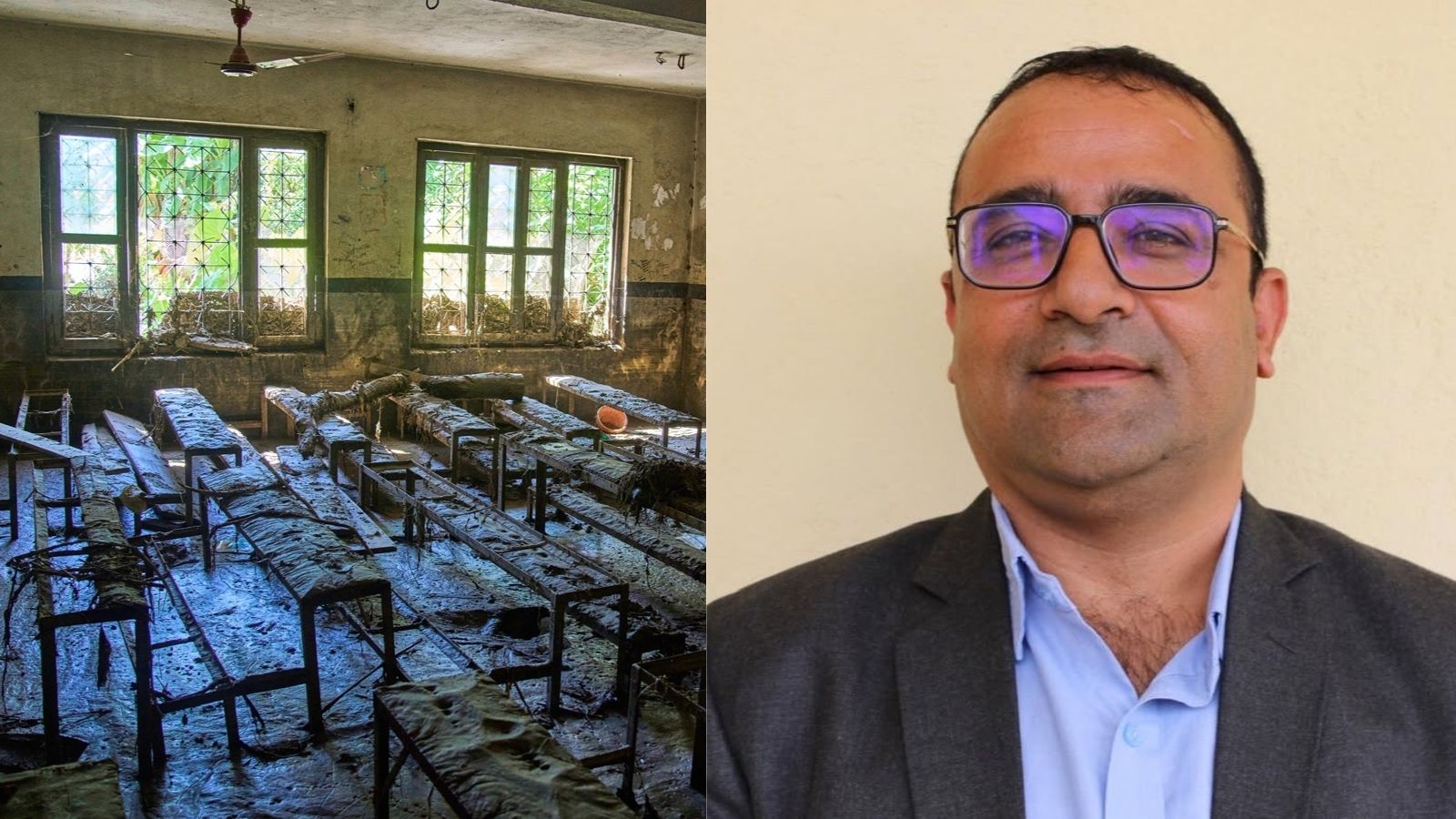
The Trishuli River did not merely overflow its banks; it erased an institution. When a catastrophic ice-and-rock landslide near the Nepal-Tibet border triggered a massive flash flood down the Himalayan valleys, the seventy-six-year-old Tribhuvan Trishuli Secondary School in Nuwakot district stood zero chance. Minutes before the torrent turned the campus into a graveyard of mud and debris, principal Rajendra Dawadi heard the warnings and evacuated nearly nine hundred students. They scrambled up the ridge, watching helplessly as a muddy wall swallowed the multi-story block.
That building had a specific history. It was an eighteen-room structure funded and constructed by the Indian Embassy following the catastrophic 2015 earthquake. Now, it is gone—buried under feet of silt, alongside buses provided by the same foreign aid program. As the community picks through the wreckage, a hard and uncomfortable truth has emerged from the valley. Rebuilding schools on the exact same flood-prone riverbanks is a systemic failure of disaster planning, and throwing foreign aid at repetitive reconstruction without mandatory relocation is nothing more than an expensive exercise in futility.
The Illusion of Permanent Recovery
Disaster aid models across South Asia suffer from a chronic lack of long-term spatial vision. When external donors step in with millions of dollars for post-disaster reconstruction, the political and logistical pressure is always immediate. Governments need to show quick wins. Donors want ribbon-cutting ceremonies. The path of least resistance is almost always rebuilding on the original footprint. The land is already owned by the state or the municipality, utility connections are theoretically present, and clearing the rubble feels like progress.
Tribhuvan Trishuli Secondary School is the textbook casualty of this cycle. After the 2015 earthquake flattened infrastructure across the region, the Indian government’s assistance package provided a modern, eighteen-room replacement for the school. It was engineered to withstand seismic shocks, adhering strictly to post-quake building codes. But earthquake codes do not account for hydraulic fury. When a glacial lake outburst flood or high-altitude landslide sends a thirty-foot wall of water down a narrow gorge, structural reinforcement against earthquakes is entirely irrelevant. The river simply swallows the foundation.
Principal Dawadi now faces a community traumatized not just by the suddenness of the disaster, but by its eerie predictability. The children call the river a snaking ghost. They refuse to look down at the muddy basin where classrooms used to stand. Yet, the initial administrative impulses from local authorities often default to temporary learning centers patched together in nearby open lots—sometimes dangerously close to the very same hazard zones.
The Geopolitical and Logistical Maze of Relocation
Moving a massive rural educational hub is infinitely more complicated than pouring concrete on a flat plot of riverfront land. In the rugged topography of Nuwakot, Dhading, and Rasuwa districts, flat earth is a rare commodity. Higher ground usually means steep, unstable slopes susceptible to landslides during the monsoon season, or remote ridges lacking road access, electricity, and water lines.
Furthermore, shifting the campus changes the entire daily geography of the student body. Tribhuvan Trishuli served over sixteen hundred students spread across steep mountain terrain. Roughly seventy percent lived on the western side of the Trishuli River, while the remainder lived on the eastern side, relying on local bridges, buses, and a residential hostel to converge on the campus. With river crossings pulverized by the deluge—taking down critical infrastructure in an instant—the student population is physically fractured.
Establishing a new school on a safe ridgeline requires massive capital expenditure far beyond standard building costs. It demands new access roads, retaining walls, slope stabilization engineering, and crucially, new bridges or cable crossings so that children do not risk their lives simply getting to first-period math. When local leaders look toward New Delhi or international humanitarian funds for another round of assistance, they are no longer asking for a simple school building. They are asking for a complete geographical re-engineering of a community's infrastructure.
Breaking the Cycle of Vulnerability
The disaster along the Trishuli and Bhote Koshi corridors—which left scores dead and hundreds missing, including international pilgrims and local security personnel—signals a terrifying new baseline for Himalayan weather events. Climate anomalies are destabilizing high-altitude slopes with alarming frequency. Traditional flood lines and historical flood frequencies are obsolete metrics.
If international aid continues to fund the rebuilding of washed-out schools, hospitals, and administrative blocks on their original low-lying parcels, bilateral donors risk becoming co-financiers of permanent vulnerability. True institutional resilience requires a strict policy precondition: not one dollar of recovery capital should go toward rebuilding public infrastructure in a designated high-risk flood zone.
The teachers and students of Trishuli Bazaar understand this better than any bureaucrat in Kathmandu or New Delhi. Their demand is singular and non-negotiable. They will accept tents, rented rooms, banquet halls, or temporary sheds, but the permanent bell will never ring down by the water again. Until regional planning bodies match that refusal with hard zoning laws and acquisition funds for safe, elevated land, the next flood will simply return to collect what it missed this time.