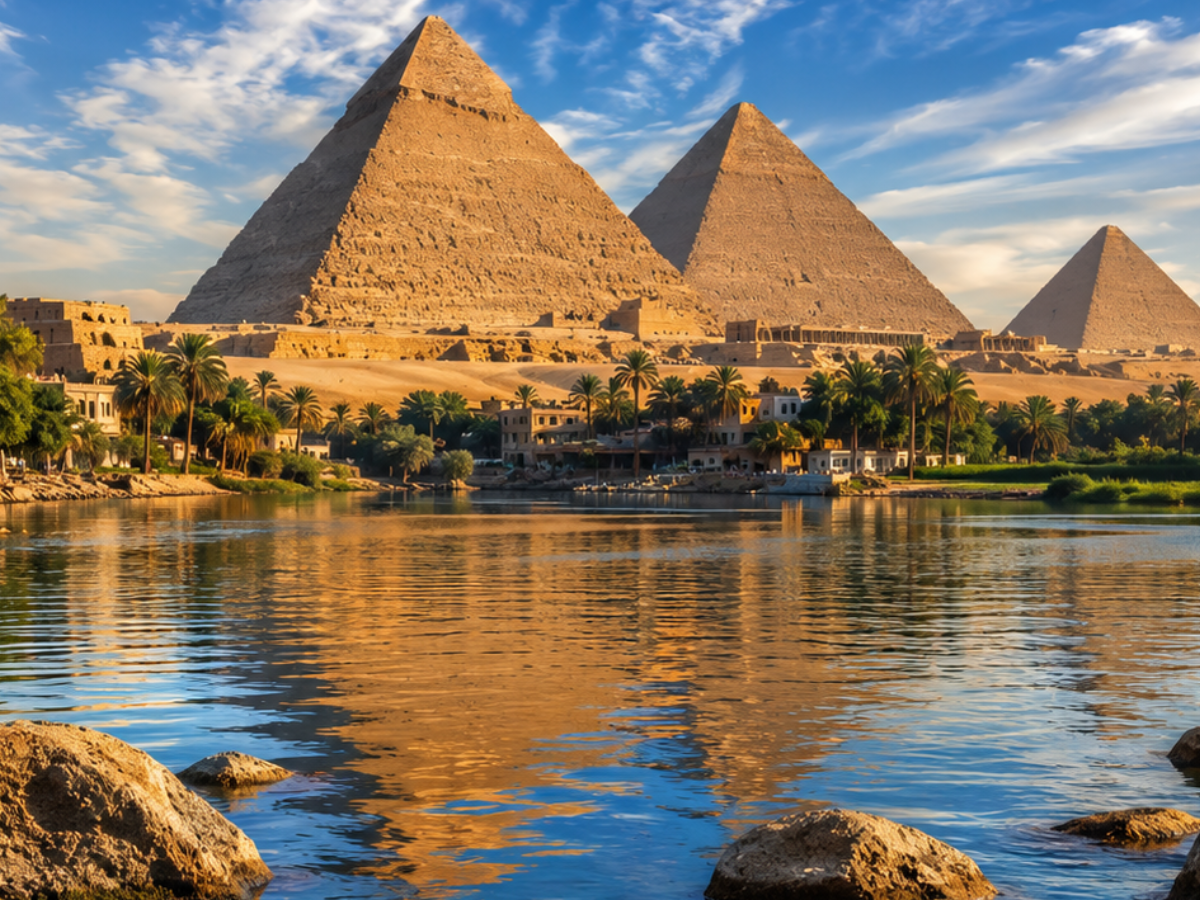
The heat of the Egyptian sun is not a passive thing. It pours over the Giza plateau like molten bronze, softening the air until the horizon wobbles. Stand near the base of the Great Pyramid of Khufu, and the sheer weight of human ambition hits you. Two point three million stone blocks. Some weigh upwards of fifteen tons. They fit together so tightly that a razor blade cannot slip between them.
For centuries, this monument has provoked a single, exhausting question. How? For another perspective, consider: this related article.
How did a Bronze Age society, lacking iron tools, the wheel, or complex pulleys, transport millions of tons of limestone and granite across miles of unforgiving desert? The standard textbook answer usually involves miles of dust-choked ramps, thousands of brutalized slaves, and an impossible amount of friction. It portrays a triumph of sheer, agonizing muscle over geography.
But that story is wrong. It misses the genius of the architects. It ignores the heartbeat of the ancient world. The pyramids were not built by fighting nature. They were built by riding it. Similar insight regarding this has been provided by NPR.
Recently, a team of environmental scientists decided to stop looking at the stones and start looking at the dirt. By drilling deep into the parched floodplains surrounding Giza, they pulled up ancient soil samples that revealed a long-dead secret. Buried under meters of desert silt were traces of fossilized pollen, tiny biological time capsules belonging to aquatic plants that thrived thousands of years ago.
The pollen proved something extraordinary. A major, deep-water branch of the Nile River once flowed directly past the foot of the Giza plateau.
It was a highway of water. And without it, the Great Pyramid would simply not exist.
The Ghost in the Grain
To understand how this discovery flips the narrative, we have to look at the world through the eyes of someone like Merer. He isn't a hypothetical ghost; he was a real person. In 2013, archaeologists working at the Red Sea port of Wadi al-Jarf discovered the logbook of this ancient Egyptian inspector. Written on papyrus, Merer’s daily entries describe a life spent on the water, commanding a crew of about forty mariners who ferried limestone from the quarries of Tura straight to the construction site of Giza.
Imagine Merer standing on the deck of a heavy wooden barge. The boat sits low in the water, burdened by a massive block of white limestone meant for the pyramid’s outer casing.
If you look at Giza today, the Nile sits miles away from the pyramids. The idea of rowing a fifteen-ton stone to the site seems absurd. If Merer had to unload those stones miles from the plateau, his men would have had to drag them across miles of soft sand. The friction would have destroyed the wooden sledges. The sheer manpower required would have bankrupt the kingdom.
But Merer didn't drag the stones across the desert. He sailed them right to the edge of the rock.
The fossil pollen analysis, led by environmental geographer Hader Sheisha, shows that five thousand years ago, the Khufu Branch of the Nile was roaring with life. The pollen came from plants like Typha latifolia—the common cattail—and various sedges, species that demand a permanent, deep-water environment to survive. This wasn't a seasonal puddle. It was a robust, navigable waterway that rose and fell with the annual floods.
The engineers of Khufu's reign were master hydrologists. They didn't just stumble upon this river branch; they harnessed it. They dug harbors. They built canals. They created a complex network of artificial basins that acted as an inland port right at the base of the plateau.
When the summer floods came, swelling the Nile with waters from the Ethiopian highlands, the Khufu Branch rose. Merer and his crew would ride the high tide, sailing their heavy barges directly into the harbors. They would float the stone blocks onto the docks, mere steps from where the builders stood waiting.
It was a supply chain of staggering efficiency. The Nile did the heavy lifting.
Reading the Dust
The science behind this revelation feels like a detective novel where the clues are invisible to the naked eye. The researchers extracted sediment cores from the Giza floodplain, drilling deep into the earth to reach layers that hadn't seen the sun in millennia.
Within these dirt columns lay the pollen grains. Pollen is incredibly tough. Its outer shell, made of a substance called sporopollenin, resists decay so well that it can remain intact for tens of thousands of years. By analyzing the types of pollen present in different layers of the sediment, scientists could reconstruct an ecological timeline of the region.
The data revealed a clear pattern. During the reigns of Khufu, Khafre, and Menkaure—the pharaohs who built the Giza pyramids—the pollen count for wetland plants was at an all-time high. The Khufu Branch was deep, stable, and wide.
But then, the timeline shifts.
As you move up the sediment core to layers deposited after the Old Kingdom, the aquatic pollen begins to vanish. It is replaced by the pollen of drought-resistant desert shrubs. The water levels were dropping. The climate was changing.
By the time Alexander the Great marched into Egypt thousands of years later, the Khufu Branch was gone. The desert had reclaimed the waterways, choking them with sand until the river became a ghost, preserved only in the mud beneath the feet of unsuspecting tourists.
The Human Core of a Colossus
This shift in perspective changes how we feel about the ancient Egyptians. The popular imagination often views them through a lens of dark, monolithic tyranny—thousands of faceless bodies straining under the whips of overseers to build a mountain of stone for a megalomaniacal king.
The discovery of the Khufu Branch replaces that grim image with one of profound intelligence and coordination.
The pyramid builders were not fighting against their environment. They were in total harmony with it. They possessed an intimate, generational knowledge of the river. They knew exactly when the waters would rise, how much weight a barge could carry without grounding in the shallows, and how to redirect the flow of a massive river to serve a singular architectural vision.
Consider the sheer logistics. It wasn't just about moving stones. It was about feeding the city of workers that grew around the construction site. Thousands of laborers needed bread, beer, fish, and meat every single day. The same vanished river channel that carried the limestone from Tura and the granite from far-off Aswan also carried the grain barges from the Delta. It was the jugular vein of the entire enterprise.
When we look at the Great Pyramid now, we shouldn't just see a monument to a dead king. We should see it as a monument to the river, and to the people who knew how to speak its language.
The Drying of the World
There is a haunting footnote to this discovery. The death of the Khufu Branch wasn't an isolated incident. It was part of a larger, systemic shift in the Earth's climate.
For a long time, North Africa was green. It was a land of savannas, lakes, and abundant wildlife. But slowly, over thousands of years, the monsoons shifted south. The rains dried up. The green Sahara became the desert we know today.
The Khufu Branch hung on longer than most because it was fed by the mighty Nile system, but eventually, even it could not fight the changing climate. As the river dried, the capital of Egypt shifted. The pyramids were abandoned to the blowing sands. The technology and infrastructure that allowed for such colossal construction faded into memory.
We often think of our modern civilization as the first to face the existential threat of a changing climate. But the dirt beneath Giza tells a different story. It tells of a society that reached its absolute zenith by mastering its environment, only to watch that environment slowly evaporate.
The next time you look at a photograph of the Great Pyramid standing lonely against the backdrop of the Sahara, look closer at the flat sand stretching out from its base. Imagine the water that used to be there. Listen for the sound of wooden oars slapping against the current, the shouting of sailors in an ancient tongue, and the heavy thud of limestone landing on a bustling dock.
The stones are only half the story. The rest is written in the water that filled the desert, and the pollen that refused to rot.