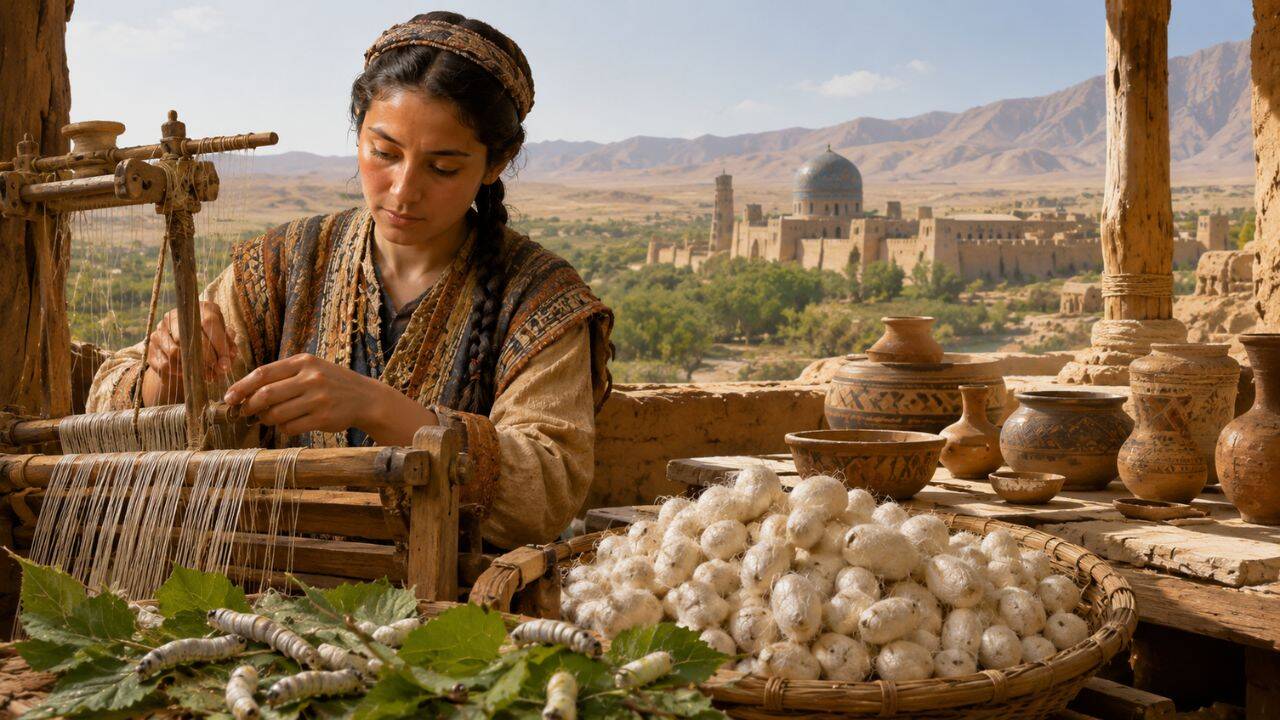
Dust gets everywhere. It settles in the creases of your palms, coats your eyelashes, and sneaks into the water skins before you have even traveled half a league under a burning Central Asian sun.
Long before caravans choked the mountain passes with the scent of camel sweat and spice, long before emperors traded maps and mercenaries for a bundle of shimmering threads, someone knelt in the dirt. They were not thinking about empires. They were thinking about survival. They were thinking about moths, cocoons, and the impossible transformation of a tiny, stubborn grub into something that caught the moonlight even at high noon.
We think we know the story of silk. We picture Florence, Venice, the great sprawling arteries of the Silk Road mapped out by schoolbook cartographers. We imagine Marco Polo with wide eyes, or Han dynasty envoys pressing westward into the unknown. But history loves a neat beginning, and history is almost always wrong.
Consider what happens next: an archaeologist in Uzbekistan, brushing away millennia of dry earth, finds something that shatters the timeline.
The Silence Before the Road
To understand the weight of this discovery, you have to strip away the romance of the ancient trade routes. The Silk Road was not a paved highway of luxury. It was a jagged, unforgiving network of survival tracks where traders risked thirst, bandits, and freezing mountain nights just to move a commodity that was lighter than gold yet worth vastly more.
For generations, the narrative stood unchallenged. China held the monopoly. China owned the secret. The technology of unwinding fragile cocoons into continuous, gleaming filaments was an imperial state secret punishable by death for anyone attempting to smuggle the worms or eggs across the border.
Except the dirt tells a different story.
Deep within the soil of Uzbekistan, far from the eastern heartlands where dynasties guarded their golden harvest, researchers uncovered microscopic evidence of sericulture dating back nearly two thousand years before the famous trade routes officially bore that name.
Imagine the scene. A prehistoric settlement in the Fergana Valley. The air smells of woodsmoke and parched earth. A woman sits outside a low-roofed mudbrick dwelling, her fingers rough, calloused from grinding grain and hauling water. Yet those same fingers are impossibly delicate as she handles a handful of small, papery husks dropped by local wild moths. She is not an empress. She wears no court silks. She is simply experimenting with the stubborn resilience of nature, dropping cocoons into hot water, testing the tensile strength of a fiber that humans had no business taming.
This is where the standard history books fracture.
The Physics of a Miracle
Silk does not make sense on paper. A caterpillar spins a tomb to protect its metamorphosis, and that tomb is somehow woven from protein strands so fine they defy the naked eye yet possess the tensile strength of steel wire.
Let us pause for a moment to look at the mechanics, stripped of academic jargon. If you were to examine a single strand under high magnification, you would see a dual-core fiber bound together by a sticky protective gum called sericin. To make fabric, that gum must be dissolved through heat, and the gossamer threads must be coaxed out without snapping.
Do this with a modern factory machine, and it is a marvel of industrial engineering. Do this by hand in the Bronze Age, using primitive pottery vessels over an open hearth, and it borders on alchemy.
The people of ancient Uzbekistan were doing this millennia before caravans rolled through their valleys. They were not waiting for eastern trade delegations to bring them culture or technology. They were innovators in their own right, bending the natural world to their will long before the geopolitics of silk became a matter of international intrigue.
The Weight of Forgotten Hands
History is written by the victors, but it is preserved by the anonymous.
When we look at museum displays of ancient garments, we see the finished product. We see the regal sheen, the deep indigo dyes, the embroidered dragons and sunbursts. We rarely see the blisters. We rarely see the quiet desperation of a community trying to find value in an arid landscape where crops could fail with a single missed monsoon.
The discovery in Uzbekistan forces us to rethink human ingenuity. It reminds us that invention is rarely a singular event born in a single brilliant capital. Innovation bubbles up simultaneously across the globe wherever human curiosity collides with necessity.
Think of the sheer audacity required to look at a writhing insect larvae and decide that its protective shell could be transformed into a second skin. It is an act of profound imagination.
And yet, for centuries, the credit was hoarded by the narrative of the great empires. We credited the massive trade networks because they left written records, monuments, and coins. We ignored the quiet settlements in Central Asia because they left only fragments, chemical signatures in the soil, and the silent ghosts of domestic craft.
The Echoes in the Dust
Standing today in the sun-baked expanses of the Uzbek landscape, the wind carries a particular kind of quiet. It is a stillness born of vast spaces. The mountains loom in the distance, snow-capped and indifferent to human timelines.
The silk makers of antiquity are long gone. Their mud homes have dissolved back into the earth, indistinguishable from the hills that surround them. But the chemistry remains. The microscopic traces of protein cling stubbornly to the archaeological record, refusing to be erased by time or by the convenience of simpler historical narratives.
We walk these same paths today, tourists with cameras and guidebooks, chasing the ghost of the Silk Road. We buy mass-produced scarves in bustling bazaars, haggling over prices in currencies our ancestors could not fathom. We treat silk as a luxury, a soft touch against the skin, a nod to elegance.
We forget what it cost the first person who pulled a wet thread from a boiling pot. We forget that progress is not a straight line drawn by emperors, but a jagged, beautiful web spun by ordinary hands in the dark, reaching out across the centuries to touch ours.