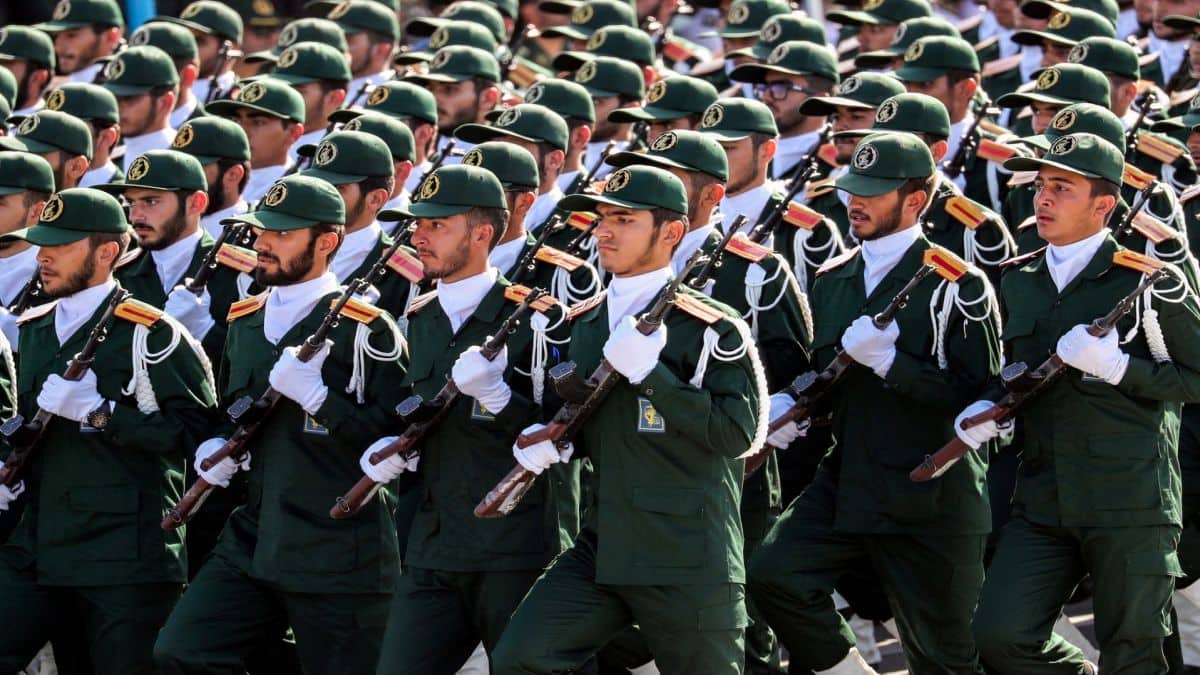
A single phone call in the middle of the night doesn't just wake you up. It changes the molecular structure of the air in the room. In Tehran, or Washington, or a trading floor in London, that ringing phone usually carries the same weight: the world as you knew it ten minutes ago is gone. When the news broke that Supreme Leader Ali Khamenei was dead, the silence that followed across the Middle East wasn't peace. It was the sound of a massive, intricate machine shifting into its highest gear.
That machine is the Islamic Revolutionary Guard Corps (IRGC).
To the casual observer scanning a headline, the IRGC is often described as a "branch of the military" or a "security force." These words are too small. They are clinical. They fail to capture the reality of an organization that is simultaneously a venture capital firm, a construction conglomerate, an ideological priesthood, and a shadow government.
Imagine a corporation that owns the ports, the telecommunications, and the literal soil of a nation, while also possessing the legal authority to arrest its customers and the military hardware to threaten its neighbors. Now, imagine that corporation loses its chairman—the only man who held the leash.
The Architecture of the Pasdaran
Most armies exist to protect a border. The IRGC exists to protect an idea.
Formed in the chaotic wake of the 1979 Revolution, the "Pasdaran" was never meant to be a conventional military. The regular Iranian army (the Artesh) was viewed with suspicion by the new clerical elite. They needed a vanguard. They needed true believers. They needed men who wouldn't just follow orders, but who would die to ensure the survival of the Velayat-e Faqih—the Guardianship of the Islamic Jurist.
Over four decades, this "vanguard" became the most dominant force in Iranian life. If you walk down a street in Tehran today, the IRGC is invisible and everywhere. They are the contractors who built the bridge you are driving over. They are the stakeholders in the bank where you keep your rials. They are the intelligence officers listening to the chatter in the tea house.
When the IRGC vows the "most powerful operation" following Khamenei’s death, they aren't just talking about missiles. They are talking about a total mobilization of their vast, multi-layered ecosystem. They are signaling to the world—and to their own people—that while the man may be gone, the system is immortal.
The Two Faces of Power
To understand the IRGC, you have to look at its two most potent limbs: the Basij and the Quds Force.
The Basij is the IRGC’s grip on the internal throat of Iran. It is a volunteer paramilitary force that permeates every village and university. In times of protest, they are the men on motorcycles with batons. In times of transition, they are the neighborhood watchers ensuring no one steps out of line. They are the human infrastructure of control.
Then there is the Quds Force. If the Basij is the shield, the Quds Force is the sword. This is the elite unit responsible for "extraterritorial operations." They are the architects of the "Axis of Resistance." From the streets of Baghdad to the mountains of Lebanon and the deserts of Yemen, the Quds Force manages a constellation of proxies.
Think of it as a franchise model of warfare.
The Quds Force provides the training, the funding, and the advanced weaponry—drones, precision-guided rockets, cyber capabilities—while the local proxies provide the boots on the ground. This allows Iran to project power thousands of miles from its borders with a degree of plausible deniability that frustrates every Western intelligence agency.
The Invisible Stakes
Why does a "most powerful operation" matter more now than ever?
The death of a Supreme Leader creates a vacuum. In the physics of power, vacuums are violent things. The IRGC is not merely a military participant in the succession; they are the kingmakers. Their vast economic interests depend on the next Leader being someone who will not trim their budget or question their monopolies.
Economically, the IRGC is a titan. Through various holding companies and "charitable" foundations known as bonyads, they control an estimated one-third of Iran’s economy. They dominate the oil and gas sector, telecommunications, and infrastructure. For a high-ranking IRGC commander, a shift toward a more moderate or "reformist" government isn't just a political disagreement. It is a threat to his bank account, his family’s safety, and his grip on the nation’s resources.
This is why their rhetoric is so fiercely "brutal." They need to project absolute strength to deter internal rivals and foreign adversaries who might see a moment of transition as a moment of weakness.
A Legacy of Fire and Steel
The world remembers the name Qasem Soleimani. He was the face of the IRGC’s ambition—a man who moved through war zones like a ghost, stitching together an alliance of militias that reshaped the map of the Middle East. When he was killed by a U.S. drone strike in 2020, many thought the IRGC would stumble.
They didn't.
The IRGC is designed for redundancy. It is a hydra. You can remove a head, but the body remains, driven by a deep-seated institutional memory and a messianic sense of purpose. Their "most powerful operation" could take many forms. It could be a massive cyberattack on global financial hubs. It could be a surge in proxy strikes against shipping lanes in the Red Sea. It could be a decisive, terrifying crackdown on domestic dissent to ensure the new Supreme Leader is seated without a whisper of protest.
The Human Element
Behind the maps and the troop movements are individuals. There is the young man in Isfahan who joined the Basij because it was the only way to get a government job and feed his mother. There is the shopkeeper who pays "protection" fees disguised as taxes to IRGC-linked entities. There is the commander in a hidden bunker, looking at a screen, weighing the cost of a regional war against the cost of appearing weak.
These are the invisible stakes. The IRGC isn't a monolith of mindless drones; it is a complex social class that has everything to lose. Their vow of a "brutal" response is a defensive reflex. It is the sound of a cornered power making sure everyone knows it still has teeth.
The geopolitical reality is that the IRGC has spent forty years preparing for this exact moment. They have built an asymmetric arsenal specifically designed to counter the superior conventional fire-power of the West. They don't need to win a traditional war. They only need to make the cost of opposing them too high for anyone to pay.
The Resonance of the Vow
As the dust settles in the halls of power in Tehran, the world waits for the "operation" to begin. But maybe the operation has already started.
Perhaps the operation isn't a single explosion or a declaration of war. Perhaps it is the quiet, methodical tightening of the grip on every lever of the Iranian state. It is the silencing of the last independent voices. It is the movement of funds into shadow accounts. It is the message sent to every proxy from Beirut to Sana’a: The king is dead. The Guard remains.
We often look for the "big event" in history—the battles, the treaties, the assassinations. But the real story is usually the one happening in the dark, in the rooms where the lights never go out. The IRGC is the ultimate practitioner of this dark art. They are not just an armed force. They are a permanent state of being.
The tragedy of the "most powerful operation" isn't just the potential for violence. It is the certainty that the cycle will continue. The IRGC has ensured that they are the only ones capable of maintaining order, which means they are the only ones who can benefit from the chaos.
In the end, the most terrifying thing about a shadow isn't that it's dark. It's that it can't be wounded, it can't be reasoned with, and as long as there is a light to be blocked, it will never truly go away.
The phone rings again. Another headline flashes. The machine hums. The world holds its breath, waiting to see which version of "brutal" the shadow chooses today.
Would you like me to analyze the specific economic holdings of the IRGC to show how they maintain this level of control?