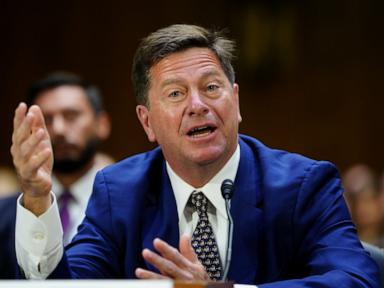
Jay Clayton wants the American public to believe he is a pragmatist. Confronted by a wall of frustratingly simple questions during his Senate Intelligence Committee confirmation hearing, the former Wall Street lawyer and current U.S. Attorney for the Southern District of New York attempted to walk a tightrope that has claimed many before him. He declared under oath that he is not an election denier, yet he stubbornly refused to utter the plain, factual statement that Joe Biden won the 2020 presidential election.
This is not a mere dispute over political rhetoric or semantic fencing. When the prospective director of the nation's vast intelligence apparatus cannot bring himself to acknowledge the established transfer of power, the failure of courage threatens the very foundation of national security.
The modern intelligence community relies entirely on the objective analysis of reality. It is an institution designed to deliver unvarnished, uncomfortable truths to the executive branch, regardless of political consequences. By dancing around the legitimacy of the 2020 election to avoid irritating a volatile president, Clayton signaled that the Office of the Director of National Intelligence may soon prioritize political self-preservation over empirical evidence.
The Art of the Non-Answer
The hearing room on Capitol Hill quickly became a stage for a masterclass in bureaucratic evasion. For hours, Democratic senators tried to extract a single, definitive declaration from the nominee. They wanted to hear him say that the 2020 election was secure, fair, and won by the sitting president.
They failed.
Instead of a simple affirmation, Clayton offered a legalistic shield. He repeated that Joe Biden was certified as the president. This is technically true, but it is also a tactical retreat. It acknowledges the legal outcome while avoiding any endorsement of the underlying process. It is the language of a corporate defense attorney defending a flawed merger, not an intelligence leader sworn to defend a constitutional republic.
The most telling confrontation came during an exchange with Senator Jon Ossoff of Georgia. Ossoff pressed Clayton on why he could not simply state the truth that everyone in the room knew to be fact. The nominee responded by insisting he had already answered the question.
"We're going to keep doing it because you're not being honest or forthright with the committee," Ossoff fired back. He then asked if it was humiliating to indulge the president’s delusions.
Clayton’s silence was deafening. It illustrated the quiet compromise that has become the price of entry for high-level service in the current administration. To secure the nomination, Clayton had to check his institutional independence at the door.
The Securities and Exchange Heritage
To understand why Clayton behaves this way, one must look at his professional history. He is not a seasoned intelligence officer who rose through the ranks of the CIA or the NSA. He is a corporate lawyer who spent decades advising massive financial institutions at Sullivan & Cromwell before serving as Chairman of the Securities and Exchange Commission during Donald Trump’s first term.
In the financial sector, survival is about managing risk and minimizing exposure. You do not volunteer information that could spark a market panic or invite regulatory scrutiny. You stick to the text, the disclosures, and the safe harbors of the law.
At the SEC, Clayton was viewed as an effective administrator who focused on retail investor protection while easing burdens on public companies. He was a creature of consensus, highly skilled at finding middle ground.
But national security is not a corporate negotiation. The adversaries of the United States do not operate in a framework where truth can be split down the middle. When a foreign adversary launches a sophisticated cyber campaign to destabilize an American election, the Director of National Intelligence cannot issue a carefully hedged press release.
By applying corporate risk-management techniques to existential questions of democratic legitimacy, Clayton is attempting to treat truth as a commodity that can be negotiated. It cannot.
The True Cost of Political Neutrality
The Director of National Intelligence oversees seventeen separate intelligence organizations. This sprawling network of analysts, spies, and scientists exists to parse signals from noise, warning the nation of impending dangers.
If those analysts believe their findings will be filtered through a political lens before reaching the White House, the entire system begins to decay.
During the hearing, Senator Mark Kelly of Arizona pointed out the danger of this dynamic. He noted that the director must be willing to present hard truths to the president, even when those truths directly contradict the president’s personal or political narratives.
Clayton attempted to reassure the committee by stating that the responsibilities of the intelligence community are principally focused outside the borders of the United States.
This defense is incredibly weak.
Foreign adversaries do not respect domestic boundaries. Indeed, Russian, Chinese, and Iranian influence operations are specifically designed to exploit domestic political divisions. If the head of American intelligence cannot publicly agree on the basic facts of the nation's own elections, he is fundamentally ill-equipped to defend those elections from foreign interference. He cannot protect a system whose integrity he is too timid to validate.
The Shadow of Tulsi Gabbard
The shadow of his predecessor, Tulsi Gabbard, also hung heavy over the proceedings. Gabbard’s tenure was marked by controversy, including her physical presence at an FBI raid of a Georgia election office.
When pressed on this extraordinary event, Clayton claimed varying degrees of ignorance. He refused to comment on the appropriateness of his predecessor's actions, citing an ongoing national security investigation.
This evasion is highly concerning. A nominee seeking to run the nation's intelligence services should have a clear, principled view on whether it is appropriate for the DNI to accompany law enforcement during raids of domestic election offices.
By pleading ignorance, Clayton chose the path of least resistance. It was another calculated attempt to avoid taking a stand that could alienate either the senators confirming him or the president who nominated him.
The Audit Trail of Distrust
When Senator Angus King of Maine asked Clayton if the United States has a systemic problem with voter fraud, Clayton shifted the conversation toward technical improvements. He remarked that the audit trail available for elections in many places is not what one would expect for something so vital.
"I don't think we can say definitively whether there is or is not until we have better processes," Clayton stated.
This statement is incredibly dangerous. It adopts the language of reform to cast doubt on the reliability of past elections. By suggesting that the lack of a corporate-grade audit trail makes it impossible to know if widespread fraud occurred, Clayton lent institutional credibility to baseless conspiracy theories.
Every major cybersecurity agency, state election official, and independent audit concluded that the 2020 election was the most secure in American history. Yet the nominee to lead the nation's intelligence services chose to treat this settled issue as an open question.
This is how institutional trust is eroded. It does not happen with a sudden, dramatic collapse. It happens incrementally, through the quiet concessions of respectable men who value their appointments more than the truth.
When the Watchdog Learns to Heel
The intelligence community was reformed after the failures of September 11 and the politicized intelligence surrounding weapons of mass destruction in Iraq. The goal of creating the Director of National Intelligence was to ensure that intelligence would be integrated, objective, and independent of political pressure.
Clayton's performance suggests a return to an era where intelligence is tailored to suit the desires of the consumer.
If confirmed, Clayton will face immediate crises. Global conflicts are expanding, cyber threats are growing more sophisticated, and the line between foreign influence and domestic political discourse continues to blur.
An intelligence chief who is afraid to say "yes" when asked if the current president won his election is not going to stand up to a president who demands intelligence to justify a pre-determined foreign policy objective.
We are witnessing the quiet transformation of the nation's premier national security office into an agency of political accommodation. Jay Clayton may not consider himself an election denier. But by refusing to defend the truth, he has shown that he is perfectly willing to let the deniers set the agenda.
For an in-depth analysis of the political fallout and the reaction of veteran national security officials to Jay Clayton's nomination, you can watch Nicolle Wallace's detailed breakdown of the DNI nomination battle. This report offers essential perspective on how intelligence insiders view the appointment of a corporate lawyer to the nation's highest intelligence post.
.jpg?width=1200&auto=webp&trim=0%2C0%2C0%2C0)