The paper feels cheap. It is the kind of thin, brightly bleached printer paper that curls at the edges when held too tightly in sweating hands.
Let us construct a man named Tariq. He is hypothetical, but his situation is entirely, devastatingly real. Tariq is sitting in a government processing office in the United Kingdom. The fluorescent lights above him hum with a mechanical indifference. Outside, the sky is the color of wet concrete. He has survived a journey that would shatter most people. He has crossed continents, evaded death, and traded his history for a single, desperate chance at tomorrow. Don't miss our recent article on this related article.
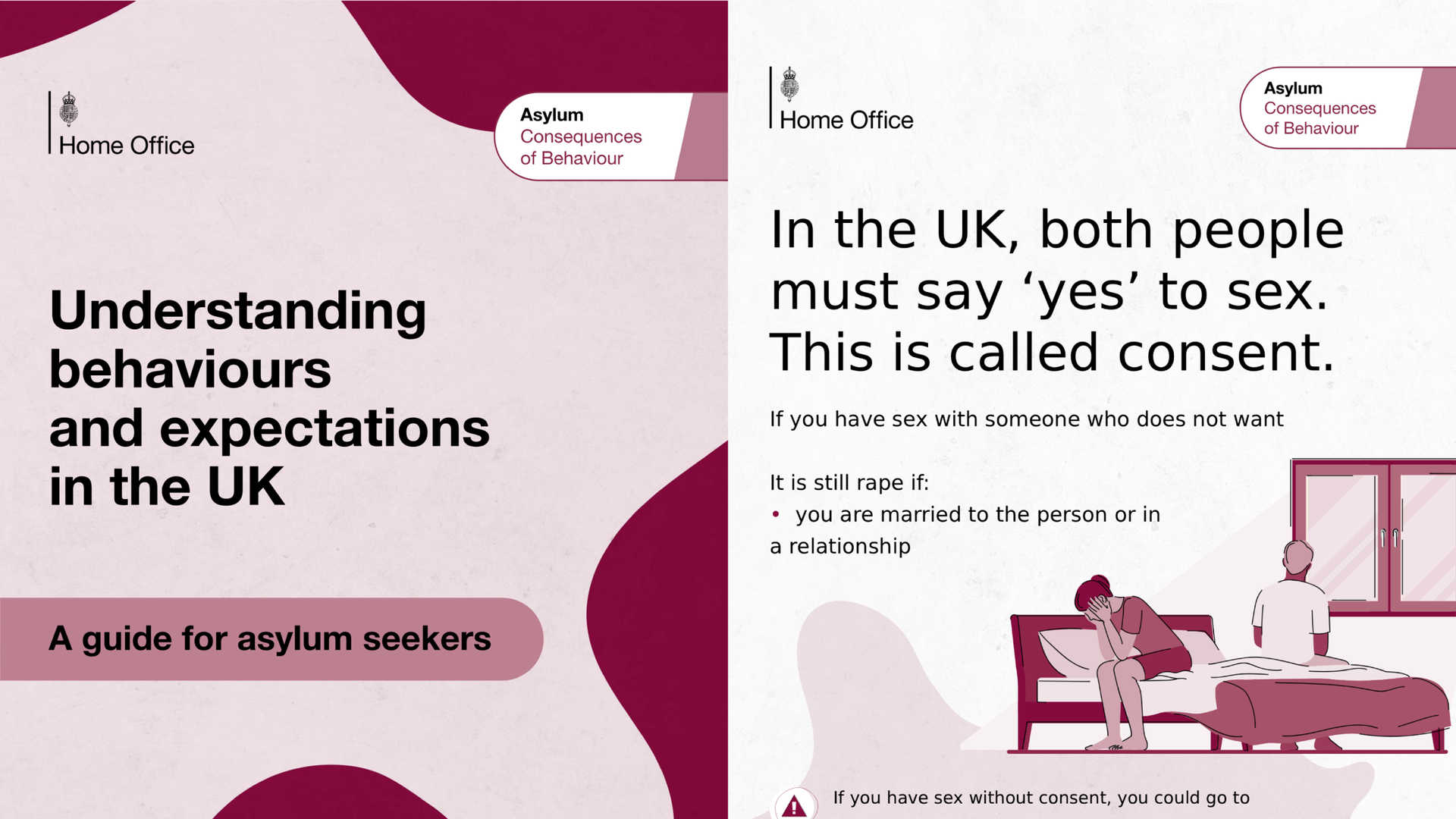
A clerk hands him a document. It is the new guidance for asylum seekers living in the UK. Tariq traces his finger over the English words, translating them slowly in his mind.
Do not rape.
Do not sexually assault.
Do not make kissing noises at people. If you want more about the history of this, TIME provides an excellent summary.
He stops. The breath catches in his throat.
Cold. Clinical. Condescending.
He reads it again. The words do not change. The state has formally, officially instructed him not to be a monster. Before he has even unpacked his meager belongings, before he has learned the route to the local grocery store, he has been preemptively categorized. He is a presumed threat, requiring explicit written instruction on the most basic tenets of human decency.
How do we even begin to unpack the layers of fear, bureaucracy, and cultural collision that result in a document like this?
To understand this pamphlet, we have to look past the ink and paper. We have to look at the terrified architects behind it. The Home Office guidance did not materialize out of thin air. It was born from a very specific, very modern anxiety.
Across Europe, demographics are shifting at a pace that breaks the human capacity to adapt quietly. Millions of displaced people are seeking refuge in nations that are entirely foreign to them. And the host nations are nervous. Politicians face intense pressure from constituents who feel their neighborhoods changing, who read headlines about crime, who feel the creeping dread of the unknown.
The government's solution is predictably bureaucratic. When faced with the messy, volatile, and deeply emotional reality of human migration, the state attempts to regulate it with a checklist.
But this is where the policy profoundly misses the mark. You cannot legislate a shared soul.
Let us be entirely honest. It is incredibly uncomfortable to admit that cultural norms clash. In some parts of the world, gender dynamics are vastly different than they are in a London suburb. What one culture views as street harassment, another might excuse as standard social friction. The UK government, recognizing this gap, decided to bridge it with the subtlety of a falling piano.
They saw a gap in understanding and filled it with an insult.
Tariq looks at the pamphlet. He is a former teacher. He has a wife. He has two daughters who died before they could learn to ride a bicycle. And here, in this damp, gray country, he is holding a piece of paper that implies he might walk down the street and assault a stranger if he isn't explicitly told otherwise.
The humiliation is absolute.
But the real problem lies elsewhere. The tragedy of this guidance is not just that it deeply insults the people arriving. It is that it completely fails the people already living there.
Consider the local resident. Sarah, another hypothetical proxy for a very real demographic. She lives in a town that has just received three hundred asylum seekers. She is nervous. She has daughters. She watches the evening news. If Sarah were to read this Home Office guidance, would she feel safer?
Absolutely not.
If the government feels the need to explicitly tell new arrivals not to rape or make kissing noises at women, the immediate, logical conclusion drawn by the local populace is terrifying. Who exactly are we letting in? The pamphlet validates the very xenophobia it likely intended to mitigate. It signals to the host population that these newcomers are so wildly untamed, so entirely alien to British values, that they must be instructed on the illegality of sexual assault.
It builds a wall of suspicion before a single greeting can be exchanged.
This is the failure of the modern bureaucratic state. It reduces complex sociological challenges into sterile, unfeeling bullet points. The state tries to engineer a polite society through admonishment.
I remember moving to a new city years ago, entirely out of my depth. I did not speak the language well. I did not understand the unspoken rules of the sidewalk, the expected distance one stands from another in a queue, the acceptable decibel level on a train. I learned these things not by reading a government mandate, but by living. I learned through the grace of strangers who corrected me gently, through the embarrassing flush of making a mistake, through observation, through time.
Integration is a slow bleed. It is the painful, beautiful, and inherently chaotic process of lives rubbing against one another until the sharp edges smooth out.
You learn a culture by absorbing its rhythm. When you walk into a local pub, or stand at a bus stop in the rain, you watch how people treat each other. You see the polite nod, the averted eyes, the specific distance maintained between bodies. You learn that making kissing noises at a passing woman on a British street will not just invite legal trouble; it will invite visceral, communal disgust.
A piece of paper cannot teach you the weight of a disapproving stare. It cannot teach you empathy.
The Home Office, in its clumsy attempt to protect British values, has accidentally highlighted a profound lack of faith in those very values. True societal norms do not need to be printed on cheap paper and handed out at the border. They are self-enforcing. They are the air a society breathes. If a society is strong, its culture absorbs and educates. If a society is terrified, it prints pamphlets.
The guidance fundamentally misunderstands the psychology of the asylum seeker. People fleeing persecution are not empty vessels waiting to be programmed by Western bureaucracy. They are exhausted. They are hyper-vigilant. They are acutely aware that their presence is tolerated, not celebrated. The vast, overwhelming majority of them want nothing more than to blend into the background. They want to be invisible. They want peace.
To hand an exhausted, traumatized father a piece of paper telling him not to be a sexual predator is an act of administrative violence. It strips away the one thing he has managed to carry across borders, oceans, and razor wire: his dignity.
We must find a better way to navigate this era of mass movement.
The conversations around integration need to happen. We cannot pretend that every person arriving from a war-torn or heavily patriarchal society immediately understands the nuanced gender politics of twenty-first-century Britain. There will be misunderstandings. There will be friction. There will be moments of deep cultural offense.
But the solution is not to treat adults like dangerous children.
The solution requires investment in actual human infrastructure. Community liaison programs. Local mentorships. Spaces where new arrivals can ask embarrassing, confusing questions about social norms without fear of deportation or judgment. We need language classes that teach conversational nuance, not just transactional phrases. We need a system that recognizes the humanity of the displaced and demands they rise to the occasion, rather than preemptively assuming they will fall to the lowest possible denominator.
Tariq folds the paper.
He folds it once. Twice. The creases are sharp. He slides it into the inner pocket of his coat, right next to his heart, where his identification papers sit. It will stay there. A permanent, physical reminder of exactly what this new country thinks of him.
He stands up from the plastic chair. The clerk calls the next number. Tariq walks out the glass doors and steps onto the pavement. The cold air bites at his cheeks. The sky is beginning to rain, a fine, misty drizzle that dampens everything it touches. A woman walks past him, hurrying to catch a bus, her umbrella angled against the wind.
He steps aside. He gives her space. Not because a pamphlet told him to, but because he is human.