Silence.
When the clerk of the United States House of Representatives calls the roll, the room does not roar like a stadium—it hums with the low, metallic tension of four hundred and thirty-five people holding their breath while two centuries of precedent press down on the mahogany desks.
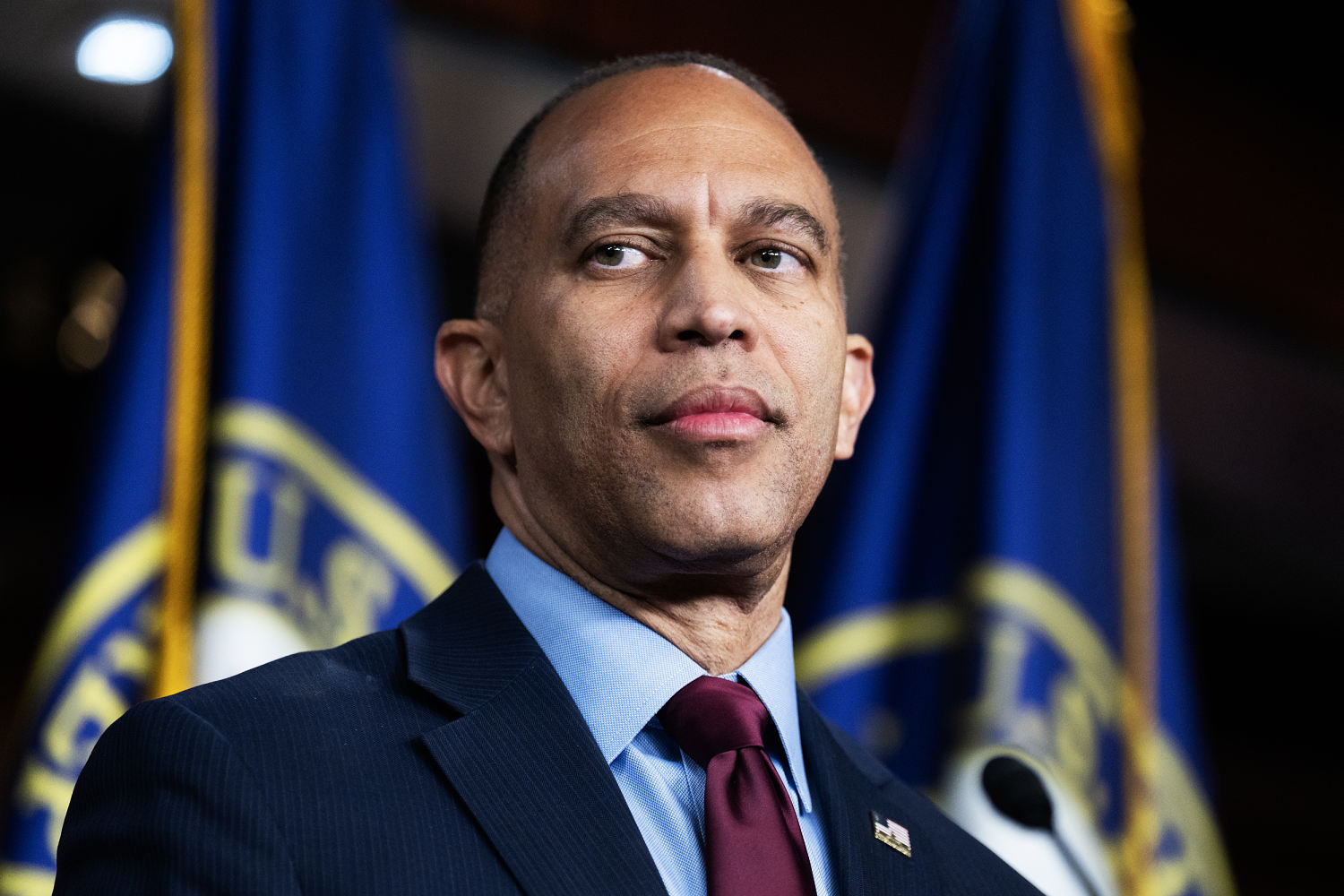
For most Americans watching on a glowing television screen from a kitchen table in Ohio or a cramped apartment in Brooklyn, the vote for Speaker of the House looks like a procedural formality. A roll call. A tally. A transfer of a wooden mallet. Yet when House Democrats formally nominated Representative Hakeem Jeffries of New York as their choice for Speaker, paving the way for him to become the first Black lawmaker to hold the gavel, the moment carried an emotional gravity that no dry congressional wire report could ever fully capture.
According to congressional records and news reports covering the Democratic Caucus vote, the decision to elevate Jeffries was unanimous among his party peers—a striking display of unity in an era defined by fractured coalitions and public infighting. Yet political observers and historians note that a nomination is only the opening chapter of a much more complicated arithmetic problem, one governed by razor-thin margins, institutional memory, and the unspoken expectations of millions of voters who rarely see themselves reflected in the portraits hanging along the Capitol corridors.
The Architecture of an Unlikely Room
Walk through Statuary Hall at dawn before the tour groups arrive, and the stone floor echoes like a cathedral. Every bronze statue, every marble bust, every oil painting tells a story about who has traditionally held the pen when American laws are written. For more than two hundred years, the office of the Speaker of the House—second in the presidential line of succession, behind only the Vice President—was occupied exclusively by white men, until Nancy Pelosi broke that barrier in 2007.
I remember standing in the press gallery above the House floor during a late-night vote years ago, watching the choreography of power unfold below. From that height, lawmakers look less like mythic figures and more like exhausted commuters trying to catch the last train home. They huddle in groups of three or four near the brass railings. They trade whispered assurances. They calculate the cost of a single "yea" or "nay" against the fragile loyalties of their home districts.
To understand what the nomination of Hakeem Jeffries actually means, consider a hypothetical voter—let’s call her Marcus, a retired transit worker living in central Brooklyn, just a few subway stops from the district Jeffries has represented since 2013.
For Marcus, politics has rarely been an abstract debate over parliamentary procedure. It is the price of insulin at the corner pharmacy, the reliability of the morning train, and the quiet, persistent question of whether the institutions of government were built with people like him in mind. When Marcus sees a kid who grew up in Crown Heights standing at the center of the House floor, receiving every single vote from his Democratic colleagues, the reaction isn't partisan triumphalism. It is recognition.
And recognition, in a democracy, is a currency far older and heavier than campaign donations.
How the Gavel Actually Works
People outside Washington often ask what the Speaker of the House actually does, assuming the role is mostly ceremonial—a dignified moderator banging a piece of wood to keep rowdy politicians in line.
Nothing could be further from the truth.
Think of the House of Representatives as a massive, bustling train station with thousands of legislative tracks, and the Speaker as the sole person standing inside the central control tower. Hundreds of bills arrive every week. Some carry hopes for healthcare reform; others carry tax adjustments, defense budgets, or local infrastructure grants. Without the Speaker’s approval, almost none of those trains ever leave the station. The Speaker decides which bills reach the floor for a vote, shapes committee assignments, negotiates directly with the White House and the Senate, and serves as the public face of the party’s legislative agenda.
When House Democrats formally nominated Jeffries, they were not merely handing him a title. According to party leaders and political analysts, they were entrusting him with the steering wheel of their entire legislative strategy—and signaling a generational transition after two decades of leadership under Nancy Pelosi, Steny Hoyer, and Jim Clyburn.
The transition itself was remarkably disciplined. Where political observers had spent years speculating about a bruising, fractured succession battle among ambitious younger Democrats, the caucus coalesced behind Jeffries without a single public fracture. In an institution where ambition usually sharpens every elbow in the room, that absence of chaos spoke volumes.
The Arithmetic of Power and the Reality of the Minority
Here is where the story complicates, because history rarely moves in a straight, triumphant line.
A formal nomination by a party caucus does not automatically place the gavel in a nominee's hand. Under the rules of the House of Representatives, winning the speakership requires an absolute majority of the members present and voting on the House floor—typically 218 votes when all 435 seats are filled.
When Democrats nominated Jeffries following midterm elections in which Republicans secured a narrow majority, the math immediately drew a sharp boundary between symbolism and immediate authority. In that cycle, every Democratic member voted for Jeffries on the floor, ballot after ballot, while the Republican majority wrestled publicly over its own leadership choices. Even when Jeffries led the raw vote count during early rounds of balloting because of divisions within the opposing party, he remained short of the majority threshold required to claim the chair.
To some critics and impatient observers, that gap felt frustrating—a historic milestone suspended just out of reach. Why celebrate a nomination when the opposing party holds the majority?
The answer lies in how legislative power actually builds over time.
In parliamentary politics, becoming the formal nominee of your party establishes you as the Speaker-designate—the leader-in-waiting whose authority is tested every single day in the trenches of minority governance. It means every budget negotiation, every debt-ceiling standoff, and every bipartisan compromise runs through your office. If your party holds together when it has no gavels and no committee chairmanships, you prove that you can govern when the political winds shift.
Two Views of a Historic Moment
Not everyone interprets the rise of Hakeem Jeffries through the same lens, and honesty requires acknowledging the competing perspectives that surround his leadership.
Supporters within the Democratic coalition point to his background as a corporate litigator turned community advocate, his meticulous preparation, and his ability to bridge ideological divides inside a party that stretches from moderate swing-district representatives to outspoken progressives. Civil rights leaders and Democratic strategists emphasize the profound symbolic and practical weight of a Black lawmaker leading a major party caucus in Congress, arguing that lived experience shapes which policy priorities receive urgency and sustained attention.
At the same time, political analysts and critics from both ends of the ideological spectrum offer more measured assessments. Conservative commentators frequently argue that Jeffries’s policy platform aligns closely with progressive priorities on taxes, regulation, and federal spending, contending that his measured, rhythmic speaking style masks a conventional partisan agenda. Meanwhile, some progressive activists have occasionally questioned whether his institutional approach moves too cautiously on structural reforms, preferring more confrontational tactics against political opponents.
Both observations can exist in the same room without canceling each other out. In fact, that tension is the exact terrain every House leader must navigate. Move too far toward the ideological edge, and you lose the vulnerable districts needed to win a majority. Move too cautiously toward the center, and you risk dampening the enthusiasm of the grassroots voters who knocked on doors to put you there.
The Man Behind the Cadence
Watch Jeffries speak at the podium during a late-night floor debate, and you notice immediately that he does not rely on the booming, theatrical cadence of mid-century politicians. His delivery is rhythmic, deliberate, almost musical—marked by sharp pauses, alliterative phrases, and references that weave together constitutional law, Brooklyn street history, and hip-hop lyricism.
He grew up in Crown Heights during the late twentieth century, a neighborhood shaped by Caribbean immigrants, Black families who had migrated north, and tightly knit civic institutions. His mother worked as a social worker; his father was a substance abuse counselor. Those details are not decorative biographical filler. They explain why his political vocabulary treats government less as an ideological theory and more as a neighborhood lifeline—something meant to catch people before they fall through the cracks.
Before entering Congress, he practiced law and served in the New York State Assembly, learning the unglamorous mechanics of legislative drafting: how a single clause buried on page forty of a housing bill can protect thousands of tenants, or how an overlooked funding formula can starve a public hospital.
When veteran leaders like Nancy Pelosi stepped aside from top leadership posts, they did not leave behind an easy inheritance. The modern House of Representatives is louder, faster, and more polarized than at any point in living memory. Cable news segments and social media algorithms reward outrage within seconds, while passing a single piece of meaningful legislation requires months of quiet, unglamorous compromise.
In that environment, patience is not passivity. It is a survival skill.
What History Actually Demands
It is easy to get swept up in the poetry of "firsts." American journalism loves a clean headline: the first woman, the first Black nominee, the turning of a page. Yet anyone who has spent real time around public policy knows that a historic milestone is never an ending—it is an audition under harsher lights.
Consider what happens next in any closely divided Congress. A government funding deadline approaches at midnight. An international crisis demands emergency aid. A faction within the chamber threatens to shut down basic operations unless specific demands are met. In those moments, speeches about history do not keep federal workers paid or prevent economic disruption. Only relationships, trust, and disciplined vote-counting do.
That is the invisible test built into Jeffries’s nomination. By uniting their caucus behind him, House Democrats made a bet that steady, methodical coalition-building can outlast the noise of perpetual political warfare. Whether that bet pays off in the form of the actual Speaker’s gavel depends not on one afternoon’s vote inside a closed caucus room, but on millions of voters across dozens of competitive districts—from suburban Pennsylvania to agricultural valleys in California—who will ultimately decide which party commands 218 seats.
I think back often to the paintings hanging in the Capitol Rotunda. In John Trumbull’s famous canvas of the Declaration of Independence, the light falls evenly across rows of men in powdered wigs, frozen in a moment of shared resolve. For generations, visitors looked at that painting and saw a finished story.
They were wrong. The story was never finished; the room was simply waiting for the rest of the country to walk through the door.
Late on the afternoon of a House roll call, when the tallies are read aloud and the clerks gather their papers, the chamber slowly empties. Staffers rush toward the elevators with stacks of folders tucked under their arms. Tourists linger near the velvet ropes, craning their necks to catch one last glimpse of the rostrum where the Speaker’s gavel rests beside a brass inkstand older than the Civil War. Outside, the marble steps of the Capitol catch the last amber light of dusk, stretching long shadows across the National Mall toward the monuments on the horizon.