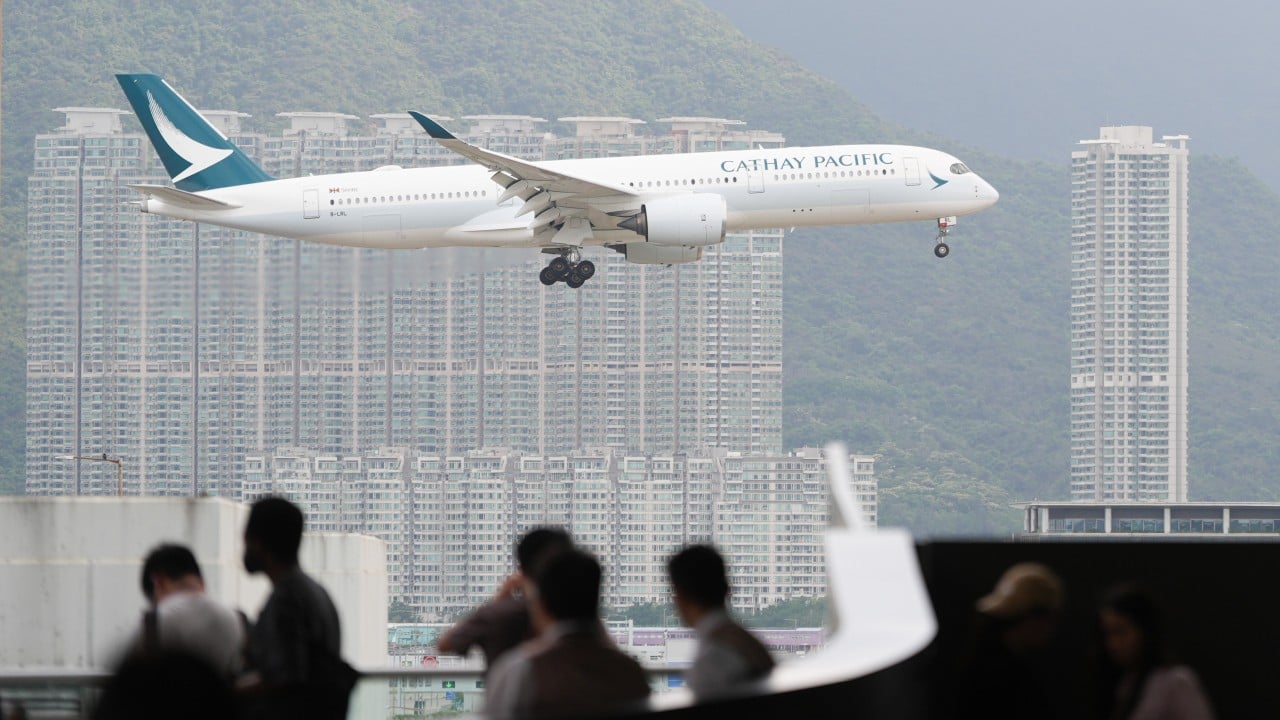
The air inside Check-in Aisle B at Hong Kong International Airport doesn’t smell like jet fuel or recycled oxygen. It smells like duty-free sandalwood and the sharp, acidic tang of hurried espresso. On a humid Tuesday morning, the floorboards vibrate. It is a low-frequency hum, the collective heartbeat of thousands of rolling suitcases striking the linoleum in unison.
To the casual observer, this is just transit. To a mathematician or a hedge fund analyst, it is a data point. But to the people behind the counters at Cathay Pacific and HK Express, this vibration is a miracle they’ve been holding their breath for since the world stopped turning in 2020.
Numbers are often used to sanitise the chaotic reality of human movement. We hear that Cathay Pacific and its low-cost sibling, HK Express, carried over 2 million passengers in a single month—specifically April 2024—and our eyes glaze over. We see a 42.4% year-on-year increase and we think of spreadsheets.
But look closer at the woman in the red trench coat clutching a passport with frayed edges. She isn't a "percentage increase." She is a daughter who hasn't seen her father in Osaka for three years. She is the reason the load factor—the industry term for how full a plane is—hit 83.8%.
The seats aren't just occupied. They are reclaimed.
The Shadow of the Desert
Aviation is a fragile business built on the assumption of a stable world. That assumption was shattered when conflict ignited in the Middle East. Logic suggests that when the sky turns dark over one part of the globe, the ripples of fear should slow the pulse of travel everywhere.
Fuel prices fluctuate. Insurance premiums for aircraft spike. Flight paths are redrawn in frantic, jagged lines to avoid contested airspace. For a moment, the industry held its breath, waiting for the "Mideast effect" to choke the recovery of Asian hubs.
It didn't happen.
Instead of retreating, the hunger for connection intensified. The data tells us that Cathay Pacific carried 1,741,227 passengers in April alone. HK Express added another 454,115 to that tally. This isn't just growth; it is a defiance of geopolitical gravity. When the world feels unstable, the instinct to return home or to find a temporary sanctuary in a new city becomes a primal urge.
Consider a hypothetical traveler named Elias. He’s a consultant based in London, trying to get to a conference in Tokyo. Ordinarily, he might look at the headlines and decide to stay put, fearing delays or redirected routes. But the pull of the East—the specific, magnetic draw of Hong Kong as a gateway—outweighs the friction of the journey.
He boards a Cathay flight, settles into the seat, and watches the flight map skirt around the edges of restricted zones. The plane takes the long way. It burns more fuel. But it arrives. That arrival is the only metric that truly matters to the person in 14C.
The Two Faces of the Sky
The synergy between a premium carrier and a budget airline is often described as a corporate strategy, but it’s actually a mirror of our fractured economy.
Cathay Pacific represents the aspiration. It is the hot towel, the vintage champagne, and the quiet dignity of a long-haul cabin where the engine noise is a distant whisper. It serves the business traveler and the luxury seeker, people for whom the journey is a cocoon.
HK Express is the grit. It is the backpacker, the student, and the family of four trying to make a weekend in Da Nang work on a shoestring budget. In April, while the flagship carrier grew by 26%, HK Express surged by an astonishing 153%.
This tells a story of a city—and a region—rediscovering its mobility at every price point. The "invisible stakes" here aren't just profits. They are the survival of Hong Kong’s identity as the world’s crossroads. For years, the city was a ghost town. The runways were silent. The Cathay brand, once a symbol of undisputed Asian dominance, was questioned.
Now, the sheer volume of bodies moving through the terminal serves as a physical rebuttal to the idea that Hong Kong has lost its luster. The cargo holds are full, too. It’s not just people; it’s the lithium batteries for your phone, the fresh flowers for a wedding in Seoul, and the high-end electronics that keep the global supply chain from flatlining. Cargo tonnage rose by 10.1% year-on-year.
If passengers are the soul of the airline, cargo is the bone marrow.
The Friction of Success
It isn't all smooth air and clear horizons. To sit in the cockpit of a major airline right now is to manage a series of rolling crises.
Supply chains for aircraft parts are still snarled. Pilots who were furloughed or retired during the dark years aren't easily replaced. Every time a passenger complains about a delay or a missing meal option, they are touching the scar tissue of an industry that was essentially dismantled and is now being rebuilt while flying at 35,000 feet.
There is a specific kind of exhaustion that comes with rapid scaling. You can feel it in the voice of the flight attendant who has worked three long-haul rotations in a week because the staffing levels haven't quite caught up to the passenger demand.
The "Mideast war" mentioned in the headlines acts as a constant, low-level stressor. It adds minutes to flight times. It adds dollars to the cost of a gallon of Jet A-1 fuel. Yet, the demand remains "robust"—a word analysts love, but which really means "stubborn."
People are stubborn. We want to see the cherry blossoms. We want to sign the contract in person. We want to feel the humidity of a Hong Kong night as we step off the jet bridge.
The Weight of the Future
When we look at the numbers for the first four months of 2024—a total of 8.8 million passengers across both airlines—we are looking at the weight of human intention.
Each one of those 8.8 million people had to make a choice. They had to look at their bank account, look at the news, and decide that the risk and the cost were worth the reward of being somewhere else.
The aviation industry is often criticized for its environmental impact, its cold corporate structures, and its vulnerability to global whims. All of that is true. But it is also the only thing we have that shrinks the planet enough to make us neighbors.
In the Cathay Pacific lounge, a man sits alone, staring out at the tarmac. He is watching a tug push a Boeing 777 back from the gate. He doesn't know the load factor. He doesn't know the year-on-year percentage increase. He only knows that in twelve hours, he will be on the other side of the ocean, and the world will feel a little less divided than it did when he woke up.
The engines roar to life, a controlled explosion of kerosene and engineering. The wings flex, catching the thick, tropical air. The plane rises, cutting through the haze, leaving the politics and the spreadsheets on the ground, chasing a horizon that stays just out of reach.
The vibration in the floorboards continues. It hasn't stopped all day. It likely won't stop for a long time. People are moving again, and in a world that often feels like it's pulling apart, that movement is the only thing holding the seams together.