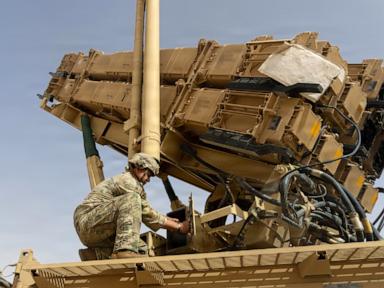
The warehouse is cold. Concrete floors hold a quiet chill that rises through the soles of your boots, and the air smells faintly of machine oil, old dust, and sulfur. If you walk down aisle four, past the yellow safety lines and the heavy-duty steel shelving, you will see what defense planners lose sleep over.
Empty pallets.
They sit there in neat, disciplined rows. Dust has begun to settle in the corners where heavy shipping crates used to rest. These are not just empty wooden platforms. They are placeholders for a shield that is wearing dangerously thin.
When you hear a Pentagon official whisper to a Senate committee that crucial United States missile stockpiles are running extremely low, your mind might jump straight to Hollywood explosions, desert war rooms, and screaming fighter jets. You might picture a dramatic countdown clock ticking down on a massive screen. But the reality is much quieter, much more ordinary, and infinitely more unsettling.
The crisis does not look like an emergency. It looks like a warehouse with too much empty space.
To understand why this matters, you have to look past the hardware and think about insurance. Missiles are not items you buy off a shelf when a fire starts. They take years to build, requiring intricate supply chains that stretch across dozens of states, thousands of specialized technicians, and rare earth materials sourced from half a world away. A single advanced interceptor missile is a masterpiece of modern engineering. It requires guidance systems that can calculate trajectories at hypersonic speeds, rocket motors built with precise chemical tolerances, and microchips that cannot simply be ordered overnight from a standard commercial catalog.
Right now, the storehouses are emptying faster than the assembly lines can fill them.
Consider what happens next when a conflict breaks out halfway across the globe. Allies call for air defense systems. Cargo planes roar out of hangers in Delaware, loaded with PAC-3 interceptors and Javelin missiles, flying eastward toward contested skies. Every crate that lifts off the tarmac represents a piece of our own armor sent away. Every successful intercept over a distant city means one less safeguard standing between us and an unpredictable future.
We have spent decades living under an invisible umbrella. We grew accustomed to the luxury of absolute security. We assumed that whenever a threat materialized, the industrial might of the nation would simply hum to life and churn out endless supplies of high-tech munitions.
That assumption was a ghost story we told ourselves.
The manufacturing base has atrophied. Skilled machinists who know how to hand-assemble delicate guidance components are retiring, and younger generations are not entering the trades in the numbers required to replace them. Factories operate on lean, just-in-time delivery models designed to maximize profit during peacetime, not to surge production during a protracted global crisis. When you try to flip a switch and double production overnight, the machine breaks down. Supply chains choke. Raw materials face bottlenecks.
The numbers told to lawmakers behind closed doors are stark. In major war-gaming simulations modeling a large-scale conflict in the Indo-Pacific, the United States runs completely out of long-range precision munitions within days, not weeks.
Days.
Let that sink in. The mightiest military in human history, backed by an economy worth tens of trillions of dollars, could exhaust its primary deterrent capability before a month even passes.
This is the hidden cost of deterrence. It is not measured in dollars allocated in the federal budget. It is measured in the silence of empty steel racks. It is measured in the heavy burden carried by defense analysts who look at the global chessboard and realize that our pieces are running out while our rivals continue to build new factories in the shadows.
We are standing at a strange crossroads. For thirty years, American foreign policy operated on the premise of peace through overwhelming, unquestioned strength. We intervened where we chose, deterred who we wished, and maintained a global order backed by the quiet confidence that our arsenal was bottomless.
That bottom has been reached.
The officials raising the alarm are not crying wolf. They are looking at inventory ledgers that resemble a checking account the morning after a disaster. They see the production rates crawling at a snail's pace while adversaries test new delivery systems, expand their naval fleets, and stockpile their own munitions with grim determination.
Fixing this will not be quick. It will require a massive, generational mobilization of industrial capacity. It will mean rewriting procurement laws that move at the speed of a glacier. It will demand that we treat our manufacturing infrastructure not as an afterthought, but as the absolute foundation of our national survival.
Until then, the pallets in the warehouse remain empty.
The wind howls softly outside the loading dock doors, stirring a stray piece of plastic wrap across the concrete. Somewhere far away, a radar screen blips. The system is watching, waiting, and hoping that the shield holds just a little bit longer.