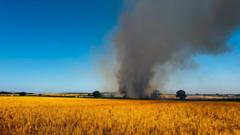
Britain is burning because its emergency response infrastructure is built for a climate that no longer exists. While local fire chiefs issue frantic warnings regarding extreme pressure, the underlying crisis is not the heatwaves themselves, but a systemic failure to fund, adapt, and scale frontline defenses against a new era of severe climate events.
Over the past decade, a quiet but devastating shift has taken place. The United Kingdom, traditionally accustomed to damp summers and manageable seasonal blazes, is now dealing with "Mediterranean-style fire weather". Tinder-dry landscapes, persistent wind, and soaring temperatures have combined to create major incidents across England and Wales. Yet, as frontline crews struggle to suppress rapidly spreading fires that consume fields and encroach upon towns, the structural vulnerabilities of a hollowed-out emergency framework are laid bare. This is an investigation into why the British fire service is being pushed to its breaking point, and the structural reforms required to stop the country from going up in smoke.
The Illusion of the Massive Capital Boost
In June 2026, the Ministry of Housing, Communities, and Local Government announced a high-profile £97 million investment designed to upgrade National Resilience assets. The funding promises a fleet of off-road vehicles and specialized teams across critical hubs like Greater Manchester, London, and South Wales. On paper, it looks like a decisive, aggressive victory over an escalating threat.
In reality, this injection of capital functions as a band-aid on a profound, structural wound.
While millions are spent on specialized hardware, the actual human capital required to operate these machines has been systematically eroded. Figures from the Fire Brigades Union point to a stark and uncomfortable reality: since 2010, the UK fire and rescue service has lost roughly 20% of its total workforce. Specialized off-road appliances are useless if there are not enough qualified firefighters to crew them during a prolonged multi-front crisis.
Furthermore, these new resilience teams are designed to be deployed across regional boundaries during acute emergencies. When a major incident is declared on a moorland border, assets are pulled from nearby urban stations. This creates a dangerous game of operational musical chairs. Moving resources to fight a massive rural blaze leaves municipal zones exposed, introducing severe response delays for domestic fires, vehicle accidents, and industrial emergencies.
The New Fire Weather Geometry
The mechanics of British wildfires have fundamentally changed, leaving traditional suppression tactics obsolete. Historically, a rural fire in the UK meant a slow-moving bracken or grass fire that could be managed with manual beaters and low-pressure water hoses. Today, intense heat and low relative humidity strip moisture from the deepest layers of vegetation long before a spark ever lands.
When ignition occurs, the result is an intense, fast-moving blaze that behaves exactly like a brushfire in Southern Europe or the Western United States.
[Low Fuel Moisture + Sustained Winds]
                 │
                 ▼
    [Rapid Forward Rate of Spread]
                 │
                 ▼
[Traditional Suppression Tactics Fail]
                 │
                 ▼
   [Severe Strain on Local Station Assets]
Consider the geography of these incidents. Many of the most challenging blazes occur in the wildland-urban interface, where open countryside directly collides with sprawling residential developments and critical infrastructure. When a fire breaks out near a major transportation link or a residential estate, crews cannot simply stand back and execute a controlled burnout. They are forced into aggressive, defensive positions to save lives and property, burning through personnel hours at an unsustainable rate.
The Statutory Loophole Costing Precious Time
The single greatest policy failure exacerbating this crisis is the lack of a statutory duty for wildfire response in England. Under current legislation, while fire services are legally mandated to attend structural fires and road traffic collisions, their obligations regarding large-scale environmental emergencies remain dangerously vague.
This legislative gray area directly impacts how local authorities allocate their annual budgets. Because wildfire prevention and specialized cross-terrain training are not hard statutory requirements, they are often the first items trimmed when local government funding gets tight. Fire chiefs are left to manage an exponential rise in environmental calls using a baseline budget structured around structural and domestic risks from thirty years ago.
| Operational Metric | 1990s Baseline Framework | 2026 Climate Reality |
|---|---|---|
| Primary Risk Profile | Urban structural and industrial fires | Dual threat: Urban fires and large-scale environmental blazes |
| Workforce Capacity | Fully staffed, robust regional stations | 20% reduction in total frontline personnel since 2010 |
| Deployment Model | Localized station response | Reliance on strained national mutual aid frameworks |
Without a legally binding mandate that forces the central government to guarantee dedicated, long-term funding for environmental risk, every hot spell will continue to be treated as an unforeseen anomaly rather than a predictable, recurring operational certainty.
Rebuilding Frontline Capacity
Fixing a broken emergency infrastructure requires moving past seasonal panic and PR-friendly equipment handovers. The solution demands structural overhaul.
First, the government must establish a statutory duty for wildfire response across all nations of the United Kingdom, aligning England with the more aggressive environmental mandates seen in parts of Europe. This change would legally compel the Treasury to provide sustained ring-fenced funding specifically for environmental risk management, permanent wildfire training academies, and local mitigation efforts.
Second, the recruitment strategy must be completely overhauled to reverse the decade-long decline in headcount. Relying on over-stretched retained (on-call) firefighters in rural areas is no longer viable when fires burn for days or weeks at a time, requiring multiple shift rotations. The service needs full-time, well-compensated personnel who are highly trained in modern suppression tactics like tactical burning and advanced fuel management.
Finally, land management policies must be integrated directly with fire service strategy. Allowing peatlands to dry out or allowing massive fuel loads to accumulate near urban fringes creates a landscape designed to burn. Fire services must have a binding seat at the table with agricultural leaders, water companies, and environmental agencies to manage the landscape before the summer heat arrives. The alternative is to continue watching the nation's emergency services buckle under the weight of an escalating environment they are legally and financially unequipped to handle.
To see firsthand how these dry conditions create immense challenges on the ground, watch this News Report on British Wildfires highlighting the severe strain placed on emergency crews trying to contain these rapid blazes.