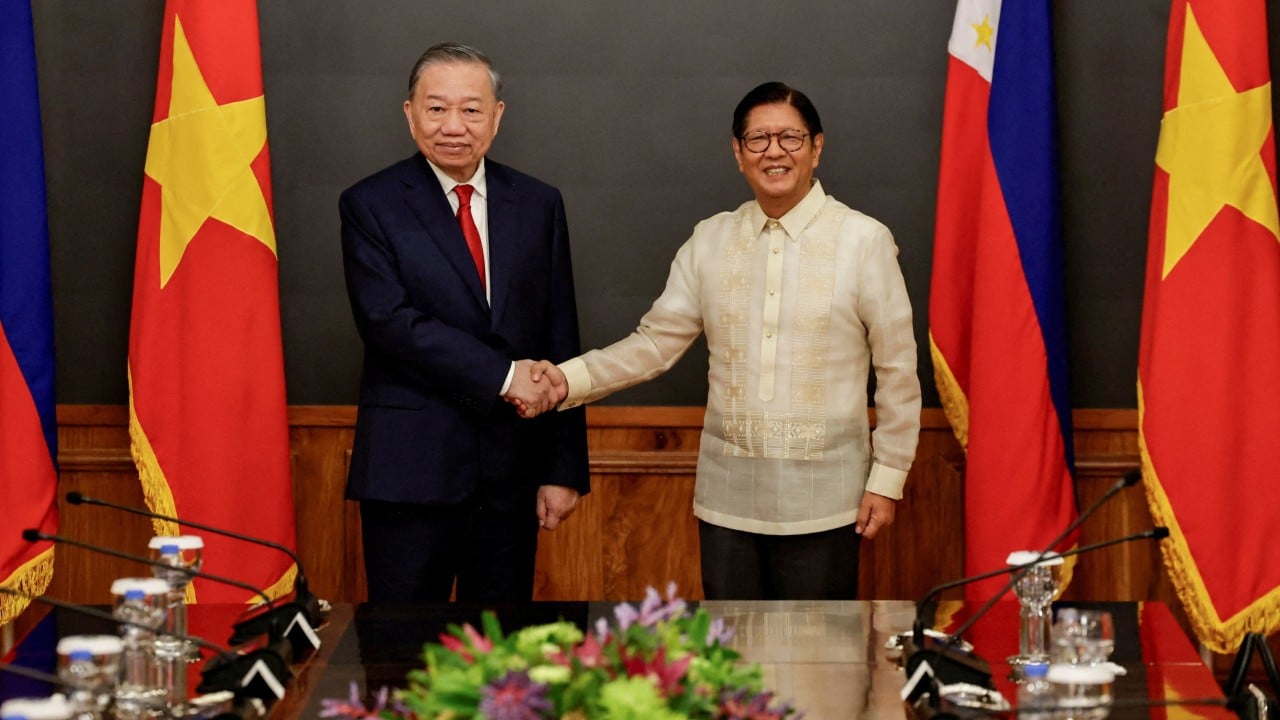
The headlines coming out of Malacañang Palace paint a picture of sudden, unified resistance. Vietnamese President To Lam and Philippine President Ferdinand Marcos Jr. have officially upgraded their bilateral ties to an "Enhanced Strategic Partnership," declaring that peace, stability, and freedom of navigation in the South China Sea are completely non-negotiable.
Yet, beneath the handshakes and the boilerplate diplomatic language lies a highly complex reality. While both nations share a deep apprehension regarding Beijing's maritime expansion, Hanoi and Manila are playing fundamentally different diplomatic games. Manila has leaned heavily into its treaty alliance with the United States, utilizing highly publicized, confrontational transparency tactics at sea. Hanoi, conversely, remains fiercely committed to its "Four Noes" defense policy, preferring quiet, backchannel statecraft that preserves its vital economic relationship with China.
This newfound alignment is less about forging a joint military front and more about survival. It is an exercise in mutual hedging. By formalizing agreements on maritime incident prevention, coast guard cooperation, and trade, the two most assertive Southeast Asian claimant states are attempting to manage their own overlapping territorial friction points. They are quietly ensuring they do not accidentally spark a conflict with each other while simultaneously facing immense pressure from a common neighbor.
The Friction Inside the Alliance
The narrative of an unshakeable united front falls apart under close historical and geographical scrutiny. Vietnam and the Philippines have overlapping claims in the Spratly Islands. They have spent decades fortifying their respective outposts.
Historically, Filipino fishermen and Vietnamese fishing vessels have clashed over territorial fishing rights. Manila has frequently detained Vietnamese fishermen for operating illegally within its exclusive economic zone. The signing of a coast guard cooperation memorandum is specifically designed to stop these localized flashpoints from blowing up. It is an internal housekeeping measure, not an offensive pact.
Furthermore, Hanoi views Manila’s aggressive strategy with unspoken nervousness. Under the Marcos administration, the Philippine Coast Guard has consistently embedded journalists on supply runs to Second Thomas Shoal, exposing water-cannon attacks by the Chinese Coast Guard to global media. This high-stakes strategy relies completely on the assumption that the United States will intervene if a Filipino life is lost.
Vietnam refuses to gamble its national security on American intervention. To Lam’s administration knows that an open conflict in the South China Sea would devastate the country's export-reliant economy, which depends heavily on Chinese raw materials.
Two Different Playbooks for One Sea
To understand why this partnership is "enhanced" rather than integrated, one must look at how each country structures its defense posture.
+-----------------------------------------------------------------------+
|                       MARITIME STRATEGY COMPARISON                    |
+---------------------------+-------------------------------------------+
| THE PHILIPPINE APPROACH   | THE VIETNAMESE APPROACH                   |
+---------------------------+-------------------------------------------+
| Assertive public exposure | Quiet, backchannel diplomacy              |
| Deepening US military ties| Strict "Four Noes" defense policy         |
| Legalistic reliance       | Pragmatic hedging, expanding commercial   |
| on the 2016 Arbitral Award| ties while fortifying island outposts     |
+---------------------------+-------------------------------------------+
The "Four Noes" policy is the foundation of Vietnamese defense doctrine: no military alliances, no affiliating with one country to counteract another, no foreign military bases on Vietnamese soil, and no using force or threatening to use force in international relations.
During his address at the Shangri-La Dialogue in Singapore right before arriving in Manila, To Lam emphasized that military power alone cannot guarantee security. He pushed heavily for regional mechanisms to prevent conflicts from spiraling out of control. This was a subtle, polite warning to both Washington and Beijing, as well as a gentle reminder to his Philippine hosts that Vietnam will not be dragged into a superpower proxy war.
Manila’s strategy is entirely externalized. By granting the United States expanded access to military bases under the Enhanced Defense Cooperation Agreement, the Philippines has tied its security directly to the Pentagon. This moves the country away from the traditional, consensus-driven diplomatic style preferred by the Association of Southeast Asian Nations.
The Economic Safety Valve
The real binding agent of the Manila-Hanoi pact isn't weaponry. It is rice, trade, and economic practicalities.
Vietnam is the primary supplier of rice to the Philippines, a vital agricultural pipeline that keeps food prices stable in Manila. During the bilateral talks, the two leaders set an ambitious goal to push bilateral trade past $10 billion. They also emphasized cooperation in technology, tourism, and fighting transnational threats like cyber fraud and human trafficking.
By framing their relationship around economic resilience, both nations are attempting to build a cushion against the turbulence of the South China Sea. If maritime supply lines are disrupted, their domestic economies will suffer immediate damage. For Marcos, securing long-term agricultural commitments from Hanoi is a major domestic victory that has nothing to do with naval hardware.
The Limits of the Enhanced Partnership
Can two middle powers rewrite the rules of the South China Sea without the active backing of a unified regional bloc?
ASEAN has spent decades trying to negotiate a binding Code of Conduct with China, a process that has bogged down in endless bureaucracy and stalling tactics. By moving forward with a bilateral agreement, Vietnam and the Philippines are signaling their frustration with ASEAN's paralysis.
Yet, this bilateral approach has distinct limits. The newly signed agreements lack enforcement mechanisms. An "understanding on incident prevention" is only as good as the political will of the captains piloting the vessels on any given day. If a Vietnamese fishing armada enters a sensitive zone claimed by Manila, a signed piece of paper in an office will not automatically stop local maritime forces from reacting defensively.
The agreement also carefully avoids any mention of joint naval patrols. The omission is deliberate. Vietnam knows that launching joint patrols with a US treaty ally would be interpreted by Beijing as an intolerable provocation, crossing a red line that Hanoi has spent decades avoiding.
This pact represents a careful balancing act. The Philippines gets to show its domestic audience that it is not isolated in its maritime struggles, while Vietnam secures its economic interests and establishes a framework to prevent accidental clashes with a neighbor. It is a pragmatic arrangement born of geographical proximity and shared anxiety. It is not an alliance, but in a fractured region, it may be the closest thing to stability these two nations can achieve.