Thermal Dynamics of Multi-Ignition Convergence
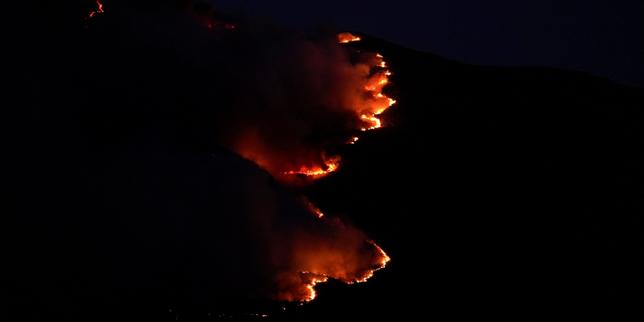
When multiple, geographically distinct wildfire fronts collapse toward a single vector, the resulting hazard profile ceases to scale linearly. Instead, it transitions into a complex, compound event characterized by rapid acceleration in consumed acreage, extreme local wind generation, and localized atmospheric disruption. The crisis in the Community of Madrid, where two of three major active blazes face imminent merging, represents a classic failure mode in regional containment architecture: systemic perimeter expansion outstripping line-construction capacity.
Wildfire propagation is governed by three primary environmental variables—fuel load continuity, topography, and ambient atmospheric conditions (specifically temperature, relative humidity, and wind velocity). When two fronts approach one another within a critical threshold distance, their respective thermal plumes begin to interact. This creates an intense low-pressure zone between the fronts, accelerating local wind speeds and drawing the convective columns toward each other. The result is a violent acceleration phase immediately prior to physical convergence, frequently generating spot fires kilometers ahead of the main perimeter via airborne embers.
[Front A Convective Column] <--- Low Pressure Draw ---> [Front B Convective Column]
                                       |
                                       v
                    Accelerated Inflow & Ember Drift
                                       |
                                       v
                             Unified Super-Front
Understanding the systemic failure of containment requires breaking down the crisis into distinct mechanical components: the atmospheric feedback loop, the physical topography of the Madrid basin, and operational resource constraints.
The Feedback Mechanism of Uncontrolled Wildfires
Uncontrolled status indicates that a wildfire’s energy output exceeds the heat absorption and suppression capabilities of deployed ground and aerial units. At this juncture, traditional direct-attack strategies—such as laying retardant lines or establishing direct water drops—become structurally ineffective due to thermal radiation barriers and extreme air turbulence.
Thermal Convection and Localized Microclimates
Severe wildfires generate their own microclimatic systems through high-volume thermal uplift. As vast quantities of biomass combust, intense heat forces air to rise rapidly, forming pyrocumulus or pyrocumulonimbus clouds.
- Convective Updrafts: Thermal columns pull surface air inward at violent speeds, creating erratic wind patterns that bypass regional meteorological forecasts.
- Ember Transport Vectors: Elevated updrafts lift burning particulate matter into the upper atmosphere, where high-altitude winds transport it across established containment barriers.
- Atmospheric Downdrafts: As rising air cools high in the troposphere, it collapses back toward the surface, producing localized downbursts that push fire perimeters outward in unpredictable, 360-degree directions.
The Dynamics of Convergence
The fusion of two distinct fire perimeters amplifies combustion efficiency through increased localized radiation. The structural mechanics unfold in four discrete phases:
- Independent Proliferation: Distinct fires advance driven by macro-level winds and local fuel bed profiles.
- Plume Interaction: Convective columns begin to draw from the same inter-fire air mass, creating a localized drop in atmospheric pressure between the two perimeters.
- Draft Acceleration: Ambient winds between the fires shift toward the center of the pressure drop, forcing the two fronts together at rates significantly higher than their individual baseline spread rates.
- Thermal Unification: Upon merging, the combined core thermal mass creates a singular, massive convective engine, vastly expanding the unburnable zone for human suppression teams.
Environmental and Topographical Accelerants in Central Spain
The central plateau of the Iberian Peninsula presents specific structural vulnerabilities during summer heat events. The geography surrounding Madrid consists of a transition zone from high-altitude montane shrubland to dense pine forests and Mediterranean sclerophyllous vegetation.
Fuel Bed Architecture
The dominant biomass in this corridor presents high surface-area-to-volume ratios, making it exceptionally volatile under prolonged drought conditions. Mediterranean brush and dry pine canopy act as volatile fuel sources due to high essential oil content and low fuel moisture levels. When live fuel moisture dips below critical thresholds, the energy required to ignite the vegetation decreases exponentially.
Topographic Chimneys and Slope Acceleration
Slope plays an exponential role in wildfire propagation rate. Fire travels faster uphill because the flames are tilted closer to the unburned fuel ahead of the front, preheating the biomass through radiant heat transfer before physical flame contact occurs.
- Preheating Mechanics: On a 30-degree incline, a fire front moves significantly faster than on flat terrain under identical wind conditions.
- Canyon Dynamics: The rolling hills and ravines of the Madrid perimeter act as natural chimneys, funneling winds and compressing thermal energy, which further accelerates flame length and propagation speed.
Containment Architecture Failure and Operational Bottlenecks
Fire suppression operations rely on establishing a continuous barrier of zero-fuel zones (containment lines) around the active perimeter. When a fire reaches "out of control" status, the operational math degrades rapidly.
The Perimeter-to-Area Scaling Problem
As a fire grows, its area expands quadratically relative to linear perimeter growth, assuming uniform spread. Suppressing a fire requires building containment lines around its entire outer edge. When fronts merge, the perimeter length increases, but the required suppression resources scale exponentially because the interior heat flux prevents close-in direct line construction.
Single Small Fire: Small Perimeter / Low Heat Output -> Direct Attack Viable
Merged Super-Front: Massive Perimeter / Extreme Heat -> Direct Attack Impossible (Indirect Attack Required)
Suppression Limits and Suppression Effectiveness
Suppression tactics split into two primary operational modes:
- Direct Attack: Deployed when flame lengths remain below structural thresholds (typically under 1.5 to 2 meters). Hand crews and heavy machinery work directly at the fire edge to scrape away fuel or apply water.
- Indirect Attack: Deployed when flame lengths exceed human tolerance limits (frequently over 4 meters in extreme forest fires). Containment lines are constructed miles ahead of the active front, often accompanied by tactical backfiring to burn out fuel before the main front arrives.
In the case of merging fires, flame lengths and thermal radiation render direct attack completely non-viable. Aircraft drops become purely defensive, aimed at slowing propagation near critical infrastructure rather than extinguishing the main body of the fire, as water or retardant dropped into high-intensity thermal plumes frequently evaporates before reaching the ground.
Tactical Interventions for High-Intensity Convergence Events
When conventional direct suppression fails due to perimeter convergence, resource allocation must shift immediately from direct containment to strategic buffer creation and asset prioritization.
Execution of Tactical Backfires
The primary mechanical countermeasure against an advancing, unified fire front is the systematic application of tactical backburning. Operational crews ignite controlled fires along pre-established barrier lines (such as highways or wide ridges) ahead of the main fire front.
- Draft Exploitation: The powerful convective draw of the main fire front is utilized to pull the backfire toward the main front, away from the containment line.
- Fuel Elimination: The backfire consumes the intervening biomass, creating a wide, fuel-free buffer zone.
- Front Stagnation: When the main fire front encounters the pre-burned area, its forward momentum stalls abruptly due to the total absence of combustible material, preventing further linear expansion along that axis.
Asset Prioritization Protocols
When containment capacity is breached, resource deployment must follow a strict triage matrix to minimize catastrophic loss:
- Tier 1: Life Safety and Evacuation Corridors. Securing primary transit arteries to prevent civilian entrapment and ensure access for emergency vehicles.
- Tier 2: Critical Energy and Water Infrastructure. Protecting high-voltage transmission corridors, municipal water facilities, and communications relays to prevent cascading secondary urban crises.
- Tier 3: High-Value Residential Structures. Positioning defensive engines exclusively at defensible structural boundaries where defensible space protocols have been pre-implemented.
- Tier 4: Unpopulated Wildland Assets. Allowing uncontained propagation through non-critical timberland or brush until atmospheric conditions shift or natural topographical barriers are reached.
Deploying ground crews to secure wildland perimeters during an active convergence event consumes finite resources that yield near-zero suppression efficiency. Resources must be anchored exclusively at hard tactical barriers until ambient relative humidity rises and local wind velocity drops below critical propagation thresholds.